

The Dusty Can
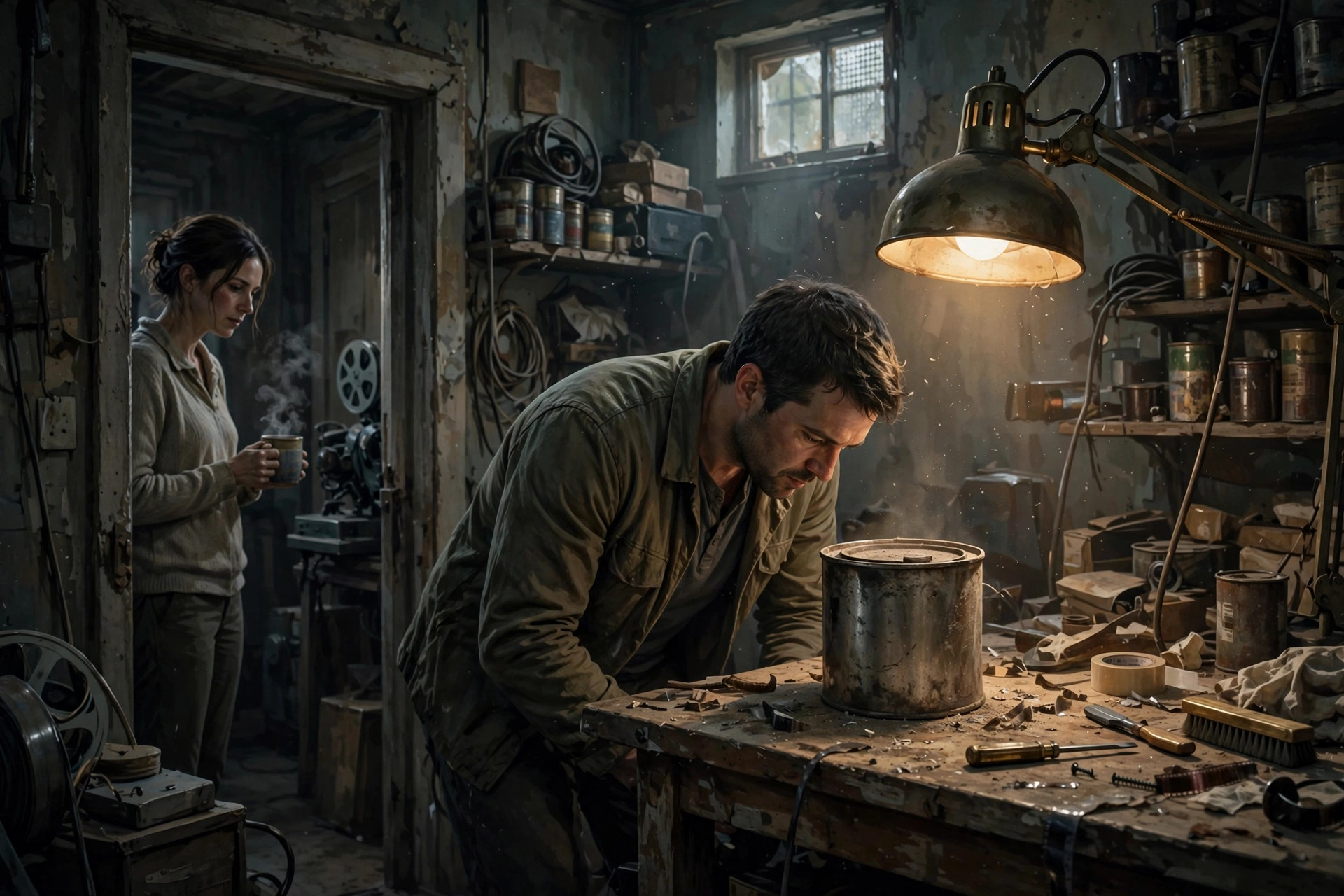
The shelf gave up the can with a groan of old steel, and Gabe Orsolak sneezed into his sleeve before he could set it on the workbench. Dust rose off the lid in a gray skin. Lorna Pettibone stood in the doorway of the projection room with a mug of coffee going cold in her hand, watching him turn the can under the work lamp.
"This one's wrong," he said.
"They're all wrong. My father labeled by mood."
"No, look." He tilted the lid toward her. A strip of yellowed tape had been pressed across the top, and the ink on it was small and square. The regional film exchange stamp was pressed into the steel beneath it, a ring of capital letters gone soft with age. "The tape says 1991. The stamp says 1994. Somebody covered the year."
Lorna came in. The room smelled of machine oil and warm dust, the smell she had grown up inside, doing homework on an upturned crate while her father threaded film. Fourteen years she had owned the Aldous Street Cinema, and she still felt like a visitor in this one room. The big projector sat under its canvas hood like a patient animal. Gabe's scanner, a gray box with a lit glass bed and too many cables, looked like an intruder beside it.
"Newsreel stock," Gabe said. "Regional edition, going by the stamp. These went out to theaters for a week and then back to the exchange. They weren't supposed to stay on shelves. Nobody keeps them."
"So why is it here?"
"That's what I'd like to know." He glanced at her. He had been in Pellam Falls three years and with the film society for six, and he still asked permission with his eyebrows before he touched anything of hers. "Can I open it?"
She should have said yes at once. The whole arrangement was her doing. The society would digitize every reel the cinema owned, the cinema would get clean copies for the anniversary program, and a sponsor would see a theater that took care of its past. She had signed the agreement at this bench two weeks ago with a pen from the box office. But the year on the lid sat in her mind like a splinter. 1994 was the year Walter Quennell had walked out of this building with the benefit-night receipts and never come back.
"Open it," she said.
The lid stuck. Gabe worked a thumbnail under the rim, then a flat screwdriver from his kit, and the seal broke with a dry crack. Inside, the reel sat wound tight on a core, the edge of the film curling brown at the margin. He lifted it into the lamplight and held it by the edges, the way a man holds a photograph of someone else's child.
"It's in decent shape," he said. "No vinegar smell. Whoever put it up put it up carefully." He ran a gloved finger along the leader. "Hang on. There's a splice here, close to the head. Tape, not cement. Somebody cut this and joined it by hand."
"Projectionists splice all the time."
"Sure. But newsreels came sealed from the exchange. You didn't cut them." He bent closer. "It's a clean job, though. Whoever it was knew what they were doing."
The stairs creaked behind her. Lorna did not need to turn. Her father climbed them the way he had for forty years, one hand on the rail, the other swinging a little for balance, and he stopped in the doorway with his cardigan buttoned wrong and his jaw set.
"Nobody told me we were at it today," Dennis said.
"I told you Tuesday, Dad. And again at breakfast."
"Did you." He did not look at her. He looked at the can on the bench, at the open lid, and something in his face closed like a shutter coming down. "What's that one doing out?"
"Gabe found it on the back shelf."
"It's nothing. Old newsreel. Rubbish." He crossed to the bench faster than she expected from a man his age and put his palm flat over the lid. "Put it back. There's a stack by the window that actually matters. The features. The Saturday serials."
Gabe stood very still, the reel still in his gloved hands. "I can do the features first, Mr. Pettibone. It's no trouble."
"Then do that."
"Dad." Lorna set her mug down on the bench. "Why is the year covered?"
"How would I know what tape was on a can thirty years ago?"
"You ran this booth. Every can in here went through your hands."
"And I've forgotten most of them. I'm seventy-nine, Lorna." His voice came out sharper than the words. His hand, still on the lid, had a faint tremor in it that she had begun noticing in the spring and had decided not to mention. "Leave it be. Some things on a shelf are on a shelf for a reason."
The room went quiet except for the tick of the scanner cooling. Down in the auditorium someone, probably the cleaner, dragged a vacuum across the carpet, and the sound rose faintly through the floor.
She knew what he would say if she asked him straight. She had heard it often enough as a girl, and again when she was grown. Walter ran off. Took the money and ran, and good riddance, and don't go repeating it to Piers. It had been the closed door of her childhood, a story told once, firmly, and never opened again. She had never pushed on it. Pushing on it meant wondering why a man who talked about everything else in this town had a single subject he would not touch.
"It's my theater," she said, as gently as she could manage. "And it's my reel, and it's in the agreement. Everything gets scanned. That was the deal with the society, and it was the deal with the sponsor."
"Then the deal was foolish."
"Maybe. Gabe, go ahead."
Dennis took his hand off the lid. For a second she thought he would say something else, and his mouth worked, but all that came was a dry breath. He looked at her, and the look was not anger. It was closer to the face he had worn when she was nine and had stood too near the rewind bench, as if he saw something about to catch.
"Your mother would've left it shut," he said, and went back down the stairs.
Gabe let out a breath. "I can stop. Honestly. I can do the serials all week."
"No." She was surprised how steady it sounded. "Thread it."
"You're sure."
"I'd like to know what my father is afraid of on a newsreel." She picked her mug up again and found she did not want the coffee. "It's probably a flood. A parade. Some man cutting a ribbon."
"Probably." But he said it the way people agree with a hopeful child.
He laid the reel on the scanner's spindle and fed the leader through the gate with small, careful turns. Lorna reached over and pulled the canvas hood off the big projector, because the room felt wrong with it covered, and the old machine stood there gleaming faintly, the brass of its lens barrel dull. Gabe wanted a light source for a reference check, a comparison of the old frame against his scan. She had not planned to wake the projector. She found she had already crossed to the switch.
It clicked. Somewhere inside the housing a fan stirred, ticked, and caught. Behind the lens, for the first time in years, the projector lamp began to warm.
Eleven O'Clock
Gabe had the scan up on two monitors by the time Lorna came in with the second pot of coffee, and he did not look around when the door shut. He only lifted a hand, palm out, the way a man signals a driver to wait.
"Two days of cleaning," he said. "Dust, scratches, a bad vinegar smell I'm trying not to think about. But it's stable now. Sit. Piers is on his way up, he called from the lobby."
"You told Piers."
"I told him the society had scanned a reel from the right year. That's all. He'd have heard from somebody on Aldous Street by lunch anyway." Gabe finally turned. His eyes were red at the rims. "He asked if he could watch. I said it was your room."
She set the pot down beside the keyboard. Her father had not come in since the first day. She had checked the stairs twice that morning, listening for his slow tread, and heard only the building settling.
Piers Quennell appeared in the doorway with flour still in the creases of his knuckles. He had come straight from the ovens, apron folded over one arm, and he stood a little too straight, like a man at a reading of a will. He nodded at Lorna and did not offer his hand. She was grateful. Her own would not have been steady.
"Go ahead," she told Gabe.
The newsreel ran as she had predicted, a flood, a parade, a ribbon cut by a man in a hard hat, all of it jumping and silvery on the monitor. Then the picture broke. A hand-taped splice flashed past, and the footage that followed was no newsreel at all. It was a lobby. The camera sat low and a little crooked, as though someone had set it on a candy counter and walked away.
"Somebody was testing the film stock," Gabe said. "Or filming the benefit for the board. It's the Aldous Street lobby, anyway. Look at the carpet."
Lorna knew the carpet. It had been red once, then brown, then replaced the year she took over. People crossed the frame in good coats, laughing, holding paper cups. A woman she half recognized as a younger Odile Rennert leaned out of the box office with a roll of tickets. The sound was gone, but nobody seemed to be shouting. It was a pleasant night. That was what struck her. A pleasant night, thirty years gone.
"There," said Piers.
He had stepped up behind her chair. Gabe paused it, and Piers pointed, not at the people, but at the wall above the concession stand where the lobby clock hung in its gilt frame.
Both hands stood at the eleven.
"That clock ran fast," Lorna said at once. "It always ran fast. My father used to say it was the only honest thing in the building, because it hurried everybody out."
"Did it run fast by that much?" Piers asked.
She opened her mouth and shut it. The benefit show was supposed to have run late, a double feature with an intermission and speeches. Anyone who had been there would have said the lobby should be crowded, loud, the doors propped, and the vault in the manager's office still locked. Yet this lobby was emptying. People were buttoning coats. A man held a door for his wife.
"The show wasn't over," she said slowly. "Not at eleven. That's what everyone said afterward. The receipts were counted after the last reel, and Walter had gone by the time they went to the vault."
"Or the show was over," Piers said, "and somebody said it wasn't."
Gabe cleared his throat. "I'm not a detective. I match frame rates. But the splice is the thing. Someone cut a stretch out of this film, here, and joined it by hand. The lobby footage has a hole in it. I can see it in the counter. A minute, maybe, gone, right before the picture goes to the lobby."
Lorna said nothing. A minute. Her father's hands, steady and clever, had spliced a thousand reels on that bench downstairs. She did not need to be told whose tape it was.
Piers walked to the window and stood with his back to them. Below, a delivery truck backed up to the alley, beeping. "My father's name was on a sign out front for eleven years," he said. "Then it was on a flyer in the post office. Do you know I still can't hear that beeping without thinking someone's come to ask me where he went?"
"Piers."
"I'm not asking you to accuse anyone. I know whose booth this was." He turned. His face was composed, and it cost him. "I'm asking you to keep looking. You own the building and the film. Nobody else can pull the other cans, or open the files, or ask your father a question without a sheriff in the room. Please."
She thought of the face her father had made at the lid of the can. She thought of her mother, gone these many years, who would have left it shut. She was fifty-two years old and had never once asked him a question he did not want to answer.
"I'll keep digging," she said. "I can't promise you what's at the bottom."
"Nobody could." Piers nodded once and crossed to the door. "I'll bring bread tomorrow. You two don't eat."
When his steps had gone down, Gabe let the playback run on a little, past the empty carpet, through the last of the guests filing out. A tall man in a long camel overcoat stopped at the lobby doors with his back half to the lens. He turned to speak to someone beyond the frame, and the light caught his face for a single second. He was younger and broader, hair still dark, but Lorna knew the jaw.
"That's Fenwick Larkin," she said. "He told the sheriff he left at intermission. Before the vault. Before anyone."
"Then why is he in the lobby at eleven?" Gabe asked softly. He reached for the mouse. "And what's he carrying under that coat?"
The coat hung heavy on the left side, pulled down and bulged out at the hip. Gabe clicked, and the picture stopped dead, the camel wool filling the frame, the clock still showing eleven behind it.
Ticket Window
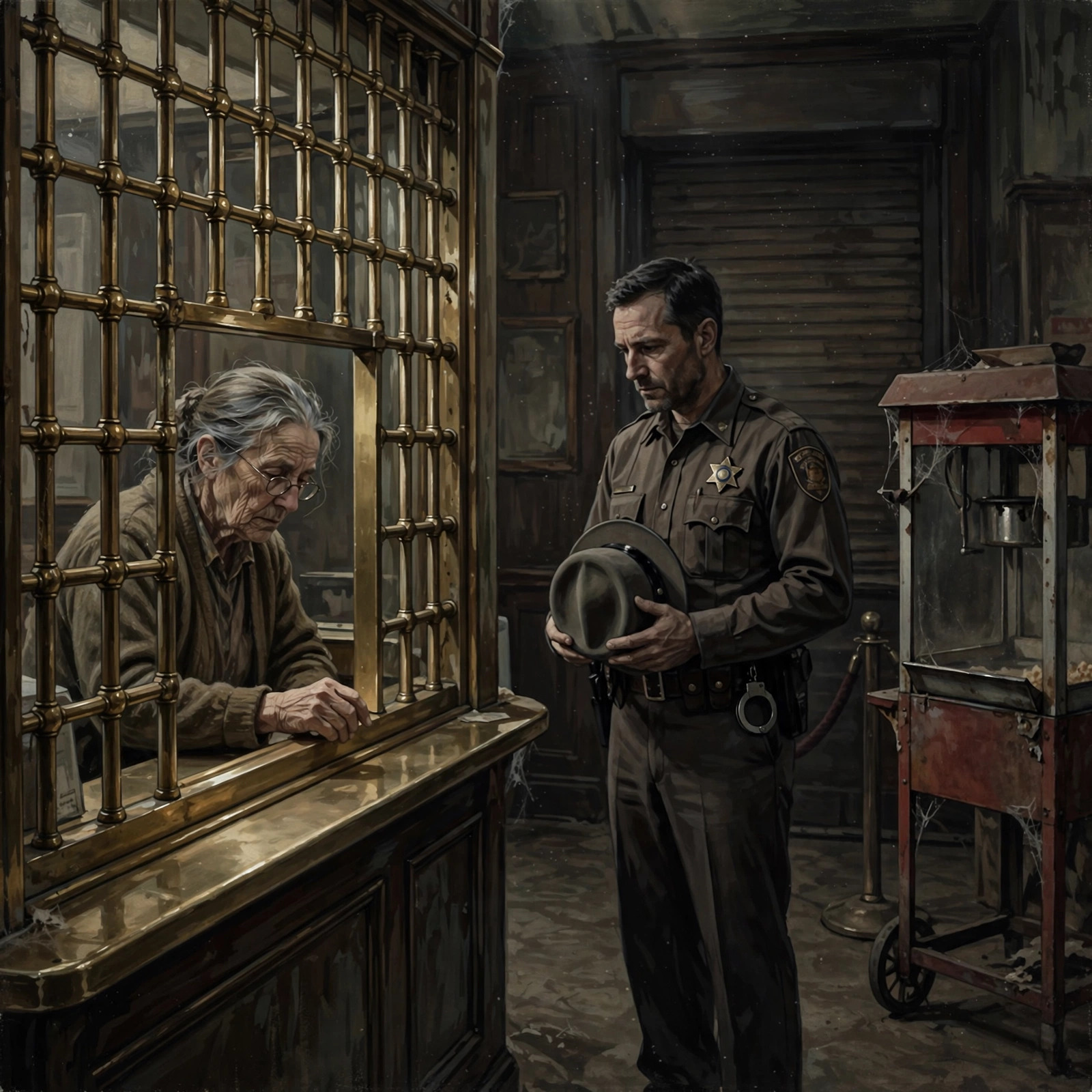
The brass grille on the old ticket window had been polished by thirty years of Odile Rennert's sleeves, and she still ran a thumb along its edge as though checking it for dust. Lorna had unlocked the lobby early. Joss Varga stood by the dead popcorn machine with his hat in his hand, trying to look like a man who had dropped by.
"You didn't have to open it up for me," Odile said. She sat on the stool behind the glass, where no one had sat in years. "I'd have come to the house."
"I wanted you where it happened," Lorna said. "Sometimes the room remembers what we don't."
"Rooms don't remember anything. Walter's gone and so's the money." Odile smoothed her cardigan. "I told the sheriff all this when I was young enough to be frightened of him."
Varga cleared his throat. "Then tell it to me, Mrs. Rennert. I've only read it in a file."
She told it briskly, the way a woman recites a recipe she has made too often. The benefit sold out. She closed the window when the second reel went up, counted the till in the box office, and carried the bag upstairs to Walter's office before the picture ended. Walter took it from her at the door. She went home by the back stairs. "He was alive and cross and wanted his supper," she said. "That's the last I saw of him."
Lorna looked at the lobby clock above the candy counter, stopped these many years at a quarter to something. Then she looked at the frame she had printed from the scan and set on the glass between them. The carpet, the emptying doors, the hands on the clock pointing straight up and down.
"It's eleven there," Lorna said. "The show wasn't over. People were leaving."
Odile glanced down and away. "Some always left early."
"You said you went home when the second reel went up. But Gabe's footage has the box office light still on behind the crowd. Someone's in your window."
"Then it was Walter, counting his own take."
"Walter's office had no window onto the lobby," Varga said mildly. He had his notebook out but wasn't writing. "And you told the deputy back then you handed him a bag. A bag of what total?"
"Nine thousand, near enough." The answer came too fast and too round.
Lorna had grown up in this building, doing homework on the stairs while her father threaded carbon arcs. She remembered ledger pages, the slow green columns. "Near enough," she repeated. "The benefit was a flat price. Seats, concessions, the raffle. You'd know to the dollar."
"It's thirty years, Lorna."
"You counted that till every night for most of those years. You could tell me the Tuesday after Easter in 1987."
Odile's thumb stopped on the grille. For a while the only sound was the refrigerator compressor in the concession stand, laboring for nothing. Varga shifted his weight and let the quiet work.
"I counted it more than once," Odile said at last. "That's all. Counted it twice, because the sums didn't sit right."
"Sat wrong how?"
"Short. A little. It was always a little." She said it to the glass. "Then it was a lot, because Walter took it."
Lorna felt the account slide out from under the woman, and it gave her no pleasure. She pulled a folding chair to the window and sat so their eyes were level. "Odile. Was it short before that night?"
"Every cashier has a bad week."
"Not every cashier has a bad week for years."
Varga drew breath to speak, and Lorna lifted a hand without looking at him. Odile's face worked. She was sixty-eight and had worn the same small gold cross as long as Lorna could recall it.
"My husband was laid off the winter I started," Odile said. "Two dollars here. Five when the furnace went. I told myself I'd put it back. I never did, and nobody ever asked, because the manager was the sort who trusted a woman with a nice cardigan." Her voice thinned. "Then Walter was gone and it all went in one pile, and I let it. God forgive me, I let a missing man carry my little sums with the big one."
"You didn't take the benefit money," Varga said.
"I never saw the benefit money past the stairs. I'd swear that on anything you like." She looked up, red at the eyes. "But I couldn't say so, could I? Not without saying the rest."
Lorna let that sit. It was true, she thought. It had the plainness a lie lacked. And it explained the roundness of the number, a woman guarding a ledger she had quietly spoiled.
"Then help us with the part you can swear to," Lorna said. "Who had keys that night? The vault, the office."
"Walter had his set. Your father had the booth." Odile wiped her cheek with the back of her wrist, briskly, annoyed at herself. "The vault was the board's, not ours. Walter and the chairman each held one. Fenwick carried the spare as well, always. On a ring with his club keys, in that coat pocket. He used to jingle it at meetings so we'd know he was still in charge of something."
Varga's pen finally moved. "The spare. Not recorded in the file."
"Nobody asked a cashier about keys." She gave a short, dry sound. "He told everyone he'd gone home before the vault was opened. I believed him. Why wouldn't I? He was the chairman."
Lorna looked at the printed frame again, the camel wool, the heavy hang of the left side. She did not say anything. Varga caught her eye and held it a second, and she saw him decide to keep quiet too.
Odile bent and opened a low cupboard under the counter, a place Lorna had forgotten existed. She came up with a dented tin, its lid painted with faded roses, the kind that had once held shortbread. She set it on the sill of the window, pushed it through the gap beneath the grille, and then, with both hands, across the counter toward Lorna.
"That's mine," she said. "Every week of it, with the dates. I kept it so I'd know what I owed."
Lorna did not touch it yet. The lid rattled faintly with the weight of coins.
"I can't pay it back to a dead man," Odile said. "So you take it."
Wrong Door
The room at the County Sheriff Annex had a table bolted to the floor and a window that looked onto a parking lot. Lorna had been told she could sit in, as family, if she kept her mouth shut. She had agreed to that on the drive over. She was already regretting it.
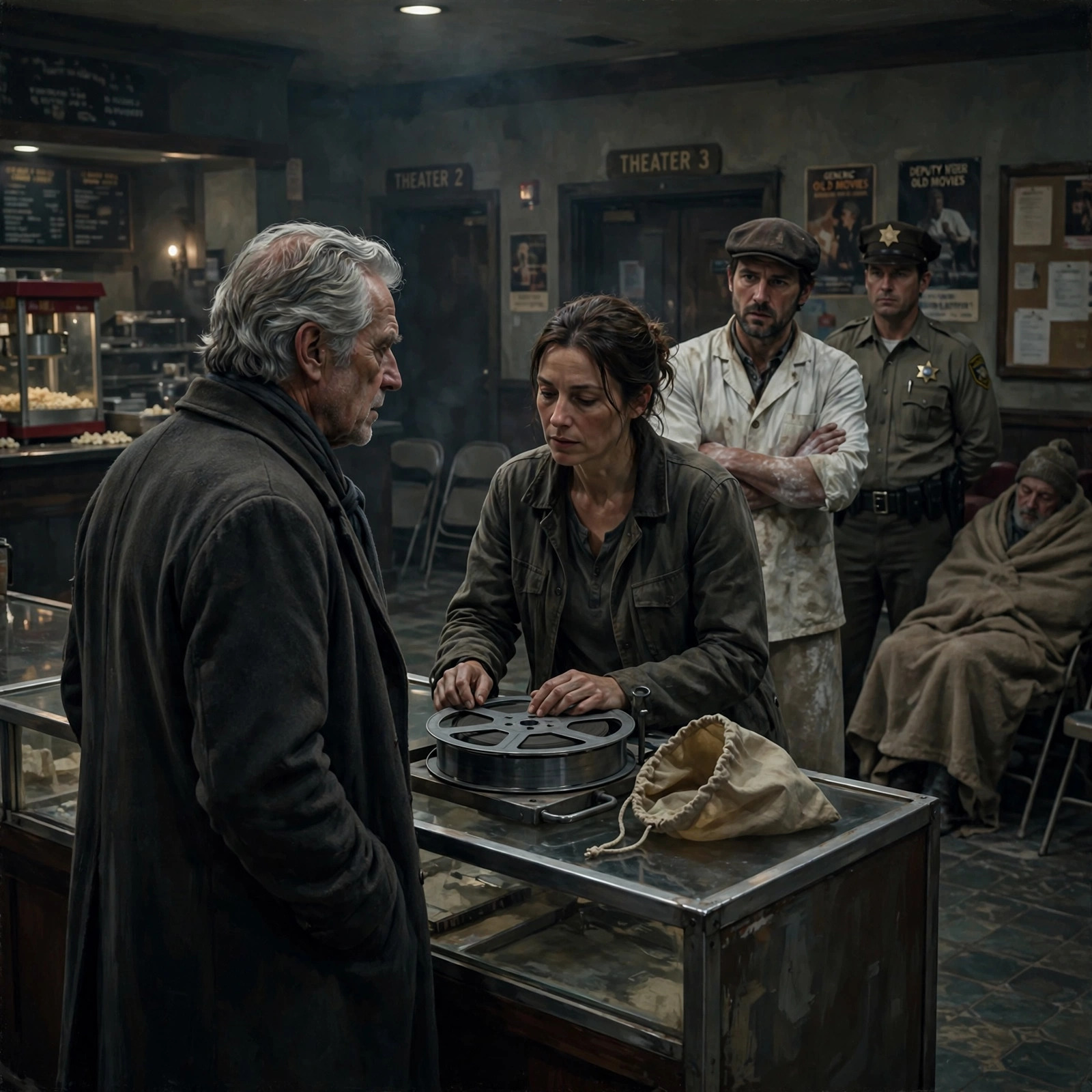
Her father sat with his cap in his lap, turning the brim a quarter turn at a time. Joss Varga laid a printout in front of him, the scan's frame counter circled in pen. Beside it he set a strip of the film itself, a few inches in a clear sleeve, the hand-taped joint showing yellow along one edge.
"That's your tape, Mr. Pettibone," Varga said. "Gabe Orsolak says nobody else touched that booth for forty years."
"Splices are what a projectionist does."
"Sure. Usually to mend a break. This one took out about a minute, right where the lobby camera swings toward the side door. The sprocket count jumps. Somebody cut it on purpose and taped the ends."
Dennis said nothing. His thumb kept on at the cap.
"You told your daughter Walter ran off," Varga went on, mildly. "You ran the machine that night. You cut the one minute that might show who left by that door. I'd like to know why."
"Dad," Lorna said, and Varga raised a hand without looking at her.
"I cut it because it was bad film," Dennis said. His voice had gone small and papery. "Scratched. It jumped in the gate."
"The minute on either side isn't scratched."
"Then I don't remember."
"You remember the projector's serial number. You remember which reel ran long in 1979." Varga leaned in. "A man vanished, and nine thousand dollars with him, and you took out a minute. Who were you covering?"
Lorna watched her father's face lose its color from the edges inward. He pressed a fist flat against his breastbone as if tamping something down, and he tried to say her name, and it came out as a breath. The cap slid off his knee. When he tipped sideways Varga was already around the table, and Lorna's chair went over behind her.
After that came a blur of other people, a deputy with a radio, a medic kneeling with a hand on his wrist, her father's shoes pointing at the ceiling on the linoleum. She rode behind the ambulance in her own car, gripping the wheel, running two red lights she would not remember.
He lived. The doctor said so on the second morning, tired and exact: a heart that had been warned before and been stubborn about it, a procedure, rest, no questions for a while. Lorna sat by the bed through the afternoon while he slept with his mouth slightly open. His hands lay on the blanket, big knuckled, still faintly stained from decades of film cement. She had made him a suspect in a room with a bolted table. She had said she would only listen.
Varga came by on the third evening and stood in the doorway with his hat in his hand.
"I pushed too hard," he said.
"You did your job. I let you." She kept her voice low. "He's lying about something, Joss. But I watched him in there. That wasn't a man hiding a theft. That was a man hiding something he's ashamed of."
"Shame doesn't leave a splice."
"Sometimes it does." She looked at the sleeping face. "We went through the wrong door. Whatever he cut, the money wasn't behind it. Somebody opened that vault with a key, and my father never had one."
Varga turned his hat once. "The spare."
"I'm going to see Fenwick. As a cinema owner who wants a board member's memory for the screening. Nothing more."
"Don't push him."
"I'm told that's my family's failing."
Larkin House stood at the top of Pellam Falls, white clapboard and black shutters, the lawn trimmed as if for inspection. The retired mayor met her at the side door in a cardigan, soft and courteous, and led her through a kitchen that smelled of toast. He asked after Dennis with what sounded like real concern. He poured her coffee in a cup too fine for the kitchen table.
"A terrible business," he said. "Your father's a proud man. I'd have spared him all this."
"You were chairman. I thought you might help me with who was in the lobby that night. For the screening notes."
"I left at the intermission. I've said so for thirty years." He smiled, patient. "Before the vault was opened, as it happens. Ask anyone."
"I have. Odile remembers you saying it."
"Odile's a good woman with a long memory for what she was told." He stirred his coffee without drinking it. "Lorna, forgive me, but is this wise? The cinema's had a hard enough year. Digging up Walter Quennell won't fill a single seat."
"Piers Quennell would disagree."
"Piers is a grieving son. I've always had sympathy."
She noticed the coat first, only because it was not on its hook by the door. Then she noticed that he kept glancing past her at the yard. When she rose to leave he insisted on walking her out the back, down a gravel path to where her car sat on the drive, and on the way he stopped to deal with a latch.
The garage doors stood open a hand's width, the way a man leaves them when he has been in and out. Inside, on a workbench between a paint can and a coil of rope, lay a canvas deposit bag, the stiff gray kind with a brass zipper and a sewn-on tag. She could read two words stitched across it in faded red thread: First County. It sagged as if something still lay at the bottom.
Larkin stepped into her line of sight, easy, unhurried, and drew the door down along its track. The bag disappeared slice by slice behind the white panels.
"Mind the gravel, my dear," he said. "It's treacherous this time of year."
Lorna thanked him, and got into her car, and sat with her hands on the wheel, looking at the garage door he had closed.
Borrowed Truck
Her father had asked for the window seat, and the nurse had cranked the bed so he could see the parking lot. Lorna sat beside him with her coat still on. Joss Varga stood near the door, hat in his hands, the way a man stands when he has been told he is not to tire anyone.
"You're not under any questioning," Varga said. "I want that clear, Mr. Pettibone. Nobody's taking you back to the annex."
Dennis kept his eyes on the lot. A thin tube ran along the back of his hand, taped down. "You put a question to me about a minute of film and my chest went out from under me. I'd say that's fairly clear."
"Dad." Lorna took the hand without the tube. "Gabe found the splice. It's on the scan. Whatever was in that minute, it's going to be seen. I'd rather hear it from you first."
For a while there was only the hiss of the oxygen line and a cart rattling down the hall. Then he said, "It was the side door. By the lobby. You can see the door open, and a man's back going out, and past him, in the alley, my truck."
"Your truck."
"The green Ford. I'd parked it behind the building every night for years." He swallowed. "Walter came up to the booth during the second reel. He was white as paper. Said he had to get out of town that night and had no way to do it. His own car was in the shop. He asked for the keys and he asked me to say nothing."
Varga stepped closer to the bed. "Did he say why?"
"He said it wasn't what it looked like. That's all. He said if anybody asked, he'd gone on foot." Dennis finally turned his head. His face looked smaller against the pillow. "I gave him the keys, Lorna. I cut the minute out myself the next week, with the splicer in the booth, because the door was open and the truck was plain as day. Then the money was gone, and everyone said he'd run off with it, and I thought, well, I've lent a thief my truck. A man in my position."
"You told me he ran off with the receipts."
"It's what everyone said. I let it be true because the other way meant explaining the truck." His voice cracked. "I never saw him carry a bag. He had a coat over one arm and nothing else. I'd swear to that on anything you like."
"Did you get the truck back?" Varga asked.
"Found it two days later at the bus depot in the next county. Keys under the mat. Not a scratch." He closed his eyes. "I never asked why there. I was ashamed of how relieved I was."
Lorna sat with it. The coat over one arm. A man who left with nothing in his hands, while the lobby was emptying and a camel overcoat moved through the frame. She thought of the canvas bag sagging on the workbench.
"Dad, you're not in trouble for a borrowed truck."
"Tell that to the town."
"I will," she said. "That's what I came to tell you. I'm going to show the reel. All of it, the lobby, the clock, the door. At the cinema, with the seats open."
Varga cleared his throat. "Ms. Pettibone, the sponsor. You told me the sale hangs on the theatre's name staying clean."
"It does." She had signed nothing yet, but the buyer's letter sat folded in her bag, and she had read it so often she could hear its polite phrases. "They want a cinema nobody's whispering about. After the screening, they'll have a cinema everybody's whispering about."
"Then wait," Dennis said. "Let Varga find what he finds first."
"Varga can't ask a judge for much on a bag in a garage and a coat in a frame." She looked at the deputy. "Can you?"
"Not by myself," he admitted. "A man's entitled to a workbench. But if he consents, that's different. He's been proud of how cooperative he is. I could ask him plainly, in front of people, and see whether he's proud enough."
"Then the screening is the pressure." Lorna stood. Her knees ached from the chair. "Piers has carried that name for thirty years. I'm not trading it for a sale."
Dennis watched her button her coat. "Your mother would have kept the theatre open another ten years on that argument."
"My mother would have shown the reel."
Something almost like a laugh moved in his chest, and a monitor ticked faster, and all three of them looked at it until it settled.
Larkin gave consent the next morning, on his own porch, with a neighbor walking a dog on the sidewalk and Varga holding a form on a clipboard. Lorna had not expected him to sign. But the neighbor was there, and the question was asked pleasantly, and the retired mayor, who had never in his life refused to look cooperative, took the pen.
"Nothing to hide," he said, and his smile did not move. "Though I'd rather you didn't track mud."
The garage smelled of oil and cold cement. The paint can and coil of rope still sat on the bench, but the bag was gone from it. Varga did not hurry. He lifted a tarp, opened a cabinet, ran a flashlight along the shelves. Lorna stood in the doorway and watched Larkin's eyes. They kept rising, very briefly, to the exposed rafters over the far wall.
She pointed. "Joss."
He fetched a stepladder from the corner, set it under the beam, and climbed until his head cleared the dust. He reached in between two joists. Something scraped on wood.
Behind her, Larkin let out a slow breath through his nose. Lorna did not turn. The empty bag is lifted from the rafters, gray canvas, brass zipper, a sewn tag that still read First County, and Varga held it out over the ladder like something that had been waiting thirty years to be asked for.
Lobby Frame
The screening had ended an hour ago, and the lobby still smelled of popcorn and wet coats. Lorna had not gone home. She stood beside the display case with the steel reel can in her hands, its label freshly corrected in her own block capitals, and watched Fenwick Larkin come through the front doors alone.
He had sat in the fourth row for the whole newsreel. She had seen the back of his silver head when the lobby clock appeared on the screen, the old brass-hung clock in its frame behind the candy counter, its hands plain as a verdict. Eleven. The benefit was supposed to have been running then, every seat full, Larkin long gone by his own account. Yet there he stood in the frame's corner, coat over his arm, the vault ring bulging his pocket.
"Lorna." He kept his voice pleasant. "A fine evening. People were kind."
"People were quiet." She set the can on the glass. "Sit down, Fenwick."
He did not sit. Joss Varga had come in behind him and stopped near the door, hat in hand, not blocking it. Piers Quennell waited by the concession stand, flour still dried in the creases of his knuckles because he had come straight from the ovens. He said nothing. Her father sat in a folding chair by the stairs, a blanket over his knees and his color poor, because he had refused to hear about the screening secondhand.
"You told us you left at intermission," Lorna said. "Before the vault was opened. But the clock in that frame says eleven, and intermission was early. You're in the picture, coat on your arm, long after. You were still here."
"A man may step back in for his scarf."
"With the spare vault key on his ring? You carried it everywhere. Odile never saw the money past the stairs, because you took it up yourself." She pulled the empty First County bag from the paper sack Varga had given her and laid it by the can. The brass zipper tag caught the light. "Joss lifted this out of your rafters. Nine thousand dollars fits in it with room to spare."
Larkin looked at the bag a long while. His smile had finally gone, and what stood in its place was a tired old face that had been braced for thirty years against exactly this.
"The pension fund was gone," he said. "I'd lent it against a development that failed. Half the town's retirees. Nine thousand wouldn't have saved it, but it bought me a season to put things back." He swallowed. "I meant to return every dollar. Walter saw me at the vault. I told him he'd be called a thief if he talked, and that I'd see to it. He believed me. He was a man who believed people."
"You frightened him out of town," Piers said. It was the first thing he had said all night, and it came out low.
"I let him go. That is all I did." Larkin's hand opened and closed on the coat. "I never put the money back."
Nobody moved. Lorna's father shifted in his chair and the blanket slid; she did not go to him, though she wanted to.
Varga came forward then, slowly, and took a folded sheet from his jacket. "Mr. Quennell, I have something for you, and I'd rather you heard it from me than a form letter." He waited until Piers turned. "After the screening aired, I reopened a file out of state. A man was killed in a single-car wreck on a county road, not long after your father left. No wallet. No name. He was buried as unidentified. The vehicle was a green Ford truck's neighbor at a bus depot, and the dental work and a repaired wrist match what your aunt gave us on Monday. It's him."
Piers put his hand flat on the counter. "Thirty years," he said. "I thought he was somewhere with the money, laughing."
"He wasn't," Varga said. "He never had it."
"Did you know?" Piers asked Larkin, not loudly. "That he was dead?"
Larkin took a moment too long. "I read it in a newspaper, years later. A nameless man. I thought it might be." His eyes dropped. "I let it stand."
Varga said, "Fenwick, I'll walk you out. The annex has a quiet room and a pot of coffee, and you'll want a lawyer there." The old man nodded once, put on his coat as if leaving a board meeting, and went with him through the doors without looking at the screen or the frame or anyone.
The lobby seemed larger after. Lorna's father cleared his throat. "I should have said about the truck sooner, Lorna."
"You said it." She crossed and straightened the blanket over his knees. "Go home, Dad. Odile will drive you."
When he had gone, she took the lobby frame from where it leaned against the case. Gabe had pulled the still from the scan and printed it large, the clock sharp, Larkin's shoulder at the edge, Walter's name finally typed on the card below. Lorna lifted a hammer from the box of tools under the counter and set a nail against the wall beside the candy counter, where the old clock had once hung.
"Higher," Piers said, and held the frame while she measured by eye. She drove the nail home. Together they hung it, and he stepped back with her to look at the true hour, and the name beneath it, and the light settling over both.
Get notified when new stories drop

Jude Harlan
Jude writes towns that close ranks and old wrongs that surface, with outsiders who earn the truth one conversation at a time.
Leave a comment
Comments