

The Tally Board
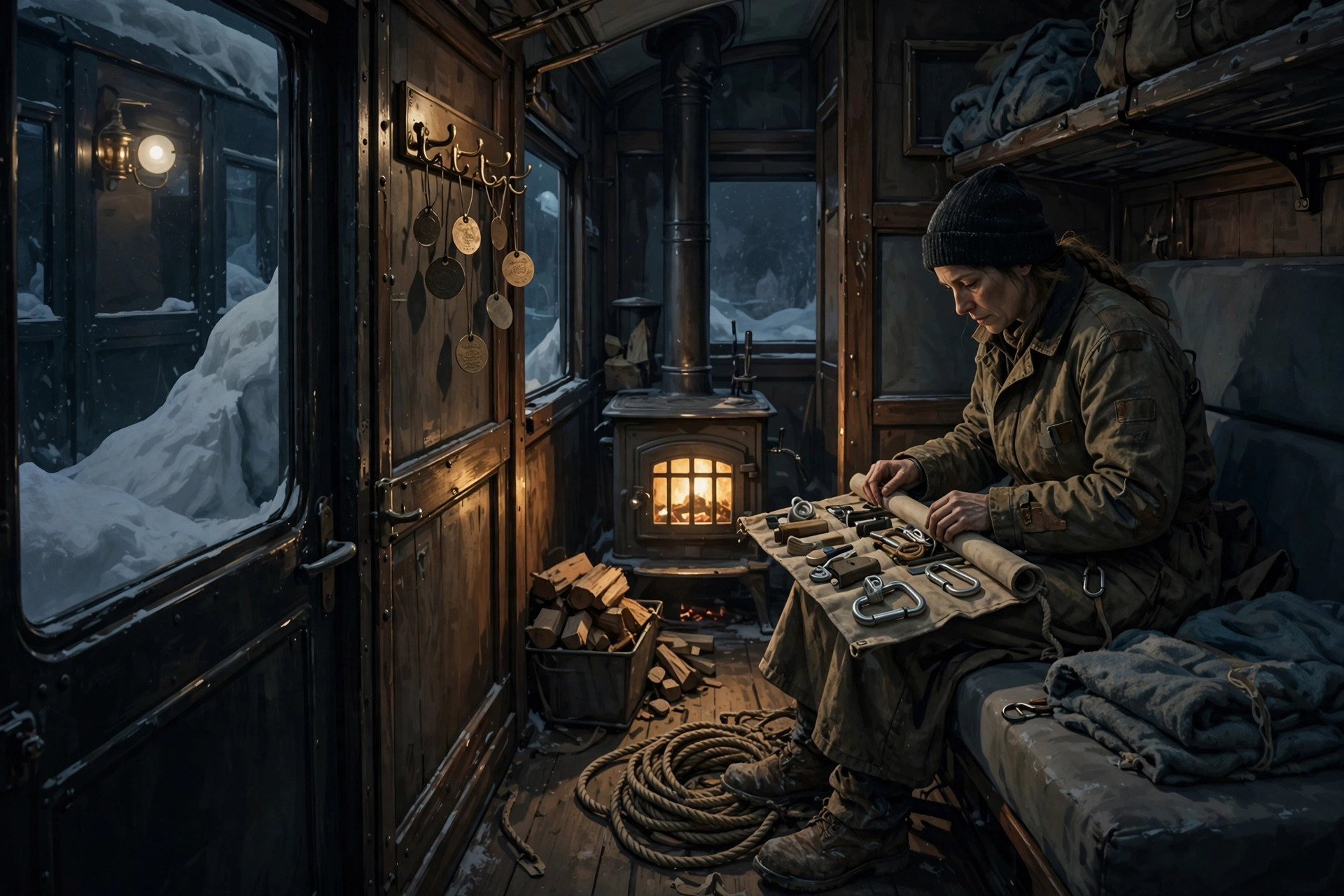
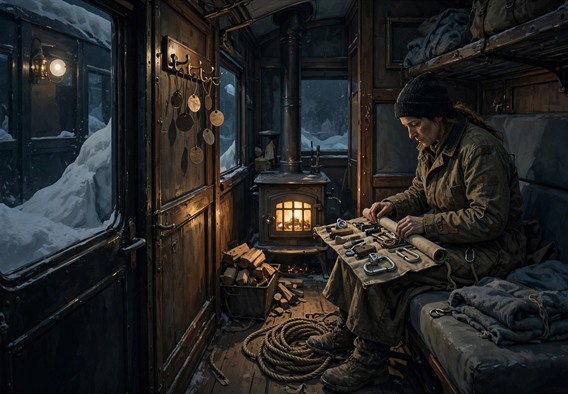
Kell had the rope end pinned under her knee and was opening the strands with a fid when the stove door banged and the coach filled with the smell of scorched pine. Outside the window there was nothing to see but the reflection of the lamp and, past it, the snow the plough had left banked along the siding. Bellhouse Siding sat below Cinder Pass with the slide across the line ahead, and the line would stay shut until the road gang and the relief engine had chewed their way through it. The inquiry would sit at Ruel whenever they could get down to it. Until then the coach was the warmest place for miles, and everybody in it was on the contractor's pay.
Tessa had claimed the sink end. Her soldering copper stood on the stove's hot plate, and she kept turning it with a rag while a scatter of brass offcuts grew beside the drainboard, bright where the file had bitten them. She was looping something small, holding the wire in her crimping pliers, and she hummed while she did it, badly and happily.
"Don't put your filings in my tea," Kell said.
"They're in the sink. The sink's where things go."
The tally board hung on the bulkhead by the vestibule door, where the guard could see it from his seat. Kell had sewn the roll herself out of tent canvas the season the cut was drilled, every pocket stitched by hand, and the pockets held the brass tokens from the anchors at Slatehook Cut. Above them ran the crew hooks, each with a name scratched into the wood beneath. Below ran the lower row of five stamped hooks, the lexicon the whole crew worked by: the eye for proof-tested and held, the cross for failed, the crescent for grout not cured, the double bar for locked out, the blank for untested. Every token carried its tester's mark on the reverse. That was the rule, and the rule was older than anyone aboard.
The roll itself lay in its canvas sleeve, wired to the board through the eyelets, the wire twisted and the twist buried under a lead seal Kell had pressed with the guard's die at the top of the shift. Her own tally hung on its hook above, eye stamp, her number struck on the back by Marcus the year she took the forewoman's hook. She had written her name across his competency card when the company brought him off the ropes and put him in an office. Neither piece of paper had ever been mentioned between them since.
Sela kept apart at the far table with her field book open and her collar up. She had a carbide scriber in her fingers instead of a pencil, and she used it the way she used it on the face, scratching numbers into brass rather than writing them, because a scribed number could not be lifted and struck again by anybody with a punch. She owned no punch. She had never owned one.
"They'll want the face itself," she said, not looking up. "They can't have it. It's under the same snow as the train."
"Then they'll have the roll," Kell said.
Sela shut the book. A yellow flimsy had been folded between the pages, and she took it out and put it in her breast pocket and buttoned the flap, and after that she watched the stove instead of anybody's face.
The vestibule door came open on a gust and Ostler stamped in with snow to his ankles and his hands held out to the fire like a man at a shrine. He had come up from the engine for warmth, which was against nothing at all as long as he kept walking his rounds.
"You been round her?" Reiner asked from the stove.
"Round her and back. She's cold enough to keep a corpse."
"Write it in my book when you go."
Ostler laughed and did not answer, and Reiner went back to his feeding. He had the door open and the shovel in and he put the wood in the way he had put wood in for most of his working life, so that the fire took it without a fuss. The mug rack over the mess table was his too. His own mug hung at the end of it, enamel, with a brass patch brazed over the chipped rim where Tessa had cut the chip back and made a job of it a season before at the camp.
Tessa held out her hand for it. "Give it here. I'll scour it out, the tea's got a skin on it."
"You'll not touch it."
"It's my patch."
"It's my mug. That's the seasoning."
Marcus came through from the baggage end with the kettle and went round the table filling what was held out to him, because it was the last stove feed and he had made himself the man who did the carrying. He set his seal case down on the seat to free his hand. The buckle was loose and Kell could see the leather punch roll inside it, rolled and buckled in its own strap, the office stamps from the toolroom at Ruel, the symbol punches and the crew's numbers, all of them ground and hardened years before anybody drilled a hole at Slatehook Cut. His own brass tally hung on the case zip. Another hung beside it, unremarked, the way a man carries a spare.
"Reiner. The tin."
"Shelf. Above your head, where it's been since the coach was built."
Marcus took the first-aid tin down, shook tablets into his palm, swallowed them dry and put the tin back with the lid pressed home. He rubbed his eyes with the heel of his hand and smiled at nobody in particular, and the smile was tired and decent and Kell had been reading it across a rope for years.
"Ruel will ask about the bond," he said. "So I'll say it here first, where you can shout at me. Forty thousand dollars, posted by the contractor. Your retained pay sits inside it. If the record comes back showing the proof tests were falsified, the bond is called, and every ticket that signed that slope is in question. Mine. Hers." He tipped his head at Kell without looking round. "The geologist's. So we go down with the roll and we go down clean."
"And if the record's wrong?" Tessa had stopped humming.
"Then somebody made it wrong, and it wasn't the snow."
Ostler said something about the company and its lawyers, low and bitter, and Sela said nothing at all. Kell tucked the last strand and pulled the splice tight against her knee and felt it come home.
Marcus held out his hand to her across the table, palm up, the old way.
"Over the edge?"
"Not alone," she said, and put her hand in his.
"And the tally?"
"Stays on the board. Always."
He let go and gathered the empties. Reiner's mug went with them, over Marcus's protest and Reiner's, and Marcus carried the patched mug to the sink and stood waiting while Tessa moved her copper and her offcuts out of his way.
"Warm water," Reiner called.
"Nothing else," Marcus said. "I know what I'm about."
Kell whipped the splice end, hung the rope on a hook, and sat a while with her hands on her knees. The lamps went down. Ostler went out to the engine and came back and lay down in his boots. Tessa wrapped her work in a rag and stowed the kit under her seat. Sela slept sitting up with the field book against her chest. Kell lay in her bunk listening to the wind come off the pass and find every gap in the coach, and she thought about the seal she had pressed and the certificate she had countersigned and the long cold ride down to a room in Ruel where men would turn the pockets out one at a time.
Near the small hours she got up for the guard, to ask him to keep the stove in until the road gang came, and found him on the vestibule floor with his back against the door and his lamp still lit beside him.
"Dov." She got a hand under his shoulder. "Dov. Up you get."
His head came round slowly. He said something about the wood and the draught and the words ran together in his mouth like wet paper. She slapped his cheek, gently and then not gently, and his eyes found her and slid off again. His breathing was deep and even. She pulled his coat from the hook and folded it under his head, and she was reaching past him for the lamp when the light went across the board.
The sleeve's wire had been cut. She could see the bright ends where the strands had parted, and she could see that they had been twisted back together afterward by hand, in a hurry, with the twist lying the wrong way about. The lead seal hung below it on the loop, scored through, no longer holding anything.
Kell knelt on the cold plate with the guard's breath going slow beside her, and worked the cut lead seal off the wire, and it came away in her fingers, and she put it in her coat pocket.
Five Stamps
Kell walked the guard backward onto the vestibule seat, her palm flat between his shoulder blades until he stayed there. His head went over against the panel and came up again. Behind him the mug rack hung on its screws, and the lamp on the floor put his shadow halfway up the door.
"Wood," Reiner said. "Draught." He tried it again and it came out cleaner. "I fed that stove myself."
"You fed it." She set the lamp on the ledge inside his reach. "Sit."
The coach came awake in pieces. Tessa sat up with her blanket round her shoulders. Sela had the field book open before her eyes were properly open. Ostler came through the outer door with the cold still on his coat and stood at the stove with his hands out to it, and Marcus arrived last, unhurried, the seal case under his arm and his sleeves already buttoned.
"Road gang?" Ostler asked.
"When there's light."
"Nothing moving at Bellhouse Siding yet. I've been round her." He turned his boots to the heat. "Wind's coming down off Cinder Pass like it's got somewhere to be."
Kell knelt at the board and unwound the twisted wire by hand. It gave easily. Whoever had done it had been in a hurry and had not cared which way the strands lay afterward. The cut lead was already in her coat pocket, and she felt it there against her hip as she lifted the roll off the board and carried it to the mess table. The crew came and stood around it because there was nothing else in that coach worth looking at.
"Dov. You'll write this when your hand steadies, so hear it now." She turned the waxed canvas back. The pockets ran in rows, an anchor number inked beside each mouth in her own stitching hand. "Five stamps in this roll. Eye, proof-tested and held. Cross, failed. Crescent, grout not cured. Double bar, locked out, nobody loads it. Blank, untested."
"Five," Reiner said from the seat. "And the tester."
"On the reverse. Every token carries the mark of whoever tested that anchor. Sela's been on the proof rig all season, so most of these carry hers."
"Scribed," Sela said. "Carbide pen. I don't own a punch."
Kell found the pocket she was after without hunting for it. She had sewn that row herself, in the tent, with the lamp swinging and her thumb sore from the needle. "The failed anchor at Slatehook Cut carried a crescent when I wired this roll. Grout not cured. I put that token in this pocket and I pressed the seal on it with your die, Dov, in front of Marcus."
"I remember the pressing," Marcus said.
She put her fingers in the pocket and brought out brass and turned it under the lamp, and the eye looked up at her, tested and held, the little oval and the pupil struck clean and deep.
Nobody spoke. Ostler's boot scraped the floor plate.
"That's not what I put in there," Kell said.
Sela came round the table fast. "That's my number." She had the token out of Kell's palm and tilted it to the light. "That's my number on the back of an eye. I never struck that. I have never struck an eye on that anchor, and I don't own a punch, and I don't own a number punch either."
"Show me your mark, then."
Sela took a blank shim from the end pocket and laid it on the table edge and drew the carbide across it, leaning in, the pen making a dry scratch that Kell could hear over the stove. She held it up. The number stood in fine bright lines, shallow, the metal barely disturbed, the strokes crossing where her hand had hurried.
Kell took the eye and put it beside the blank. The number on the eye was sunk. Each figure had a floor and a wall and a lip of brass raised where the steel had pushed it. She turned it over twice and knew what she was looking at and did not like how well she knew it.
"That's a struck number," she said. "That's out of a punch roll."
Marcus set the seal case on the table and unbuckled it and unrolled the leather across the wood, and the steel faces caught the lamp in a row. The symbol punches, the crew's numbers, each in its loop, the leather shiny where his thumb had gone in and out of it for seasons. He picked the eye punch and a number and a blank shim, and struck it there in front of all of them, two blows, and the sound went through the coach like something dropped.
"That," he said, "is what the room at Ruel will read out of your pocket, Josefa. Tested and held. That's what the record says now."
Kell picked up the fresh strike while it was still warm. Along the rim of the oval the metal had lifted into a small burr, a whisker of brass you could catch a fingernail on. She held it to the lamp and turned it and found the same whisker on the token that had come out of the failed anchor's pocket.
"Your eye punch is going," she said. "It's throwing a burr at the rim. Retire it."
"It's been in that roll a long while." Marcus laid the punch back in its loop, not defensively, the way a man puts down a tool he means to look at later. "I'll not throw it away, though. A scaler never destroys a tally, and I'd not destroy the steel that made one either. It goes down as it is."
"It goes down as evidence."
"As evidence," he agreed.
The case sat open beside the roll, and the zip on its inner flap stood partway, and the lamplight went in through the gap and found brass in there, a rim and another rim behind it, lying edge to edge. Kell looked at it and thought of his own tally and the spare he had carried since he came off the ropes, and she went back to the token in her hand, because the loop of it was wrong.
Her loops were brazed. She had watched them done. This one was soft-soldered, a fat grey fillet, dull where brazing would have been yellow, and there was a smear of flux dried brown under the shim.
"That's solder," she said.
Tessa's head came up. "That's an iron did that. Any iron. Half the camp's got an iron."
"Yours was hot at the last feed. I moved round you at the sink."
"I was working." Tessa's chin came forward. "You've all seen me working. What am I supposed to have done, sat up all night making brass?"
"Nobody's said that."
"You've all thought it, then." She pulled the blanket tighter and looked at the punch roll lying open on the table, the leather flat, the loops full, the case sitting there where it had sat all evening while anyone in the coach walked past it to the stove or the sink.
Reiner had got his hand up to the rack behind him and taken down his mug, the patched one, the brass brazed over the chipped rim, and he was staring into it. It was clean. It stood upside down on the board when he set it back, and the enamel shone.
"Somebody's washed my mug," he said. "I never wash that mug."
"Warm water," Marcus said. "I did it with the empties. You'd have had a headache from the rim."
Kell laid the false eye in the middle of the table and put her hands flat on the canvas. "I'm taking the crescent's absence down to Ruel in writing, Marcus. Signed. That pocket held a crescent when it was sealed."
"And I'll countersign that you say so." He said it kindly, and that was the trouble with him; he had never once been sharp with her. "But the roll goes down exactly as it reads. You sewed it. You pressed it. If we start opening pockets on a siding with the guard half asleep, every man in that room will ask what else we opened, and then it isn't the anchors they're weighing, it's the bond and the retained pay and every ticket that ever touched that certificate. Yours. Mine. Hers." He nodded at Tessa without looking at her. "Let the record stand and let them read it standing."
Sela was still holding the blank she had scribed, turning it over and over.
"Give me your tally," Marcus said to her.
"What for?"
"Custody. Your mark's in question and your tally's on an open hook where anybody can lift it. It rides in my coat until Ruel, and Dov writes it in the book, and you have his line to point at if anyone says otherwise."
Sela looked at Kell. Kell thought about the punch roll lying open all evening, and the solder, and the iron that had been hot at the sink, and she did not say the thing she might have said.
Marcus went to the board and lifted Sela's tally off its hook and dropped it into his coat pocket and buttoned the flap. Reiner wrote it down with the pen held in his whole hand. The hook stayed empty, turning a little on the board where the draught found it.
Solder and Brass
Kell brought the false eye up under the mess lamp and tilted it until the light ran along the rim. The metal was bright. Not the dull gold of a token that had hung a season in a canvas pocket with the dust of Slatehook Cut working into it, but the raw yellow of brass cut lately, shear marks still standing where somebody had trimmed the shim with snips and left them.
She turned it over. The loop had been made by threading wire through a drilled hole and wetting it with soft solder, and the solder had gone on in a blob, grey and lumpy, the tail of the wire bent back instead of trimmed. Whoever did it had been hurried, or working in the dark, or had never done it before.
The number on the reverse stood up clean under the lamp. Sela's number, but punched. Every figure was a bite of steel with a burr thrown along its shoulder, and the burr caught the light. Sela scribed. Sela's carbide pen left a thin wandering line you could feel with a thumbnail and hardly see, and Kell had watched her lay those numbers on often enough to know the slant of them.
She wrote in her own book: edges bright, loop soft-soldered, number struck. She underlined nothing. There was a great deal to carry down to Ruel and she had not yet settled what any of it weighed.
Marcus had gone down the ballast to the call point with the day-sheets under his arm, to raise Ruel on the wire and find out when the plough would come up from below Cinder Pass. The coach had got quiet in the way it did when he stepped out, everybody's shoulders down a little. Kell looked at the punch roll lying open on the mess table, five symbol punches in their loops and the crew's numbers in a row beneath, the burred eye back in its place where she had put it.
The bond stood at forty thousand dollars. The crew's retained pay sat inside it, and every ticket that had ever touched that certificate sat inside it too, hers at the top because she had countersigned. Bellhouse Siding was a passing loop and a hut and a wind that came down the mountain with nothing to stop it, and six people had been shut in the heated coach with the record wired to the vestibule board where any of them could reach it.
Reiner fed the stove and sat down heavily on the seat opposite, holding the coal shovel across his knees like a thing he had forgotten to put away. His colour was bad. Beside his elbow the first-aid tin stood open with the lid folded back, and a blister of tablets had been pushed through, the foil curled and shining.
"Head's still thick," he said. "I've been on this road since before you were drilling, and I've never come up out of sleep like that. Like coming up a ladder with the rungs too far apart."
"Who was up, Dov?"
"Mugs went round on the last feed. After that I was on the vestibule floor and you were standing over me." He rubbed his mouth with the back of his wrist. "I'll write what you tell me to write, and I'll write the hour I wrote it, and that's all I've got."
Behind him on the rack his patched mug stood upside down, dry, the enamel washed clean and the brass patch over the chipped rim polished bright by whatever had scoured it. Tessa had brazed that patch at camp with the torch, because enamel takes a torch and not an iron. Kell looked at the mug and then at the blob of soft solder in her hand, and the two things sat beside each other in her mind and she let them sit.
Ostler had come up from the engine and stood at the end of the aisle with his cap in his hands, not sitting, keeping the door in view the way enginemen do.
"Rounds," he said, before she asked. "Outside, whole way round, same as always. Nothing moving on the slide, nothing coming up behind. I looked at the sand boxes and I looked at the brake and I came back."
"All night?"
"Long night." He turned the cap a quarter turn. "It's cold out there."
His boots were dry. There was no crust in the welts and no melt on the floor under him, and the coach stove had been going since the small hours. Kell noted it the way she noted the solder, wrote nothing, and moved on, because the thing in her palm was brass and the brass had come out of a pocket she had sewn herself.
Sela sat in the aisle seat with her field book closed on her lap and both hands flat on the cover. A fold of yellow flimsy showed at the buttoned flap of her breast pocket. Her carbide pen was clipped beside it. Her hook on the board stood empty, turning a little in the draught.
"I was in my berth," she said. "I stayed in it. You can write that."
"Open the book, Sela."
"No."
"It's your record of the tests."
"It's my record of everything." Her chin came up. "There are sheets in there with my name on them that I will not have read out on a siding by people who are cold and frightened. It goes to Ruel and it goes to Ruel whole. My tally's in Marcus's coat and Dov has the line in his book, so what exactly am I being asked to prove, and to whom?"
Kell let it go. She had had that argument with better men than herself and lost it, and the yellow corner stayed where it was, buttoned down.
Tessa stood by her seat with her arms folded, watching all of it, saying nothing. Her kit was open on the floor. Kell crossed and put two fingers on the iron where it lay in its cradle at the sink end, and the barrel was warm. Not hot. Warm the way a thing is warm when it has been hot a while ago and is going cold in a coach that is only just heated.
"You were soldering."
"I slept," Tessa said.
"The iron's warm."
"It's near the stove pipe."
"Who was up, then?"
"Couldn't say." She looked at the floor and then at Kell and then at the floor again. "I slept the whole night."
Kell rolled the punch roll shut and drew the thong round it and held it out to Reiner, who took it and set it on the seat beside the incident book and put his hand on top of it, and wrote. Then she folded the canvas roll along its old creases, pockets inward, the empty pocket of the failed anchor lying flat against the others, and slid it into her own bag with the cut seal already in her coat and her breath going short.
"Give me your wire," she said.
Tessa crouched, took the coil and the crimping pliers out of the kit and put them in Kell's hand, and stood back. Kell threaded wire through the mouth of the bag and round the strap ring, pulled it up with the pliers until the canvas puckered, and twisted the ends down flat. The roll had been sewn by her and pressed by her and now it was wired by her, and it rode against her hip instead of on a board where anybody could lift a sleeve.
Then she knelt at the kit.
She took it out piece by piece and laid it on the floorboards where the lamp reached. The iron. The coil of soft solder, the end freshly melted. Brass offcuts, thick plate, the sawn faces still bright and the file marks new, a curl of swarf in the bottom of the box with the shine still on it. Crimping pliers, snips, a stub of drift, a fold of rag with brass dust in the weave. Nobody in the coach spoke. Reiner's pen went on moving. Sela watched with her hands still flat on her book, and Ostler watched the door, and Tessa stood over Kell with her arms folded and her jaw set and did not say one word.
Kell held a plate offcut up to the false token. Same thickness. Same shear. She could put the two edges together and they would agree, and she felt the whole coach waiting for her to do it, and she thought about the retained pay and about the men she would still be standing beside on the face next season.
Tessa unfolded her arms. She sat down on the edge of her seat and unlaced her left boot and worked her hand down inside it, past the sock, and brought out a plate of brass wrapped in the corner of a rag. She did not look at anybody. She reached out and laid it in Kell's palm and closed Kell's fingers over it with her own, hard, the way you press a wound shut, and then she took her hand away.
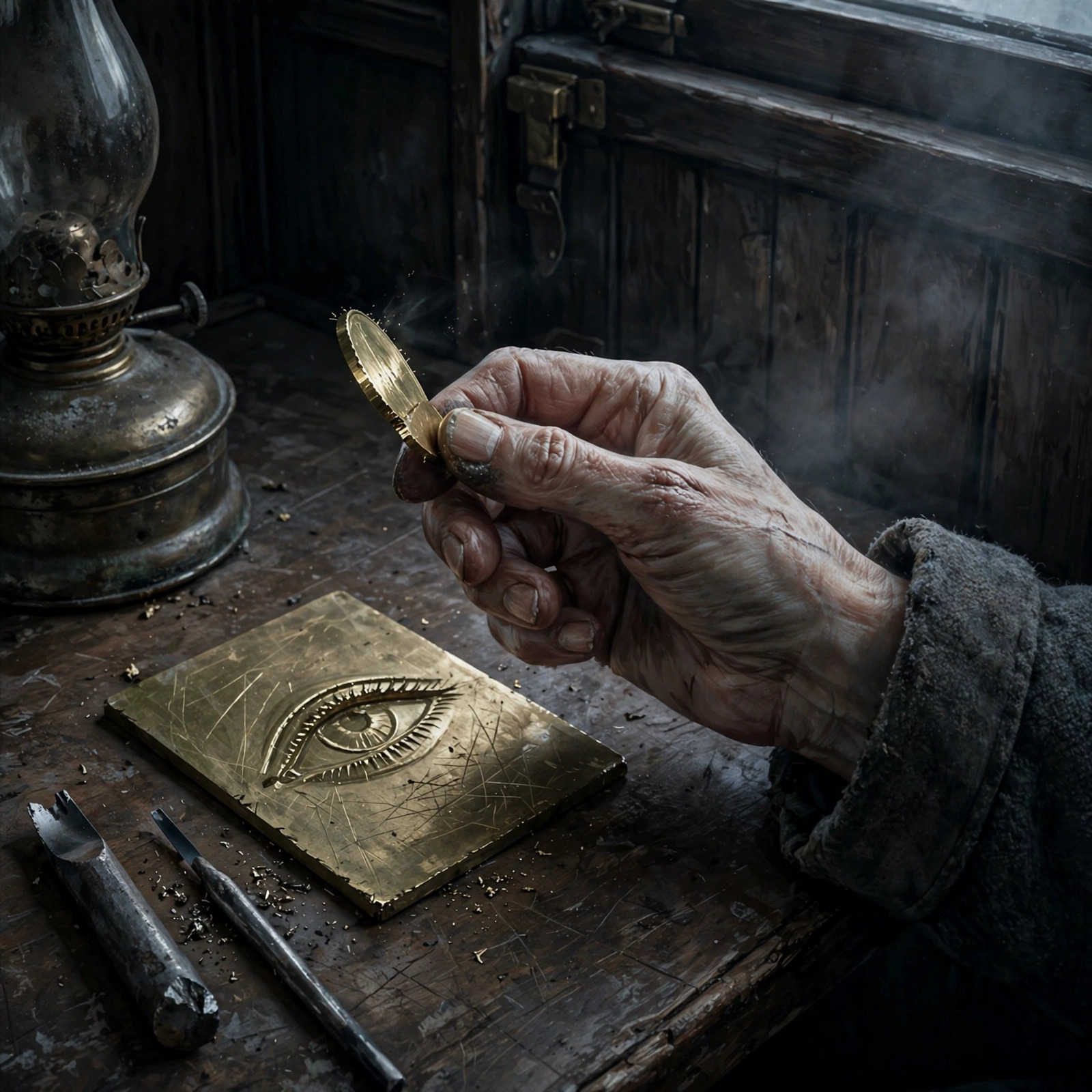
It was heavy, thicker than any token on the roll, sawn and filed to shape, the loop neatly soft-soldered and the tail trimmed flush. On the reverse, Tessa's number. Filed by hand. Every figure cut with the edge of a file, the strokes crossing at the corners, the burr lying sideways where the metal had been pushed rather than struck.
The Cold End
Kell carried the brass to the lamp table and laid the false token down beside the plate Tessa had pulled out of her boot, then turned the lamp until the light ran along both edges at once.
"Look at them," she said. "Same plate. Same saw. Your loop's soft-soldered and so is this one, trimmed flush the way you trim them, and your iron was warm when I put my hand on it."
Tessa stood over the table with her arms folded. "It's my brass. It's my iron. I never told you different."
"You told me you slept."
"I told you I was in my bunk."
Outside, the light coming into Bellhouse Siding was the colour of dishwater, and the wind off Cinder Pass pushed snow along the footboards in long threads. Nobody had touched the stove since the small hours. Reiner's pen went on moving.
"There are five stamps on that roll," Kell said. "Eye, cross, crescent, double bar, blank. You've hung your own tally under an eye since you came on this job. The pocket for the failed anchor held a crescent when I wired it shut at Slatehook Cut. Before dawn it held an eye, with a soldered loop and a burr on it. That's brass work. That's your bench."
"That's my bench and it isn't my token."
Marcus came up the coach from the vestibule, stepping over Ostler's boots, and set his seal case down by the stove before he spoke. He had his hands open at his sides, the way he had them on the face when he wanted men to stop and listen.
"Josefa. Leave it a minute." He turned to Tessa, and his voice went softer, not louder. "Nobody in here thinks you cut a wire. What we have is a token that shouldn't exist and a kit that could make it, and the inquiry sits at Ruel whenever the road opens. Own to the token and I'll stand up beside you and say the schedule came from me and the pressure came down on you from above."
Tessa's jaw worked. "You'd say that."
"I'd say it under my hand." Marcus glanced at the wired bag against Kell's hip, then away from it. "The bond is forty thousand dollars. The crew's retained pay is held inside it. If the record says the testing was rotten from the top, the bond goes and every ticket on that cut goes with it, yours and mine and hers. I would rather carry a name than a crew."
Kell heard the whole coach take that in. She heard Sela's chair creak. She thought about the men she would be standing beside on the face next season, and about the pay that had already been earned and not yet paid, and she kept her mouth shut, and that was the moment she let it happen.
"I lost my tally," Tessa said. "Over the face. It came off the hook when I was bar-ing down and it went into the trees and I never found it. I filed that one so I'd have something to hang. That's the whole of it."
Reiner looked up from the book. "A lost tally is a hole in the record. You know what the standing order says."
"I know what it says."
"Then state it for the book, in your own words, and I'll write them and not mine."
She stated it. Short, flat, no ornament, the way she called out a weld. Reiner wrote her name at the head of a fresh line, and his pen made a small dry sound in the cold, and then he took the filed plate off the lamp table and clipped it to the page with the bulldog clip he kept on the board, so that her number lay against her name where anyone could see it.
"Baggage end till Ruel," he said. "That's separation, not punishment. I've a duty to keep the record apart from the people in it."
"Take your bag," Marcus said, gently, and lifted it down off the rack himself and held it out to her.
Kell opened the door at the far end because Reiner had the book in both hands. The cold came through it like water. Frost stood on the inside of the glass in feathers, and the lamp above the baggage stack had been out since the siding, and the air in there smelled of canvas and iron and old snow. Tessa went past her with the bag on her shoulder and her chin up.
"It's my brass," she said again, to Kell, close, almost conversational. "You know what a file does and what a punch does."
Kell shut the door. Through the glass she could see Tessa set the bag down and sit on it, and put her hands up inside her sleeves, and her breath went out pale and kept going out pale, and the cold began doing its work on her while the stove ticked behind Kell's back.
"That's not right," Ostler said.
He was standing at the vestibule door with his cap in his hands, and he had been standing there since the kit came out of the box.
"Ruben," Reiner said, "leave it."
"I never went out." Ostler's voice cracked in the middle of the word and he let it. "Not after the last feed. My boots were dry because I never put them on the ballast. I came up here for the warmth and I lay along that seat with my coat over me and I slept, and I let you write my rounds, and I've been standing here listening to that girl go into the cold for it."
Reiner set his pen down. He did it carefully, in line with the edge of the book.
"You let me write them."
"I did."
"Then say what you saw before you lay down, since you're awake to it now."
"You fed the stove. The mugs went round." Ostler turned his cap over. "Marcus carried them. He took the empties to the sink, and yours with them, the patched one, and he washed it. I heard the brush on the enamel. I remember thinking you'd have something to say about that."
Reiner turned in his seat and looked at the rack behind him. The patched mug hung upside down with the brass shining where the chip used to be, clean as a shop window.
"I never wash that mug," he said. "Not in all the years I've had it."
Sela unbuttoned her breast pocket.
She had been sitting with her hands flat on her book since the lamp came up, and now she took out a flimsy of yellow carbon, folded once, soft at the creases from being carried, and she held it out to Kell without looking at anybody else in the coach.
"Pour and loading," she said. "Same sheet. Read the entries."
Kell read them. The grout pour entered, and the anchor loading entered under it, in the same hand, on the same day, with Sela's signature at the foot and Marcus's countersign beside it.
"Grout stands thirty-six hours before you load it," Sela said. "Those anchors were loaded green. I said so on the face and I said so on the sheet, under protest, and then I signed it, because he told me the pour would be cured by the time the load came on and I let a man with a card tell me what my own test meant."
"You had this in your pocket the whole time."
"Since the day it was written." Sela's mouth was thin. "My name is on it too. I hid it because I signed it. There's your reason, and it isn't a better one than hers."
"I was on the far face," Kell said.
"You were on the far face."
Kell looked at the book, at the plate clipped to the page. Tessa's number lay there with the strokes crossing at the corners and the burr pushed sideways, every figure cut with the edge of a file, metal shoved out of the way rather than driven down. A file leaves that. A file cannot leave the clean deep floor of a struck figure, and the number on the false token had been struck, and Tessa owned no punch and had never owned one. The brass could have come off her bench. The mark could not.
She lifted the false token off the lamp table and put it in her coat pocket with the cut seal, and she did not say any of it out loud, because the road was still shut and the bag was still wired against her hip and she had not yet worked out what she was willing to pay.
"Don't close the book, Dov," she said.
She folded the yellow carbon down small and pushed it up her sleeve against her wrist, where the pour and the loading and both signatures lay against her pulse. On the board, Tessa's hook stood empty beside Sela's. At the far end of the coach the frost went on feathering the inside of the glass, and behind it Tessa sat on her bag with her hands in her sleeves, and Kell stood with her palm flat on the latch and did not lift it.
Two Tokens
The latch came up under her palm and the baggage end let its cold out over her boots. Kell went in with her coat over one arm and the filed plate in her fist, and the brass had taken the temperature of the latch.
Tessa sat on her bag against the crates with her hands pulled up inside her sleeves. Frost had feathered the inside of the glass above her head. Her breath went up into it and came back nothing.
"You took your time."
"I did." Kell shook the coat out. "Arms."
"I'm not--" Tessa stopped, and let the coat go round her shoulders, and pulled it closed herself. "There. Happy?"
"Hold out your hand."
The fingers were stiff and the knuckles cracked with cold. Kell put the plate into them and closed them over it. "Your number. Filed on your bench out of your own offcut, because you dropped your tally over the face and hadn't the nerve to say. That mark stands."
"And the other one."
"There isn't another one. I held the lamp while they went through your kit." Kell waited until Tessa looked at her. "I should have read your number properly before I let anybody write your name down."
Tessa turned the plate over with her thumb, the strokes crossing at the corners where the file had shoved the metal sideways. "It's ugly work."
"It's yours. Come into the warm."
"They'll ask why."
"They'll know why."
Kell picked up the bag. There was frost on the strap and it melted against her palm, and she carried it out ahead of Tessa because Tessa's hands were full of her own name.
The stove heat took the ache out of Kell's knuckles. Tessa stopped shivering hard enough to stand straight, and stood in the aisle with the coat hanging off her and the plate in her fist.
Reiner had the book open at the lamp. He had taken his patched mug down off the rack, and the brass patch Tessa had brazed over the chipped rim caught the light every time his hand moved, which was often. The enamel ticked against his teeth when he drank. Kell held out her hand for his pen.
"That's a signed entry."
"Then witness the strike."
He looked at the name he had written and at the empty bulldog clip beside it. Then he drew the pen through it and put his initials in the margin, and his hand shook so the letters climbed. "They read strikes at Ruel the same as they read names."
"Let them read it."
Reiner set the mug down and took his time getting his breath. "Forty thousand dollars. That's what the contractor posted, and the crew's retained pay sits inside it. The roll goes down reading falsified, the surety pays the road, and then the surety comes back on every ticket that signed. Yours. Mine, for the seal. The pay goes while they think it over."
"Say my name in that list." Sela had come up the coach with her arms folded. "I signed the sheet. You know why I kept the carbon in my pocket. Cross out one name and start reading that roll again, and it's my ticket in the tin next."
"The crescent doesn't say the rock failed," Kell said. "It says wait."
"I know the five stamps." Reiner's palm was flat on the page. "I've wired every token that came off Slatehook Cut."
Ostler came through with the coal scuttle and put coal on the fire, working round Kell to do it. "I told you where I slept. That's mine paid." He set the scuttle down by the stove. "Don't come asking me for the rest."
Sela took her coat off its hook and went to the far seat and sat with her back to the lamp. Nobody moved up to make room for Tessa, and Tessa did not ask them to. Kell had worked beside these people through worse weather than this, and she stood in the aisle and watched them decide, all of them, not to know her.
Marcus had his seal case on the seat by the stove, the zip pull hanging with its little brass weight. Kell sat down beside him with the wired bag against her hip, unthonged the punch roll and laid it open on the seat between them, the eye punch uppermost, the burr on its face where she had ordered it retired. She said nothing about it. She kept her voice under the noise of the fire.
"Give me the token that was wired in that pocket."
"There's an eye in your coat pocket, Josefa." He said it the way he handed round mugs, as though she had asked for it.
"That eye came off a roll of steel punches, and the number's driven deep, and Sela scratches hers with a carbide pen." Kell let the punches lie there in the lamplight. "Here's what I'll put down. My card in the tin. My ticket with it. I'll say the pocket was mine, the wiring was mine, the seal was mine, and I'll say it at Ruel with my hand on the book. The roll goes down wired as it stands and nobody opens it. The whole record, buried, with me on top of it."
Marcus turned his head towards the fire. "And?"
"And you give me the crescent."
"The face came down because the rain never stopped." He kept it gentle and he kept it low. "Water in the joints, and the whole cut let go. That's what buried the line. Not anchors."
"The anchors were loaded inside thirty-six hours."
"Sela signed the load sheet." He let that sit. "She's the geologist. She signed it, and you countersigned the certificate, and you of all people know what a signature costs once it's down on paper."
"I know what mine cost. You struck it for me."
"I struck it because you'd earned it." His thumb went along the zip of the case and stopped. "There's a winter coming. Tessa's got her bench and Sela's got her ticket and the crew have pay held against this job. Call the bond and you're doing arithmetic with other people's rent."
"Nobody goes over the edge alone," Kell said. "And a tally never goes in the fire. You taught me that on the far face before you ever carried a case."
"I remember."
"If you haven't got it, tell me now. I'll go on with what's in my pocket and leave you your case."
The fire popped. Marcus looked at the open punches, and then at the board with its empty hooks, and his thumbnail worked at the loop threaded on the zip pull. It slipped. He tried again, and the brass came free, and he put it into her hand and closed her fingers over it, the way she had closed Tessa's.
Grey dust lay in the floor of the crescent. Her thumb found the grit of it, grout off the pour, still sitting down in the strike where no wire had touched it. On the reverse the number ran thin and scratched, scribed by hand on a wet face.
"I struck the eye," Marcus said. "I put the tablets in Dov's mug." He was not looking at her now. "It kept the crew working. That's all it was for."
Kell did not answer him. She did not raise her voice either, and the fire went on making its noise, and Sela watched from the far seat with her coat over her knees.
She stood with the crescent in her left palm and crossed to the board. Reiner's pen lay across the strike he had initialled. Kell put her finger under the loop of her own tally and lifted it off the hook.
The grout dust stayed in the crescent. Her own eye swung from her finger, warm off the board wire, the loop he had brazed for her, and behind it the bare hook went on swinging.
The Relief Engine
The plough's wash came up the vestibule steps as steam and blew out again, and Kell held the door with her shoulder while the kit went down past her. Ostler passed the drill case to a plough man and took back the water can. Beyond them the relief engine stood coupled on, breathing, its rods dripping into the churned snow at Bellhouse Siding, and far up under Cinder Pass the spoil lay flattened where the blades had shoved it off the rail.
She had the crescent in her left palm and her own tally hanging from her finger. The cold was taking the board's warmth out of both of them.
"Dov. Bring the book out here, where they can hear you."
Reiner came up the coach with the incident book against his chest and his pen behind his ear. Sela rose off the far seat and followed him, coat over her arm. Tessa stopped in the aisle with a coil of rope on her hip and did not put it down.
Kell brought the false token out of her coat pocket, the cut seal still rattling against it, and held the brass in the grey light off the snow. "Look at the eye. Along the lower curve, there's a lip on it. A burr, where the punch face is worn and pulls metal up instead of cutting it clean."
Reiner bent his head. Sela bent hers.
Kell reached past them to the seat and took the eye punch out of the open leather, and turned its face to the light. The corner of the eye was chipped away, a small bright bite out of the steel.
"Now the back." She flipped the token. The number stood deep and square-shouldered, driven in one blow. "Sela. Show them your pen."
Sela took the carbide scriber out of her breast pocket and held it up like a woman showing a licence. Her hand was steady enough. "I scratch them. On a wet face, in the wind, with a glove off. I've never owned a punch. There isn't one in my kit and there never has been."
"That number was struck," Kell said, "and it was struck with the office roll, and the office roll rides in Marcus Oyelaran's case. He cut the sleeve wire while Dov slept, took the crescent out of its pocket, put this in, and twisted the wire back so the mouth looked untouched."
Ostler had come to the door with the water can. He set it down on the step and stayed there.
Reiner opened the book on the folded seat and wrote, standing, the pen digging. Sela watched the page and not Marcus.
"Dov, that mug of yours." Kell nodded at the table, where the enamel stood with the brazed patch shining over the chipped rim. "You've never washed it since Tessa put the patch on. You wipe it round with your thumb and hang it back. It was washed last night, proper, at the sink, and it was washed by the man who carried it round on the last stove feed, because he'd put tablets in it and he needed it clean before you woke."
"I never wash it," Reiner said. "It spoils the tea."
"I know."
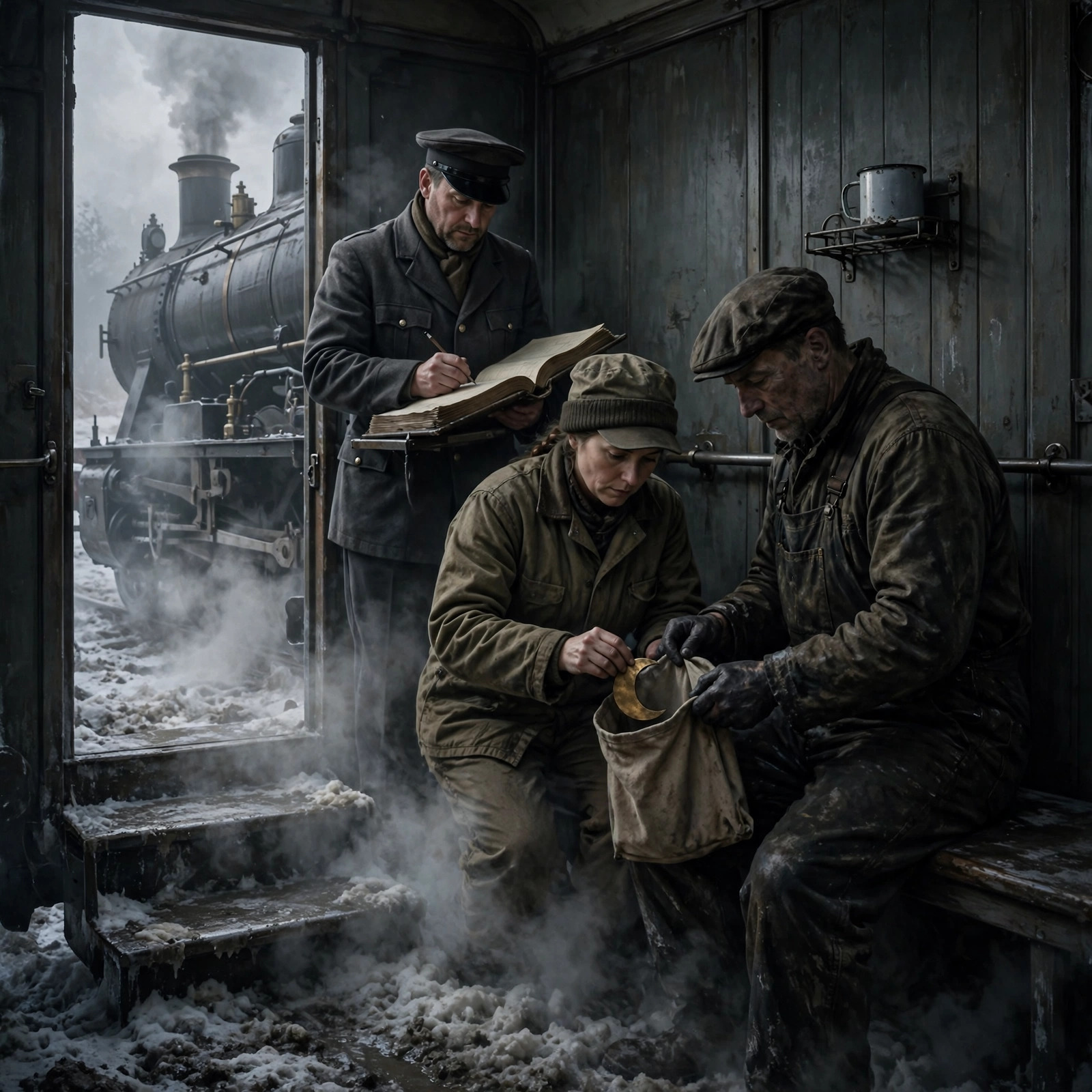
She lifted the crescent then, and let the light into the floor of the strike, where the grout dust still lay grey and undisturbed. "And he couldn't throw this away. No scaler can. He kept it threaded on his zip where his thumb would find it every time he shut the case. He gave it to me an hour ago because I offered him my card and my ticket and a buried record for it, and he took the offer." She let that stand in the doorway with the wind coming in. "Write that too. I offered it."
Marcus had come up the coach without hurry. He took Sela's tally out of his coat pocket, where it had been riding warm against him since the small hours, and put it into Kell's right hand, and she felt the heat of his lining still in the brass.
Then he knelt, rolled the leather over the steel, and drew the thong through and around, and stood and put the roll into Reiner's arms.
"The eye's been worn since the toolroom sent it," he said. "I never had it dressed. It's all there, the numbers too." He looked at the book, not at Kell. "Don't write it kind."
He asked for nothing. He went back down the coach and stood at the window with his hands empty.
Kell hooked her own tally on the door frame and got the wire cutters out of her bag, and the roll came out after them, mouth still wired shut the way she had left it. She snipped the twist and drew the wire free and unfolded the waxed canvas on the seat, pocket by pocket, until she found the empty sleeve where the crescent belonged.
Tessa put the rope down and held the pocket mouth open with two fingers while Kell seated the token and passed the wire through the sleeve and twisted it tight with the pliers. Neither of them spoke. The fitter's hands were black to the wrist and cold-reddened at the knuckles, and she took the pliers back afterwards without being asked.
"Right pocket," Tessa said. "It's the right one. I checked the labels when they had my kit open."
Kell worked the yellow carbon out of her sleeve and flattened it on the book, and the flimsy crackled and tried to curl. Reiner pinned it under the clip. Pour and loading on the one sheet, at Slatehook Cut, the anchors put under load inside thirty-six hours of the grout going in, on the manager's order; Sela's signature under protest, and his countersign beneath it.
Reiner wrote the true account above it in his own hand, and Kell read it over his shoulder, and then took the pen and put her name under it, and under her name she wrote that she had sealed the tally and countersigned the certificate from the far face without checking the tokens against the sheets.
Sela read it twice. "That's my writing on the load sheet," she said. "I hid the carbon because of it."
"It's in the book now," Kell said. "Both halves of it."
She dropped the false eye into the guard's evidence tin, and the cut seal after it, and then took her card out of the oilskin wallet where it had lived since the year she took the forewoman's hook, and laid it on top. Reiner put the lid on and pressed it down with his palm.
Kell gave him the lead seal. He threaded the wire through the roll's mouth and twisted it and set the die and squeezed, and the lead took his mark and hers, and he wired the roll back onto the vestibule board himself.
"That's forty thousand dollars called at Ruel," Ostler said from the step. "Our retained pay sits inside that bond. Every one of us."
"It does," Reiner said, and did not soften it.
"Then you've done us." Ostler picked up the water can and went out past Kell with his eyes on the doorframe, and he did not look at her, and she knew he would not for a long while.
Reiner took his mug off the table and hung it back on the rack with the skin of old tea still in it. "It goes as it is," he said. "Let them smell what was in it."
Tessa went to the board and hung her filed duplicate on her own hook, in the open, where the light caught the saw marks and the neat solder of the loop. She stood back so they could all see it, and then she went down the steps for the last of her kit.
The relief engine took up the slack with a clang that ran the length of the coach. Kell put Sela's tally on its hook and heard it settle. Then she carried her own eye across to the hook under the double bar and hung it there, and shut the vestibule door on the snow, and the board's brass swung and turned and touched together as the coach took the road.
Get notified when new stories drop

Nora Vance
Nora writes sealed-room puzzles and family houses with secrets: small casts, fair clues, and endings that put someone right.
Leave a comment
Comments