

The Night Book
Hester lifted the leaf with her bone folder and found the ladder at last, inked in the margin beside a word for water, no bigger than a thumbnail. Some pilgrim's clerk had drawn it to mean the refuge post halfway across the Chantry Sands, and the pilots still kept a ladder painted on the post itself, and there it was, six centuries apart, saying the same thing. She copied it into her notebook. Around her the reading room went on being loud.
Exam week did that. Students came and went in the restless way of people who had revised the wrong things, asking for the Adair charter because it was on the list, asking whether the seal counted as a primary source. Hester answered them, initialled their slips, and kept her place in the itinerary with the folder laid across the gutter.
At the gate Alf Croser sat with the night book open under the lamp, ruling his columns straighter than the printer had. Beside him stood the box of blue placeholder slips. Nothing left the room without a slip going into the box in its place; that was the whole of Alf's religion, and he had never once been argued out of it.
"You're certifying tomorrow," he said, without looking up. "They've put a tablecloth in the muniment room. I heard it from the woman who launders it."
"I'm certifying if the book is whole." Hester turned another leaf. "It's a route book, Alf. It was made as one book. The Adair half is a charter with a seal on it, the roads and the tolls and the pilotage set out in a single hand. The Merrow half is a cartulary in boards, calfskin over oak, and it lists the same roads from the island end. Put them together and you have the whole pilgrim way from Nettleford to Sillow Isle. Apart, they're a family quarrel with paperwork."
"And tomorrow they stop being apart."
"Tomorrow Ninian marries Grizel at Sillow Grange, and the halves go into one case, and I write beneath them that they form a complete book, and Peel frames my signature and hangs it in the corridor." She heard how dry she sounded and did not soften it. "I've asked to collate the Merrow half against the charter. Properly, leaf by leaf. I've been asking since the spring."
Perpetua Adair spoke from the conservation bench, where she had a torn rent roll spread under weights and a brush of paste going in small strokes along the tear. "You've been asking the wrong people. Ask me. I'll tell you no."
"You would."
"I would." Perpetua laid a strip of tissue down and smoothed it with the flat of her finger. "My son is putting the town's road book behind a private door on that island, and the door will have a keeper, and the keeper will be a Merrow. You'll have signed the lock."
"I'll have signed that the leaves are all there."
"That's what they'll read out," Perpetua said. "It isn't what they'll do with it."
Ninian came in while she was still saying it, and the room took him the way rooms did: two people called his name, and he answered both, and then he stood at the end of Hester's table with his bag against his hip and waited to be noticed. He had a way of arriving quietly that had made him a good archivist and a poor suitor. Hester had taught him to read these road marks back when he could not tell a ladder from a comb, and she still could not watch him without checking whether he had eaten.
"Hester." He set the bag down. A folded printer's leaf showed at the corner of it, cheap stock, letterpress, the ink slightly furred: a bookseller's catalogue out of Wem, Solomon Teague's name at the head. Under the printed line a hand had written in pencil, small and upright, in Ninian's hand.
"Packing paper?" she said.
"It came round a purchase." He pushed the corner out of sight with his thumb. "Can I ask you something technical."
"You may ask me anything at this hour."
"If a schedule of contents lists a gathering." He stopped, and started again. "And the gathering isn't in the book. What do you call that?"
"A hole," Hester said. "And I'd stop signing anything until anyone found the leaves."
Ninian looked at the table for a while. Then he said, "That's what I thought," in the voice he used for agreeing with a mark scheme, and picked his bag up again.
Perpetua had put her brush down. "Say it to me."
"There's nothing to say yet."
"You've been at that schedule with a pencil since the weekend. Say it to me before you say it to her."
"Mother." He said it gently, which made it worse for her. "Not here. Not in front of the students."
Hester watched Perpetua's hand go back to the brush and hover, and then set the weights straight instead. Later, when the room had emptied a little, she said, "You could ask him to wait. A week. Nobody dies of a week."
"He's twenty-seven," Perpetua said. "If I ask him to wait he'll hear me asking him to choose me, and he'll do it, and he'll hate me for the rest of my life." She turned the rent roll under the light. "So I mend paper."
Hester bent to her own boot, which had been troubling her since the afternoon, and worked the bone folder into the tread. Red grit came out, a little ridge of it in her palm, sharp-edged and new, and with it the smell that had followed her all the way home. She had driven the Wem Bridge road behind the tar sprayer, eleven miles of queueing with the heater on and the fresh black steaming ahead of her, and the chippings had come back with her on the soles. She tipped them into the waste bin and thought, as she always did, that the long road was the honest one. Eleven miles over the bridge, open all night, whatever the water did. Or two miles of firm sand at low water, straight out from the causeway head to the island, with the Pilgrim's Ladder halfway if you were caught.
Fabian Merrow came up to the gate just then with his tractor and trailer standing outside and the engine still ticking as it cooled. He had the Grange schedule in a wallet, folded once, and he handed it up to Alf as though it were a delivery of eggs.
"Grizel's compliments and she can't come off the island," he said. "That's the contents, gathering by gathering, in her own hand. The book doesn't leave the muniment room. Not for me, not for the bishop."
"Then I certify a list," Hester said, coming to the gate.
"You certify what's true." He smiled at her, easy, entirely reasonable, a man who had brought her over the sands in weather she would not now walk in. "You've read her hand. She's not a liar, our Grizel. She's a keeper."
Something heavy shifted in a paper bag on the tractor's seat as he leaned in for the wallet, and Hester saw the ironmonger's name printed down the side of it, a Wem shop. His keys were on the rail beside the wheel: old brass, worn smooth, and one bright new one among them.
"Watch loft," Fabian said, catching her look. "Hasp and a padlock. The old one's rusted through and I'm not having somebody's cousin up there in a gale."
"Which way will he come?" he added, to Alf, nodding at the room. "Ninian. I've a launch to fuel and I'd sooner know."
"He'll come the way I'd come," Alf said. "Dry."
"Board shuts the sands at nine o'clock," Fabian said. "I chalked it myself this morning. After that it's the bridge for anybody with sense." He touched the rail, and the trailer rang. "Tell him the Grange kitchen's been at it since noon. There'll be nothing left of the pie by the signing."
When he had gone down the hill Hester stood at the gate a moment. From there you could see the causeway head and the tide board, the slate-painted deal he had made himself when he took the pilotage off Mattie Rundle, and beyond it the sand going out pale and wet in the last of the light, and the island lying long and dark behind it.
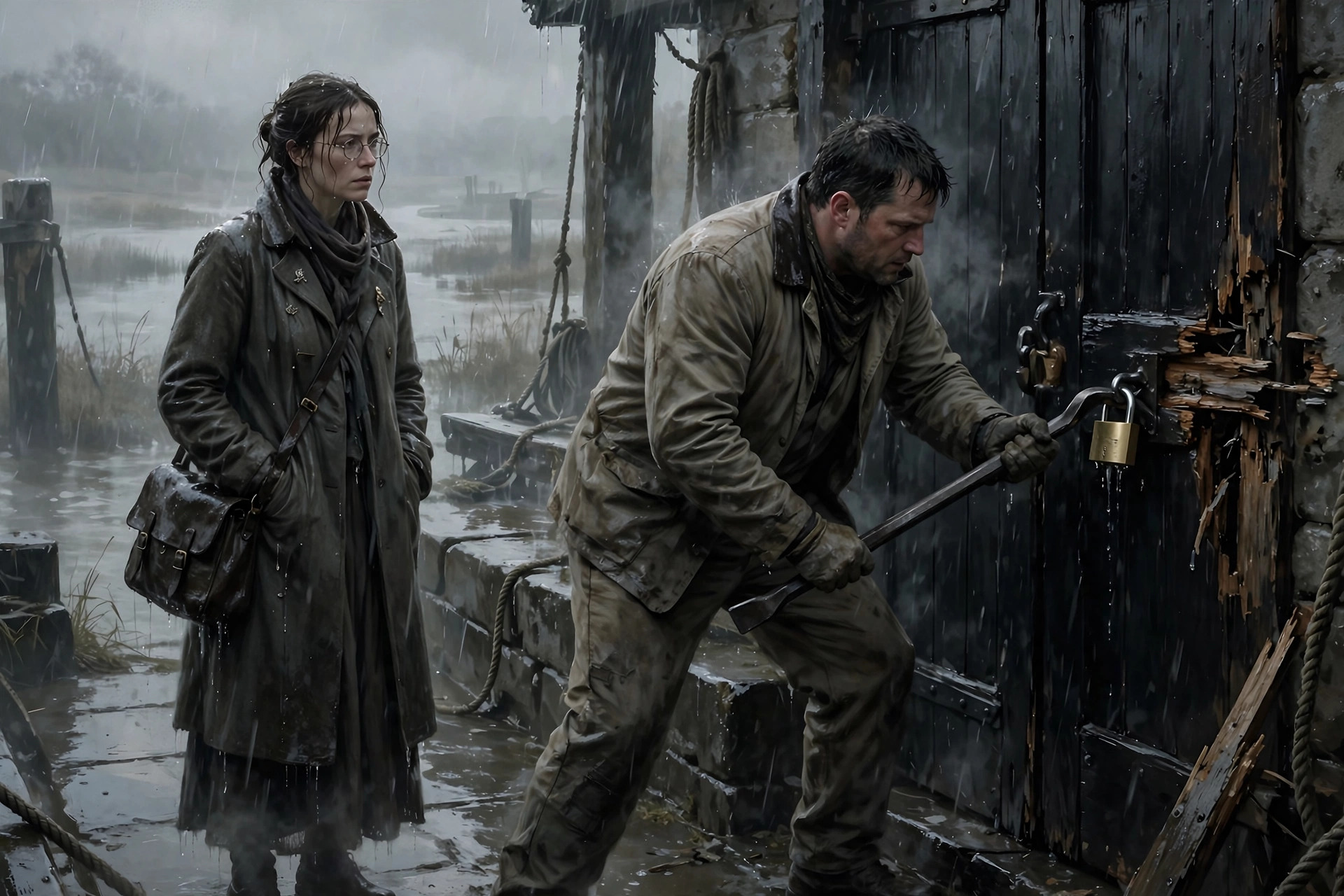
Ninian came out with the tin deed case slung across his shoulder, the leather sling buckled short so the case rode high, the lid closed, the pendant seal safe inside under its padding. He had wheeled the bicycle up from the rack and the lamp was already lit. Hester glanced at the tyres because she had grit on her mind: pale town grit in the tread, nothing red, nothing black.
"The sands are shut," she said.
"I know. I'll go round by Wem Bridge." He was looking at the road, not at her. "There's a thing in Wem I have to settle first. It won't take long, and then I'll come over the bridge and be at the Grange before the signing."
"Ninian."
"I'd rather bring you the leaves than the hole," he said, and got on.
Alf took the pen and wrote him out: name, the case, the hour. The clock above the desk had gone on past nine while they talked. Hester saw it and thought only that he would be late for his pie.
She stayed with the itinerary until her eyes stopped taking it in, and slept a little with her head on her arms, and woke when the windows went grey. The reading-room box held a blue placeholder slip with his name on it and nothing behind it. The case had not come back.
Fabian's tractor was at the gate again, and Fabian with it, unshaven, his hands raw from the water. "Grizel's been up all night," he said. "Nobody at the Grange has seen him. Not the kitchen, not the boatman, nobody. He'll have gone into Wem and stayed there, that's all. He's a man who forgets the time."
Hester came out and stood at the gate with the empty slip in her hand, and looked down the hill past the board with its chalked hour still on it, out along the causeway where the tide was going away over the sands, mile after mile of firm sand going bare and shining, and nobody on it at all.
The Pilgrim's Ladder
Rain had got at the chalk in the night, and Hester had to stand on the wet lip of the causeway with her head tilted to read the hour through the blur. Nine o'clock. Fabian's hand, the loop of the nine pulled wide the way he made it, the words above it worn down to a grey smear. He had not chalked the new day. Below her the channel ran full and pale, and the search was out on it: a boat working across the current with two men leaning on poles, and further in a woman in a coastguard jacket writing on a clipboard balanced against her knee.
She got her notebook out and copied the board down, the hour and the blur and the fact that the hour was yesterday's. The paper went soft under her wrist. Two miles of firm sand at low water, and a refuge post halfway out, and the island lying behind it like something set down and forgotten; she had walked it in every season since she came to Nettleford, and she had never once walked it looking for a person.
Alf came down the slope with the night book inside a bread bag to keep the rain off it.
"They asked me for the last entry," he said. "I thought better to bring the book than my mouth. I've told it twice already and it comes out different."
He held the bag open and she read the line where she had stood and watched him write it. Ninian's name, the tin case, the hour. After nine o'clock.
"That's your writing."
"That's my writing. He handed me the pen back and I put it in the pot." Alf rubbed his thumb along the book's edge. "He was cheerful. That's the part I keep leaving out because it sounds like nothing."
She copied the entry onto the same page as the chalk, one under the other, and looked at the two of them, and the wind took her hair across her eyes and she pushed it back and did not put them together. A man in a hurry. A man who had forgotten the time. She wrote the words after nine and underlined them, and the underline was as far as she went.
Beside the board, under a stone, a notice had been pinned to the post. Mattie Rundle read it out loud in the voice she used for harbour business, slow, giving every word its full weight, that the estuary search would stand down when the spring tide scoured the channel.
"Scoured," Mattie said. "That's a nice word for it. Water goes over the bottom fast enough and there's nothing left to find, and then everybody goes home and has their tea." She folded the notice back under the stone. Her tractor stood at the head with the trailer hitched, ramps up, the whole rig grey with salt. "I'd have had him off that sand by now, if it was mine to do."
"It's not yours to do," Fabian said.
"No. I handed it over." Mattie looked at the water. "I signed his readings for years. Every sheet he brought me. Never once walked out behind him to see whether the sand said the same thing." She spat into the wrack. "You get comfortable. Twelve years of a man doing it right and you stop putting your boots on."
Fabian had not shaved and his hands were raw across the knuckles. He set an ironmonger's bag down on the concrete and Hester heard the weight in it, metal on stone.
"Hasp for the loft door," he said, when she looked. "Before the signing. Grizel wants the boathouse locked up proper with people coming over." He drew his keys out to show her, and among the worn brass there was one bright as a new coin.
"Fabian. Tell me what you saw."
He told it standing square to her, the way a man gives evidence to a harbourmaster. He had been at the head late. He had seen a lamp go out along the sands, well after nine o'clock, moving away toward the Ladder. He had watched it a while and then it was gone.
"And you said nothing."
"I took it he'd turned back." He picked the bag up again. "You see a light where a light shouldn't be, you think, that's a fool going to get wet and think better of it. Alf of them do. You don't ring the coastguard every time a man changes his mind."
It fitted. That was the trouble with it, and the mercy of it. Hester wrote it down word for word, the lamp, the hour, the turning back, and felt her shoulders come down from around her ears. A fool going to get wet. Ninian late for his pie, Ninian who forgot the time, Ninian who had ridden eleven miles over Wem Bridge behind the tar sprayer because there was a thing in Wem he had to settle first, and then had come back and tried the sand in the dark like a boy. She could bear that. She wrote it in a clean hand.
Perpetua came down the slope in her work coat with the sleeves still turned back from the bench.
"He meant to cross at first light," she said. "He told me so. He was always exact about the water, whatever else he was vague about. He would have waited for the morning and come over dry."
"Perpetua. How did you part?"
"Ordinarily." She turned her cuff down, then the other, smoothing each one flat. "There's a seal in that case with padding I made myself, and if it's been in salt water the parchment will cockle before anybody thinks to look at it. That's what I have to say about it." She looked out at the boat. "He was twenty-seven and he thought everything could be put right by Tuesday."
Hester let it stand. She had a certificate to write and a betrothal to bless and a woman in front of her holding herself together with talk of padding, and she let it stand.
"Can you take me out to the post?" she asked Fabian.
"Walk. Water's away." He glanced at the tractor. "Not with the search on the channel. Nobody drives on the search."
They went down the ramp and out. The sand took her heels and gave them back with a kiss of sound, and the light lay on it in long sheets, and the ramp's concrete apron behind them was scored with fresh scrapes, two bright arcs where steel had come down hard and dragged. She noted them because she noted everything, and thought of Mattie's ramps, and of every trailer that had ever come down that slope.
The Pilgrim's Ladder stood up out of the flat with its ladder rungs black with weed at the foot. Something dark leaned against the lowest rung.
The bicycle was locked to the post through the frame, the old brazed lugs green at the joints, the lamp cold. The frame lock was shut and there was no key in it. Hester crouched and turned the pedal back and put her thumb into the tread. Red chippings came away in the grooves, and one fleck of tar, black and still tacky at the heart of it, the same grit she had carried home on her own boots from behind the sprayer on the bridge road. She turned the mudguard over with her finger. Dry inside. Dry along the whole curve of it, dry where the spray of two miles of wet sand would have written a line.
"He'll have locked it and come on with a boat," Fabian said. He said it too quickly, and then said it again slower, to make it sound like thinking. "Lads do that. Leave the bike at the Ladder and get a lift the rest of the way."
"With the case?"
"With whatever he had."
She got the camera out of her coat, the old film thing she used for watermarks and sewing structures, and wound on and photographed the tread twice, once close and once with the post in the frame for scale, and then the shut lock and the empty keyhole. Her fingers left red dust on the barrel. She wrote in the notebook: grit red, tar fresh, guards dry, lock shut, no key, ramp scrapes at head, and under it she wrote Fabian's lamp again, because his version was the one that let Ninian be alive somewhere being embarrassed.
Back at the head Perpetua took one look at the photographs she had not yet made and went up the slope to the Cardew Archive without a word. She left the conservation darkroom unlocked, which was the only thing she said all morning, and she said it with her back turned.
Hester developed the strip in the sink and printed it small, all the frames together on one sheet, and laid it wet on the blotter under the bench lamp. Then she took archive paper and wrote to Barnabas Peel in her own hand, no typewriter, because he weighed handwriting the way he weighed seals. Ninian had gone out over the Chantry Sands after the hour chalked on the board. The pilot had seen his lamp go out along the sand and had taken it he turned back. The bicycle was at the refuge post. Grizel Merrow at Sillow Grange said he never wrote and never came, and her account could not be leaned on. She signed it and read it through and did not soften a line.
Red grit had come off her fingers onto the wet emulsion, a scatter of it across the frame of the tread, drying there as the sheet dried. She looked at it for a while. Then she folded the letter, and left the grit where it was.
Cut Threads
The road men waved her past the sprayer, and she drove the eleven miles with her window down because the tar made her drowsy. Loose red chippings rattled under the tyres the whole way to Wem Bridge, and beyond the bridge the lane went quiet and green between hedges still holding the morning's rain. She came up to Sillow Grange with grit worked into the seams of her boots.
Grizel Merrow was at the door with the schedule of contents in her hand, as though she had been standing there since the search opened.
"You'll want the muniment room."
"I want the book itself."
"The book doesn't leave the Grange."
"Then I'll sit where the book sits."
Grizel led her down a passage where the plaster had been stripped and left stripped. Above them a tarpaulin bellied against the rafters, and through the stair window Hester could see slates on the near slope in a grey that did not match the rest, bright at the edges, laid straight by somebody who had been paid properly.
The muniment room smelled of cold stone and old calf. The cartulary lay on the table under linen, oak boards, leather gone the colour of strong tea, the raised cords standing along the spine. Hester set her weights on Grizel's schedule, lifted the board, and began at the first gathering with the flat of her hand rather than a finger, the way she had taught a roomful of students to begin.
She found it before the light had shifted on the table.
Where leaves had been taken, the sewing thread had been cut close against the cord, and the cut ends were pale. Thread that parts with age parts brown and frayed and pulls its neighbours out of true. These ends were square. Somebody had gone in with a blade and taken the trouble to be neat about it. The stubs stood along the gutter in a run, narrow tongues of parchment, and the old numbering in the corners went along in faded ink, and then leapt, and then went along again in the same hand, untroubled, as if nothing had been asked of it.
Hester laid a strip of blotter across the gap and did not write anything yet.
"It's been so since my mother's time," Grizel said.
"Cut thread doesn't grow old backwards." She kept her voice mild, the voice she used on donors. "Who has had the book open?"
"Nobody has had it open."
"Somebody has had it open."
Grizel put both hands on the schedule and smoothed it flat, though it was flat. Out in the passage a bucket took a drip from the tarpaulin, and then another.
"Your roof is new," Hester said.
"The roof was seen to."
"Seen to by whom?"
"It was seen to." Grizel's chin came up. "There's a family in this house that has kept the island's roads written down since before your archive had a door. We've not been rich in my lifetime. Last season there was money and the slates went on and I asked no questions, because when I ask questions the money stops."
"Whose money?"
"Family money." She said it the way a door is closed. "You'll not put my brother's name in a letter to the university. He keeps the pilotage. He's the only one of us who earns."
Hester turned a leaf that was there and read the pilotage rights in a hand three centuries dead, and let the silence sit long enough to be uncomfortable.
"Ninian," she said. "Did he write to you?"
"He never wrote and he never came."
"Not a line? Not a card?"
"Not a line." Grizel's knee pushed shut the shallow drawer under the table, which had been standing open the width of a hand, and Hester heard the wood stick and then give. "He was to be married here. He knew the day. If he had a word to say to me he had a mouth to say it with."
Fabian came in with a tray and the good lamp, the paraffin one with the polished reflector, and set it where it would not throw Hester's shadow across the page.
"You'll be perished in here," he said. "There's no heat on this side since the flue went. Tea's stewed, I'm afraid. Grizel, put the cloth under her elbow, the board's damp."
He was easy with them both, and he found Hester a cushion without being asked, and he stood where he was not in the light.
"You came the long way," he said. "You did right. The Chantry Sands were under water before your man ever left the gate. Board said nine o'clock and I chalked it myself before my supper."
"He was keen on the marriage," Hester said.
"Keen as anything. He asked me twice over what was in her book, and I said ask her, and he said he'd rather know before he asked." Fabian laughed a little, comfortably. "Lads. They'd rather walk to Wem than say a hard thing in a warm room."
"He may have walked to Wem."
"Then he walked to Wem." He poured for her, and set the pot down straight. "When you're ready to certify the two halves complete, I'll have the table set here and the schedule copied out fair, and Perpetua can bring her half over in my boat. Nothing wanted then but your hand at the bottom. I'd like it done while the search is still on, if that's not thoughtless of me. It'd be a good thing in the middle of a bad week."
Hester thanked him and wrote nothing, and asked to see the boathouse, because a man who came by water came to a boathouse, and because the tin case had not been accounted for by anybody she had spoken to.
Mattie Rundle was on the bench by the water door splicing a warp, with her spectacles pushed up and the strands working under her thumbs. Out at the head of the jetty her tractor stood with the trailer hitched and a tarpaulin lashed over it.
"You'll be the writing woman," Mattie said.
"I'm the one who taught him to read the hands."
"Aye. He came to me once for the tide tables and wrote them out wrong." Mattie spat a strand end into the water. "Grange launch was lit that night."
Hester stopped with her hand on the bench.
"Lit where?"
"On the water." Mattie's thumbs went on working. Then they stopped. "I'd my own hull wet that night and my own lamp burning, and I'll not have you telling Peel what I saw from a beach in the dark. Put nowt down. I saw nowt I'd swear to."
"Mattie--"
"Nowt I'd swear to."
Fabian, behind her, said pleasantly that half the estuary had lamps on it that night, what with the search, and that Mattie had been out late and was tired, and would she like her flask filled. He filled it. Hester watched him do it and thought that he was a kind brother and a better pilot than anyone gave him credit for.
The facsimile box stood open on the shelf under the window, the cheap kind sold to visitors, its lid warped. Packing paper had been stuffed round it and pulled half out again, grease-spotted, letterpress on poor stock. She drew a sheet free to see what the box had come in, and the print resolved under the lamp: Solomon Teague, bookseller and valuer, Wem, and a lot described as manuscript leaves on parchment from an island cartulary of pilgrim roads and pilotage rights, the property of a private family. Somebody had gone round the lot number in pencil, twice, pressing.
Her hands went cold in a way the room did not account for.
"That's rubbish," Fabian said. "Box came back from Wem with that stuffed in it. Take it if it's any use to you, it's only fit for the stove."
"It's useful," Hester said. "Thank you."
Above the water door, up the outside stair, was the old pilot's watch loft. She had been in it years ago with Mattie, when there was a jug on the shelf and a folded blanket, and a stove that smoked. The door was shut. The hasp was new, the screw heads unmarked, the pale wood around them raw where the old fittings had come off, and the padlock hanging from it still had the shop's shine on the shackle. The bright key sat on Fabian's ring with his house key and his bottle opener.
"Locked up," he said. "Lads come over from Wem after anything that isn't nailed down. I've had the loft open all my life and lost half of what was in it."
Inside the boathouse the shelf ran along the wall with coils of warp on it and a tin of grease and a coil of chalk line. There was a ring of clean wood in the dust where a jug had stood, and beside it a rectangle where something folded had lain long enough to keep the dust off, and both of them were empty.
Hester looked at the empty places and then at the coils, and made nothing of them, because she had a better thing to hold.
It fitted. Ninian had sat in her reading room with the schedule and the Adair half and had found the holes in the Merrow book, and had gone the long road to Wem to get proof rather than say a hard thing in a warm room, and had come back with proof and no stomach for it. Then a bicycle left at the refuge post and a lamp going out along the sand, and a young man taking the safe road away from a marriage he could not honour and a mother he could not face. Men did that. She had watched them do it for years, and it was so much easier to bear than the alternative.
She wrote in the notebook: gaps found, proof sought, marriage refused. She underlined nothing.
Grizel came out to the yard to see her go and said, "You'll tell them he ran."
"I'll tell them what I have."
"Then tell it kindly."
At the gate Fabian shook her hand and said he would keep the table clear for the signing, and that she was not to worry about the crossing, he would see her over whenever she needed it.
She folded the catalogue leaf twice and put it in her coat pocket, and felt the grease of it through the lining. Above her the loft door stayed shut, the new hasp taking what light was left, and she went down the path to the jetty.
Teague's Day Book
Hester turned the notebook so the page faced Peel and pushed it across the blotter, her finger under the hour she had copied off the board.
"Nine o'clock," she said. "That was the chalk at the causeway head. Under it I've put Alf's entry, and Ninian signed out after that hour with the charter case on his shoulder. The sands were shut when he left. He went over Wem Bridge, eleven miles, behind the tar sprayer, because there was nowhere else for him to go."
Peel read it with his glasses down his nose. "You've written 'marriage refused'."
"He sat in my reading room with her schedule and found the holes in the Merrow book. He told Alf he would bring leaves rather than a hole. He went to Wem for proof, and then he had proof in his hands and no stomach to lay it in front of the woman he was to marry. Fabian watched his lamp go out along the sand and assumed he'd turned back. Men do turn back. They turn back and keep going."
"And Grizel Merrow?"
"Says he never wrote and never came. The book she keeps has cut sewing thread and stubs where leaves were lifted out and old numbers that jump. Somebody has been paying for a roof with parchment, and she will not say who."
Grizel stood at the window with the schedule under her arm, still in the coat she had come over in. "Say it with my name on it."
"I've said it."
"You've said it to a desk."
Peel took off his glasses. He was a careful man and he had been careful for years, and Hester watched him be careful now, weighing her handwriting against a woman's word, and she felt the pleasure of being believed and did not examine it.
"There's a letter or there isn't," he said.
"There's a letter," Grizel said, "or there's a woman who wants a marriage off. Ask her which."
The drawer under Peel's elbow came out and he lifted the buff card from the front of it and laid it flat on the blotter, and Hester knew the card. She had countersigned it herself, seasons ago, when the island woman first wanted the Adair half in front of her.
"Your ticket's withdrawn," Peel said. "No collation. Nothing from the Adair side until this is settled."
"Nobody else alive can read those island hands."
"I can," Hester said.
Grizel looked at her for a while. Then she set the schedule down on the chair, very squarely, as if it mattered that it should sit straight.
Perpetua came in from the conservation room with a roll of tissue under her arm and stopped where she could see the card on the desk. She had heard it all through the open transom; the whole floor had.
"The betrothal's void," she said. "I'll write it to the Grange tonight. The Adair half stays in this building. I've said from the beginning that the town's charter does not go behind a private door, and I'll not have it argued over my son's empty chair."
"You've got what you wanted," Grizel said.
"Not like this." Perpetua's voice went thin. "Not with him nowhere."
Out on the channel the search lights were still crawling, and Hester could see them from the stair window when she went down to ring Wem again. The bookseller had said he would come if she asked him properly, so she had asked him properly, and he came in at the close of the day with his hat in his hand and a cloth ledger under his arm, smelling of the road.
"You'll want the entry," Solomon Teague said. "I keep everything. It's the only virtue the trade leaves you." He opened the ledger on Peel's desk and turned it round for them, and there it was in a valuer's small upright hand: island manuscript leaves, parchment, bought of Fabian Merrow of Sillow Grange, cash, no invoice asked for. "For the roof, he told me. Slates come dear."
Hester took the catalogue leaf out of her coat pocket and unfolded it and laid the grease-spotted paper beside the entry. The lot circled in pencil was the lot in the book. The description ran word for word, and the printer's cheap stock had gone soft at the folds from the packing it had done.
"Now," she said. "Ninian Adair. He came to you over the bridge road with a tin deed case on a leather sling. He wanted the leaves in front of him and a note from you saying where they came from. What day was it?"
Teague did not touch the ledger. He looked at her with the mild patience of a man who has valued other people's hopes for a long working life.
"He wrote to me," he said. "I've got his letter in the back, and my copy of what I sent him. I named a morning and put the kettle on." He turned to the back of the book and smoothed a folded sheet with his thumb. "Nobody came. I thought the young man had thought better of it. They often do, when it's a thing that will cost them money to be right about."
"Nobody."
"No gentleman of that name, and no tin case, and no leaves offered. I'd have remembered a Nettleford case. I'd have wanted the seal."
The room went quiet in a way Hester could hear. Grizel had her pocketbook open before anyone spoke.
"Then here's mine," she said, and put a letter on the desk beside the bookseller's ledger, folded and refolded until the creases had gone furry. "He wrote to me. Before he ever set off. I've had it in my coat since the morning and I let you say it."
Hester read it standing. She knew the hand better than her own; she had taught it. The g was made the way she had shown him to make it, in a fifteenth-century secretary hand he had never quite stopped using for pleasure, and the words were plain enough for a girl to read at a kitchen table. He had collated the schedule against the Adair half. There were gaps. He would set it right before he would marry her, because he would not come to her with a hole in her book and call it a dowry.
"Why hide it?" Hester asked.
"Because a hole in the book means somebody sold the roof," Grizel said. "Because it's my brother. Because I thought if the signing went ahead the whole thing would come right and nobody need be shamed."
"You let me write that he ran from you."
"You never asked me twice." Grizel put her hands flat on the desk. "You wrote it in your own hand and gave it to him, and he believed your hand. My ticket's on that blotter. I keep the Merrow book and I'll lock it tonight and nobody collates anything now. And in the morning I'll go into the shop and they'll say the Merrow girl was left, and swore blind he never wrote, and they'll say it kindly to my face and differently behind the counter, and that's the name I've got to keep the book under."
Hester walked her to the gate because there was nothing else to do with her hands. In the lamplight by the post office a man with a fish box said something to the woman beside him, and the woman laughed and said "swore blind," and neither of them lowered their voices, because they had done no harm that they could see.
She came back before light. Perpetua was already at her bench with the lamp on and a leaf of parchment under weights, and she did not look up.
"You had a choice of stories," she said, "and you took the one that let my son be a coward. It's easier to hunt a man who ran. You taught him to read hands. You couldn't be troubled to read him."
"I'll unsay it."
"In your own hand, then. The same as you said it."
Peel arrived with the harbour's message in his coat pocket. The bicycle had been lifted off The Pilgrim's Ladder and laid in the harbour store, labelled as a found item, and the estuary search would stand down when the spring tide scoured the channel; the notice was going up beside the tide board.
"Put men on Sillow Isle," Hester said. "Not the water. The Grange."
"On what? The bicycle was on the sands. Fabian is the pilot; his account is the only account anybody has. I can't put searchers on private ground and neither can you, and yesterday you told me the man had run."
She opened the notebook and set the three things out on the page with the pencil between them: the chalk hour, Alf's entry after it, and the red chippings in a tyre tread, the same grit that was still in the welt of her own boot from driving behind the sprayer. Dry mudguards. A frame lock shut with no key. She could not make them lie down together, and she could not yet say which of the two accounts had been built to deceive her.
Grizel's ticket lay where Peel had put it, buff side up, her countersignature at the foot of it. Hester left it there and went out through the sleeping town to the causeway head, and put her torch on the board. The chalk still said nine o'clock, unwiped, in the pilot's hand, with the notice pinned beside it lifting and settling in the wind off the water. Across the channel the Grange showed a light low down and another higher up, where no light had any business to be. She looked at that for a while. Then she wrote the hour under Alf's entry, on the same line this time, and stood in the dark with the pencil still on the page.
The Certificate
Fabian Merrow wiped the board with the flat of his hand and the old hour went into his sleeve. Hester came down the slip while he was still chalking the new window, and it was shorter than the town looked for, a good deal shorter, and he offered nothing about it. The notice beside the board lifted and settled on its pin. Somebody had driven a fresh pin through the corner of it.
Mattie Rundle sat up on the tractor with the engine ticking and a flask between her knees.
"Spring water," Fabian said. "Out far, back quick. It isn't the sand that catches people. It's the hurry at the end."
"Where's the launch?"
"Under the Grange, where she lives."
Grizel came down the slip behind Hester in a coat too thin for the wind, with no bag and nothing in her hands. Whatever the town had said to her since yesterday, she had walked through it to be here. She stopped at the tractor's wheel and did not look at her brother.
Hester opened the notebook on the ledge under the board and turned it so the page faced him. Her own copying of the chalk hour. Alf Croser's entry beneath it, the time he had written when Ninian signed out of the Cardew Archive with the tin case on its sling.
"The board said nine o'clock," she said. "He left after nine o'clock. The water was already over the sand before he had his coat on. He knew it, too. He learned to read a tide table from the man who chalks that board."
"Then he went the long way. Eleven miles over Wem Bridge, open all night. Alf of Nettleford would have done the same."
"He did go the long way." She took the twist of paper from her pocket and shook it out on the ledge, and the red chippings lay there in the grey light like something spilled from a wound in the road. "The bridge road was under these all that week. I drove behind the sprayer and carried the same grit home in the welt of my boot. There's grit in his tyre and a fleck of tar that was still soft when I picked at it. His mudguards were dry, and the sand that night was wet."
"Grit gets about."
"Not into a frame lock that's shut with no key in it. And not up the apron at the causeway head. Those scrapes sit at the height of his pedals. A man wheeling a bicycle down a ramp doesn't cut concrete that way. A loaded trailer does, going down and coming back up."
Fabian set the chalk on the ledge and gave the grit his attention, unhurried, as though she had brought him a reading to check.
"Somebody rode that bicycle towards Wem," Hester said, "and brought it back on a trailer, and chained it to The Pilgrim's Ladder halfway across, and shut the lock and kept the key. And then stood on this slip and told the search he had watched a lamp go out along the sand after nine o'clock. There was no lamp. There was nothing out there to watch. There was water."
The wind came up the slip and moved Grizel's hair and nobody's hands. Out on the Chantry Sands the light lay flat and lovely, the way it did before it took everything back.
"You've a good eye for a page," Fabian said. "The Grange roof was stacked in the yard last spring. The pilotage keeps the Ladder standing and that board painted and the launch fuelled, and it does not buy slate. You'd have had the whole road in a glass case in Nettleford with your name on the label, and my sister would have had rain in her muniment room. Tell me which of those you'd have picked, Doctor, and I'll believe you."
"I'd have picked the truth and paid for it."
"Aye," he said. "You've a wage."
He let that sit, and then he asked, in the voice of a man arranging a crossing for a stranger, "What will you give me for the launch and the loft key?"
"Name it."
"You know what the signing waits on. A paper in your own hand. The halves make a whole road, nothing missing, nothing left to collate. Grizel's book and the Adair charter, complete." He nodded at the notebook. "You've read the stubs. You know what you'd be writing."
She did know. She had knelt on the muniment room floor with the lamp beside her and put her finger on the cut sewing thread, on the parchment stubs where leaves had been taken out with a blade, on the old folio numbers that jumped and went on as if nothing had happened. A certificate saying otherwise was not an error. It was a lie in the only hand in the country that anybody would trust on that book, and she would have to unsay it in that same hand, and Peel would read the unsaying, and there would be no collation and no post under him and no reason for anyone to send her a book again.
"I'm forty-one," she said. "I've given most of my working life to that hand. It's the only thing I have that anybody in this town needs."
"Then it's worth what I'm asking."
She took Teague's catalogue leaf out of her pocket, folded twice and worn through at the crease, and laid it on the ledge for a backing, because the deal was ridged and her pen would have gone through the paper. She wrote out the wording she had drafted for the signing before she ever collated the book: that the Merrow cartulary and the Adair charter together comprised the pilgrim route book of Sillow Isle, continuous and entire, lacking no leaf. She signed it. The grease from the packing paper came up through the back and stood in a faint halo under her name.
Fabian read it standing, with his lips moving on the long words, and folded it into the breast of his coat and pressed the fold flat with his thumb. Then he worked the bright key off his ring with his thumbnail, slowly, the ring being stiff, and held it out to her.
"Loft's above the boathouse. Mind the ladder, the lower rungs are soft."
"And the launch."
"The launch is under the Grange and she'll not come to this side without me, and I'll not put her across with the water doing this. Rundle's wheels will do it, if she's willing."
Hester turned to the tractor. "Mattie. Take us over. Now, at the tail."
"No." Mattie screwed the flask cap down. "I've not put wheels on that sand at the tail of a window since I gave up the board, and I'll not start with spring water."
"Then Grizel and I walk it, and we're on it when it comes back."
"You'd not get past the Ladder."
"Then somebody should have said so yesterday." Hester kept her voice down, which took more out of her than shouting would have. "You signed his readings for years. You told the harbour the pilot was sound. Say something now."
Mattie looked out at the flat light for a while, and her jaw worked.
"I saw the launch's lights," she said. "Off the Grange steps, going in, riding low, with a man's lamp on the thwart as well. I put my own lamp out and went up the slip and said nothing to anybody." She turned the flask in her hands. "I had a paying crossing out there past the hour. Men from the Nettleford side who wanted landing late and paid me for it, and my wheels were on the sand when that board said shut. I wasn't going to stand up in front of the harbour and be asked what I was doing out there myself." She wiped her mouth with the back of her wrist. "Get in, then. All of you. Sit where I can see you, and don't talk to me on the soft part."
Grizel climbed into the cab without being helped. Fabian stepped up onto the trailer and stood with a hand on the rail, easy, a man going to see a job finished properly. Hester got up beside him and put the notebook away and kept the key in her fist.
The sand took them beautifully at first, ribbed and hard and ringing under the tyres, the gulls lifting ahead in a long white sheet. They passed the tarred legs of The Pilgrim's Ladder with the chain hanging in a loop and nothing at all in the loop, and Hester made herself look at it as they went by.
Then the ribs went out of the sand.
The trailer sank and stopped as if it had been anchored. Mattie kept her foot down and the wheels threw wet sand and the water came up the ruts behind them, not creeping, running, thin and fast and spreading wider than the tracks. Hester was off the trailer before she had decided to be, and the cold went up her legs and took her breath, and Grizel was down beside her with her thin coat gone black to the shoulders.
"Shoulder to it," Mattie called. "Don't lift, push, and keep pushing when it starts."
Hester put her shoulder against the wet rail and pushed until her boots had nothing under them and the sand came over her ankles, and Grizel pushed with her palms flat and her face turned away from the water, and the trailer came up out of its own hole with a sound like a cork drawn. They ran alongside it, hauling, stumbling, and Mattie nursed the engine and would not let it die, and the flood went over the place where they had been standing.
The island's hard standing came up under the wheels, black stone and weed and old tar, and the tractor climbed onto it and stopped. Grizel sat down on the bottom step and shook. Fabian stepped off the trailer and looked at the water closing behind them from the far end, quiet, without hurry, and the fold of Hester's paper stood up white in the breast of his coat. She did not ask him for it. She stood above the flood with the loft key driving its teeth into her palm.
The Watch Loft
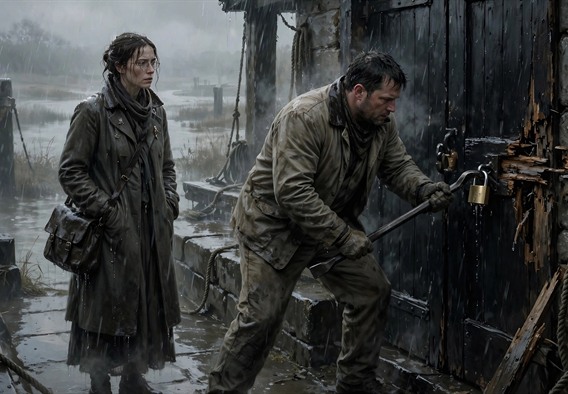
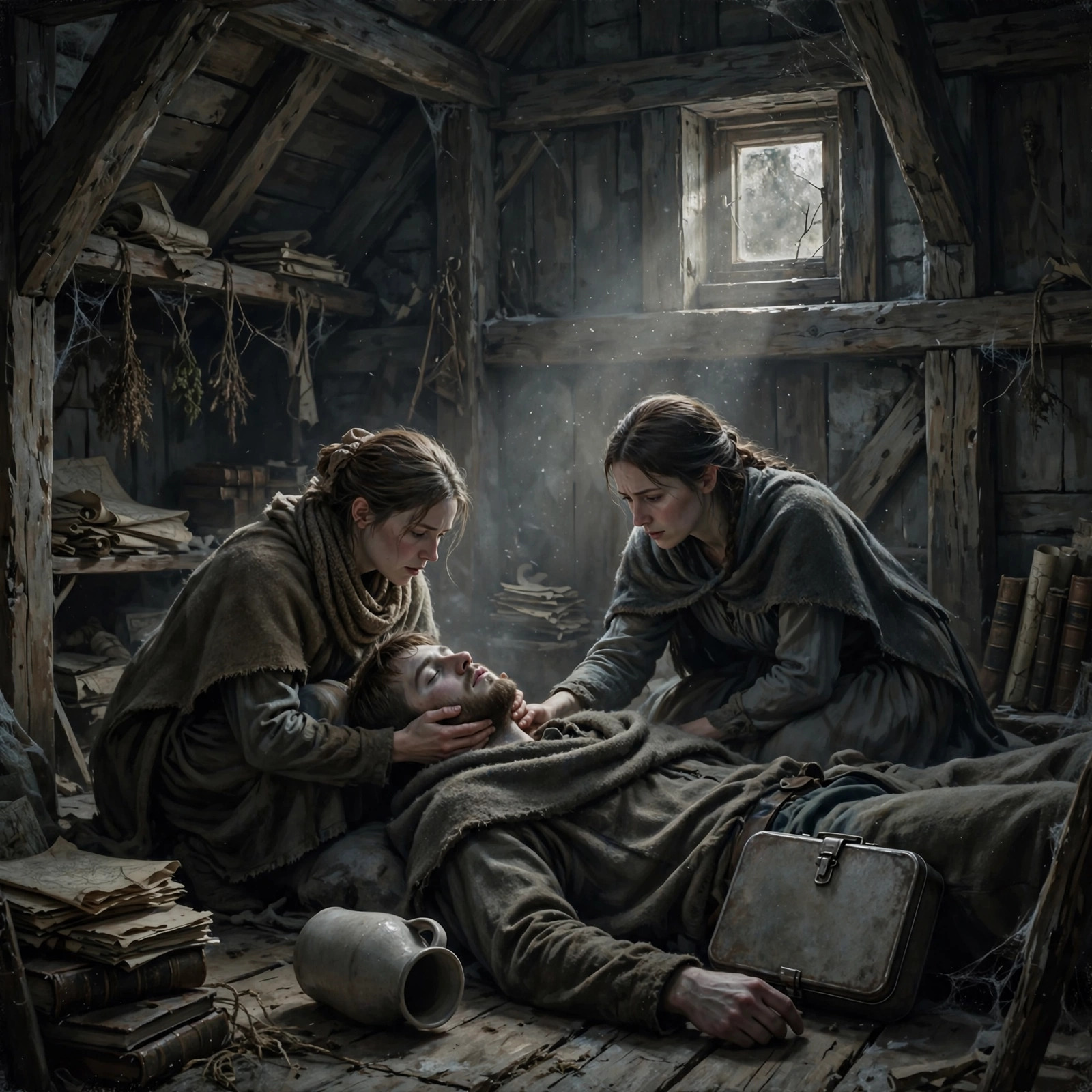
The key went in and would not turn. Hester worked it out and back, felt the wards bite, tried again, and the padlock hung there bright as a shop window against the black door. Fabian lifted the mooring bar off the boathouse wall and set its heel under the hasp. "Stand clear of the swing." She stood clear. He leaned on it, and the screws came out of the wet frame with a sound like a tooth drawn, and the hasp hung loose with the lock still shut on it, and the door gave inward onto the dark.
Ninian lay under the window with a blanket pulled over his shoulders and the tin case pushed against his hip, the way a man sleeps beside a thing he has decided not to lose. The jug stood by his hand. Hester got to him first and put her fingers to his throat and found the beat there, quick and shallow and alive, and the relief went through her so hard she had to sit back on her heels.
His eyes came open. "Grizel," he said, and it came out as a scrape of sound, nothing shaped. She was already down beside him with her wet coat steaming in the cold, holding his face in both hands, saying his name over and over like a woman counting money.
Hester tipped the last of the water into his mouth. He swallowed twice and got his elbow under him and looked at her with the awful clarity of a man who has had nothing to do for days but be certain of something.
"You collated it," he said.
"I did. The stubs are where you marked them. The sewing's cut, not broken. You were right about all of it."
"Then the signing--"
"There'll be no signing." She wiped his mouth with the corner of the blanket. "Drink that slowly. You've a long ride home."
Fabian had not come past the doorway. He stood with the bar still in his fist and the water light moving on the boards under him, and Hester stood up and made herself keep her voice level, because the thing she had to say was made of paper and chalk and she would not let it come out as shouting.
"You chalked nine o'clock on the board yourself. Alf's night book has Ninian leaving the archive after nine. The sand was already covered when he came out of the gate."
"He might have tried it," Fabian said. "Men do."
"His tyre had red chippings in it and fresh tar in the tread. The bridge road was being laid that week. There's nothing on the causeway but grey sand, and I carried that grit home on my own boots." She let that sit. "The corners of Mattie's ramp are scraped bright. Something narrow went up it and came down again."
Grizel had stopped saying his name.
"And you told them you watched his lamp go out along the sand," Hester said. "You never watched anything. You put his bicycle at the Ladder with the chain hanging empty, and you wrote the hour to make him a fool instead of a man you'd locked up."
Fabian set the bar down against the wall, carefully, the way he did everything. "The roof was coming in over the muniment room," he said. "I sold Teague the leaves for cash. Ninian had counted the stubs and written to my sister about it." He looked at the jug. "I asked him to come out and let me show him he was wrong. I promised myself a day of it. Only until the signing was done."
"You brought water up," Grizel said.
"Every day. And the blanket." He said it plainly, as an account he had kept and could produce. "I never meant him harm."
"You meant him quiet," Hester said, and picked up the tin case.
Mattie and Fabian carried him down between them, and Fabian took his weight properly all the way, and Hester came last with the case and the empty jug because she would not leave the jug where nobody could see it. On the jetty the wind took the blanket and Grizel held it down with her forearm.
Headlights came up the Grange drive, and a van stopped with its lamps still burning, and Peel got out, and Alf behind him with his coat over his arm, and Perpetua last, walking fast for a woman who never hurried in the reading room. They had come the long way, eleven miles over Wem Bridge, because the sand was shut and had been shut since the board said so.
"He's alive," Hester said. "Cold. He can talk. There's a doctor wanted and no time to be clever about it."
Perpetua had her coat off before she reached the jetty and put it round her son over the blanket, and did not say anything to him at all, which was the kindest thing Hester had ever seen her do.
Hester held out her hand to Fabian for the paper. He took it out of his breast and gave it to her, and she laid it on the van's bonnet in the headlight glare with the grease-spotted catalogue leaf under it for backing, and wrote across her own signature in her own hand: Withdrawn. The Merrow book is not complete. I knew it when I signed. Then she put her archive keys and her ticket into Peel's palm and closed his fingers on them.
"I can't carry a post for you on a withdrawn certificate," he said. "You know that."
"I know it."
"Fourteen years of collation."
"It was never mine to keep at that price." She turned so the others heard her, Alf with his lamp, Mattie with her hands on the rail. "I sent Barnabas the lamp account in my own handwriting and I said Grizel Merrow's word couldn't be trusted. I did it because that was the account that hurt least. It was mine and it was wrong. Her ticket comes back tonight, and her access, and I'll say so in writing to anyone who asks."
Peel looked at the keys in his hand a while. "Bring it to me in the morning," he said. "Both of you."
Grizel took the pen. Under Hester's line she wrote that the leaves bought by Solomon Teague would be bought back out of the pilotage money, every one, and that the gaps would be listed as gaps. Then she went up to the muniment room with the lamp and unlocked the cartulary and wrote the jumping folio numbers down the front leaf in a clear hand, without softening a single one, and Hester pinned the catalogue leaf beside the list and laid the withdrawn certificate inside the boards, and left the room without touching anything else.
At the water steps Fabian gave Mattie the stub of board chalk out of his waistcoat. "The board's yours. I've no reading to give anybody." To Peel he said, "Will you take me over the bridge road? I'd rather walk in than be fetched."
"I'll take you," Peel said, and that was all of it.
Ninian had got his feet under him on the jetty with Grizel's arm round his back. "There's no merger now," he said. "There's nothing to give you."
"I never wanted the door," Grizel said. "I wanted you at it."
Perpetua pulled her coat straight across his shoulders. "You're twenty-seven," she said. "You don't need my leave, and you'd not have got it if you'd asked."
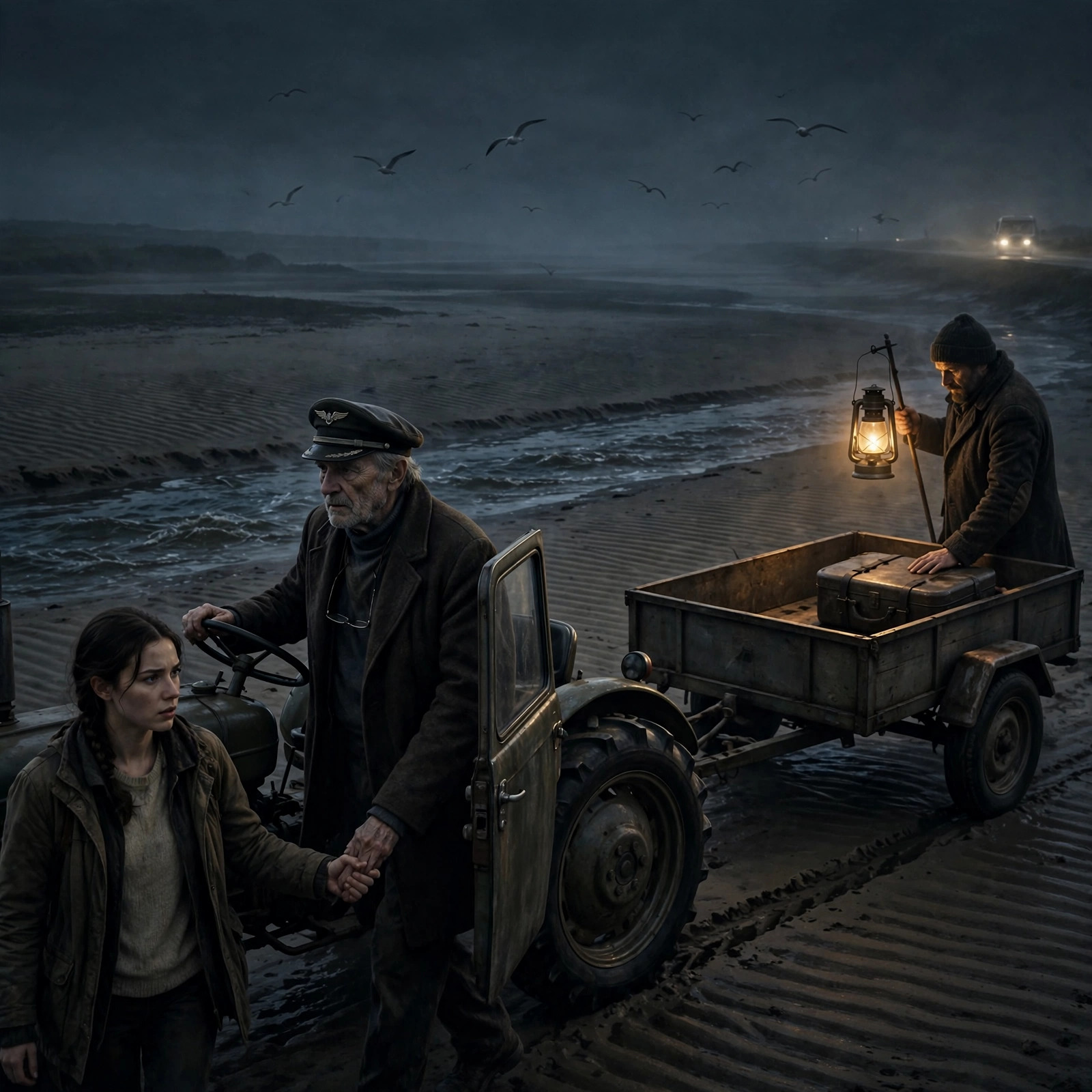
Alf had brought the bicycle up in the back of the van with the harbour's label still tied to the brake cable, and he cut the string with his thumbnail and wheeled it onto the flat and chocked it against the rail. Hester unbuckled the leather sling of the tin case, laid the case in Ninian's lap where he sat with his back to the cab, and buckled it again across him, twice pulled tight, so that the seal rode unbroken against his knees. Mattie let the engine crawl in bottom gear and walked at the wheel with the door swung wide. Grizel took the near side and Mattie's free hand the other, and Alf came behind holding the lamp low so the ruts showed.
The sand came up ribbed and ringing under the wheels, and the gulls went over in the dark, and the water ran thin and fast across the low gut and kept coming, and Hester walked the last of it with her hand flat on the tin case and the road closing behind them.
Get notified when new stories drop

Priya Castell
Priya writes inheritances, cold trails, and the people who keep looking, with every clue on the page before the answer.
Leave a comment
Comments