

The Kiosk Drawer
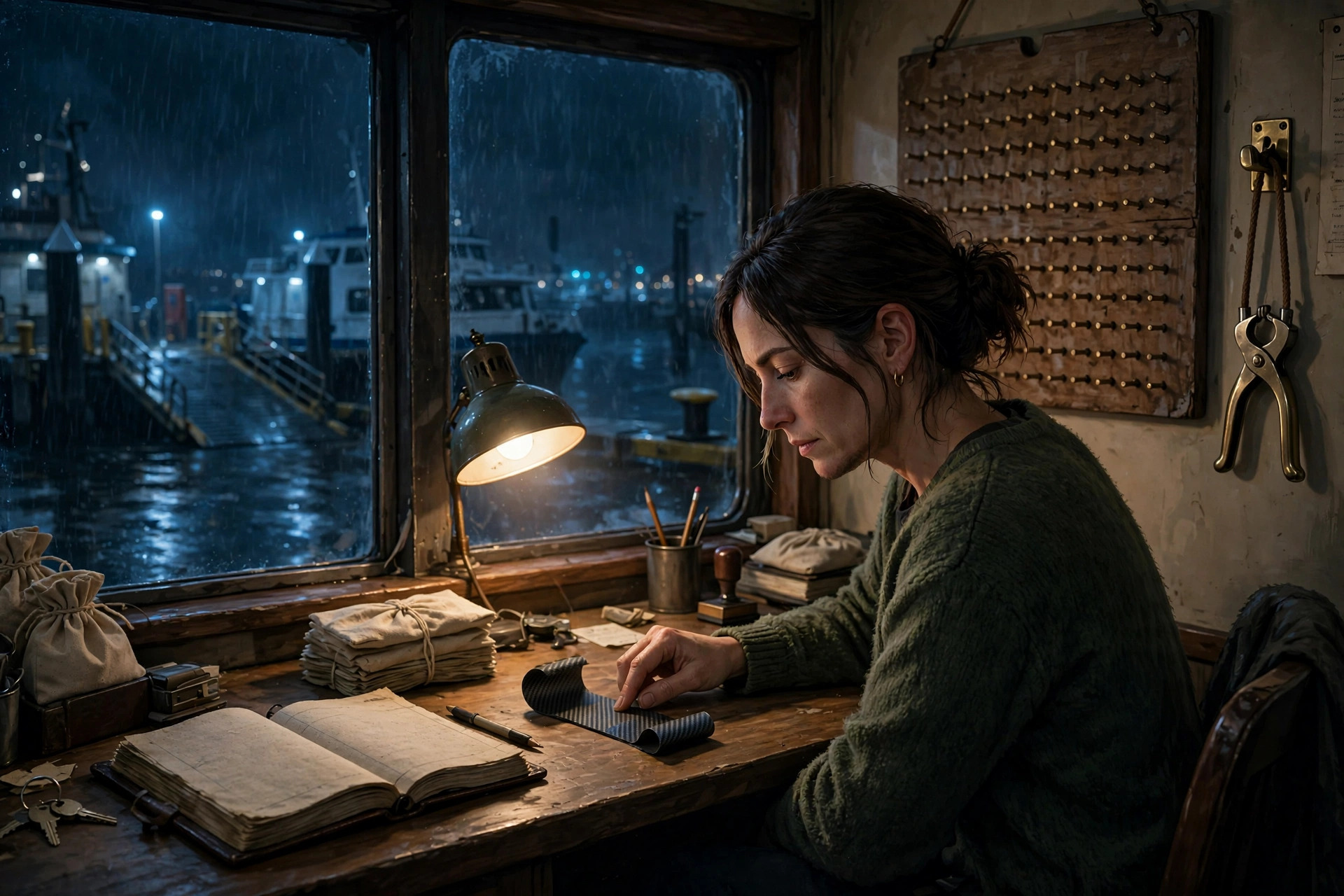
Ottoline Sarr pushed the last peg of the summer into the crossing board and stepped back from it, the way she did every night, though nobody else ever looked. Quarrow Ferry Terminal at the end of the timetable sounded like a kettle coming off the boil. The ramp came up. The kiosk shutter came half down. Gulls worked the slipway where the fish crates had stood all August.
Ada Quill was at the window with her pass already out, held between finger and thumb like a communion wafer.
"Summer's done, then."
"Timetable's done. The water stays."
"The water's a nuisance is what it is." Ada leaned in. "I'd have come over the road tonight and saved you the trouble of me. Only my kettle's on and I'd like to be there when it boils."
Ottoline pulled the kiosk drawer open. The punches lay on their cord at the front, brass gone soft-cornered from handling, the notch and the round hole hanging together like a pair of old teeth. Behind them sat the island concession book with its counterfoils still joined along the perforation, fat as a hymnal.
"You'd not get the kettle on," Ottoline said. "Ninety minutes either side of low water, and the low's been and gone while you were telling me about it."
"Then I'd best be on the boat." Ada laid the pass in the tray.
Ottoline set the triangular punch on the card's edge and squeezed. The little chip of paper fell into her palm and she flicked it in the bin, and the pass went back with a fresh white notch beside the old ones, a whole coastline of them along the border. Islanders crossed free. It was the oldest thing about the terminal, older than the board, older than her.
The man behind Ada was mainland, going through to Ostmere on the bus, and he put his money down and got the round hole through his ticket and a receipt he did not look at. Coin went into the tray. Ottoline reached for the island book to enter the notch.
"Leave it." Bettina Froy had come up behind her with the shutter key in her fist. "I'll do the book at the count. You've the board to finish."
"It's your book."
"It is, and I'll do it." Bettina's mouth went thin and then relented. "Go on. Ada, mind the step, they've took the mat up."
Ada went out into the dark saying something about mats and pensions, and the queue went with her, and the kiosk was suddenly a small room with a lot of paper in it.
Gilroy came off the ferry in his deck shoes with the cash bag under his arm, and the bag's zip was pulled and the seal wired through it, and he swung it once like a man carrying a rabbit by the ears.
"Last bag of the season," he said. "Say something ceremonial."
"Mind the step."
"That's Ada's line." He put the bag on the counter and took the docket out of the clip and wrote his initials on it, G.S., in the hand that had never improved since school. "There. Witnessed by the nation."
"You're bright tonight."
"I'm always bright at the end of the timetable." He was already looking at the door. "Don't sit up for me at the weekend."
She had the peg box in her hands and she stopped with it. "What's at the weekend?"
"Nothing that'll keep." He grinned at her, and it was a real grin, that was the thing she'd think about afterwards, it was not a man hiding anything, it was a man pleased with himself. "I might be over to Ma's later, if the water lets me. She's got a face on her about the cottage roof and I'd rather hear it off her than off you."
"Tell her I'll come Sunday."
"I'll tell her something." He took the bag. "Safe, then. Then home. Then possibly glory."
He went out along the boards and she watched him go past the pilot launch, sitting under her cover at the inner pontoon with her fuel topped for the season's end, larch planking that Halden Rooke had put on her himself and copper rivets you could read with your fingertips. Gilroy slapped the cover as he passed, the way he slapped everything.
Vernon Pate came up from the shore with his collar damp and his shirt too clean for the hour, and went into the kiosk, and Bettina pulled the shutter the rest of the way down behind them, which was how the count was always done, and Ottoline finished the board and squared the pegs and thought about her mother's roof.
She heard the coins going into their trays. She heard the notes being told off, that flat riffle that was the most familiar sound in her working life. Then she heard nothing at all for a while, and the nothing had a shape to it.
Bettina came out first. She had the counting sheet held against her chest.
"It's out," she said.
"How far out?"
"Three hundred and forty dollars."
Ottoline put the peg box down. "Count it again."
"I've counted it over and over." Bettina's voice went up and cracked and came down again. "I've had it in trays and I've had it in the machine and I've had it on the floor. It's out. It's been out all season, likely, and I've been carrying it forward like a fool, and now it's the end and there's nowhere to carry it to."
Vernon came out behind her with the cash-bag docket in his hand. He did not look angry. He looked like a man who had already thought about how the paperwork would read in Ostmere, which was, Ottoline supposed, his job.
"The bag went from the kiosk to the safe," he said. "Sealed. Signed for. That's clean, and I'll say it's clean. But the count's short and the bag's the only thing that moved tonight, and the company will want a name against it."
"It'll want a recount first."
"It'll have whatever it likes on Monday." He laid the docket on her desk, square to the edge, the initials sitting up at the top of it in her brother's bad hand. "Nobody's said taken. I've not said taken. I'm saying I can't sign a season off with a hole in it and no name by the hole."
Gilroy came back along the pontoon then, empty-handed, whistling something tuneless, and put the watch-handover slip on the desk beside the docket. His signature was on the lower line. Vernon took the pen off the spike stand and put his own underneath, still standing, still with his coat on.
"There," Vernon said. "Watch is mine. Go home, Gil."
"Going," her brother said, and to Ottoline, "Sunday," and was off up the ramp before she could ask him what about Sunday.
She spiked the slip without reading it, the carbon copy smudging purple against her thumb, and pushed it down under the crossing board where the filed slips lived, and turned to the window because the yard lorry was coming in for the winter hardstanding and the crew cars had to be shifted off the seaward side.
She went out to find his pickup and tell him to move it. The crew lot had the ferry van and the warden's Land Rover and the paint-stained estate car that belonged to whoever was on the early, and between the van and the wall there was an empty space with an old oil stain in it and a curl of dried mud where a tyre had been.
She stood in the space. She could see the tailgate as clearly as if it were parked there, the hand-painted stripe he'd done one wet spring, the tide card wedged in the sun visor where he kept it because he claimed the printed table in the office was always a day behind. He must have gone over already. He must have gone over the moment he was off the watch, to get the roof over with before her.
She rang him from the office. It rang and rang and went to nothing, and she rang again and got the same nothing, and stood with the receiver against her ear after it had stopped, listening to the quiet of a phone lying somewhere with no one near it.
The crew room smelled of wet rope and instant coffee. His locker was the one with the ferry transfer peeling off it. She opened it and the door swung wide and knocked the bench, and there was his oilskin on the hook, shoulders still hunched in the shape of him, and his good jacket, and the tin of the throat sweets he swore by.
The boot shelf was empty. Not pushed aside, not fallen behind. Empty, with the grit still lying where the soles had been.
He'd gone off in a temper about the money, she thought. He'd taken his boots and gone up the harbour road to sulk in some doorway until the count was sorted and somebody apologised to him, and his phone was flat because his phone was always flat, and in the morning he'd come back with a face like a boy sent to the office.
From the doorway she could see her desk with the lamp on it and the docket lying square to the edge, her brother's initials at the top in ink that had not had time to dry properly before Vernon laid it down. Behind her the boot shelf sat bare in the dark of the locker, and she found that her hand was still on the door, holding it open, as if there were something further in it she had not yet looked at.
A Foot Passenger
Ivo Trang came up the ramp with a plastic wallet under his arm and the volunteers strung out behind him, torches swinging against the wet concrete, and he had the grid sheet out before he reached the office door.
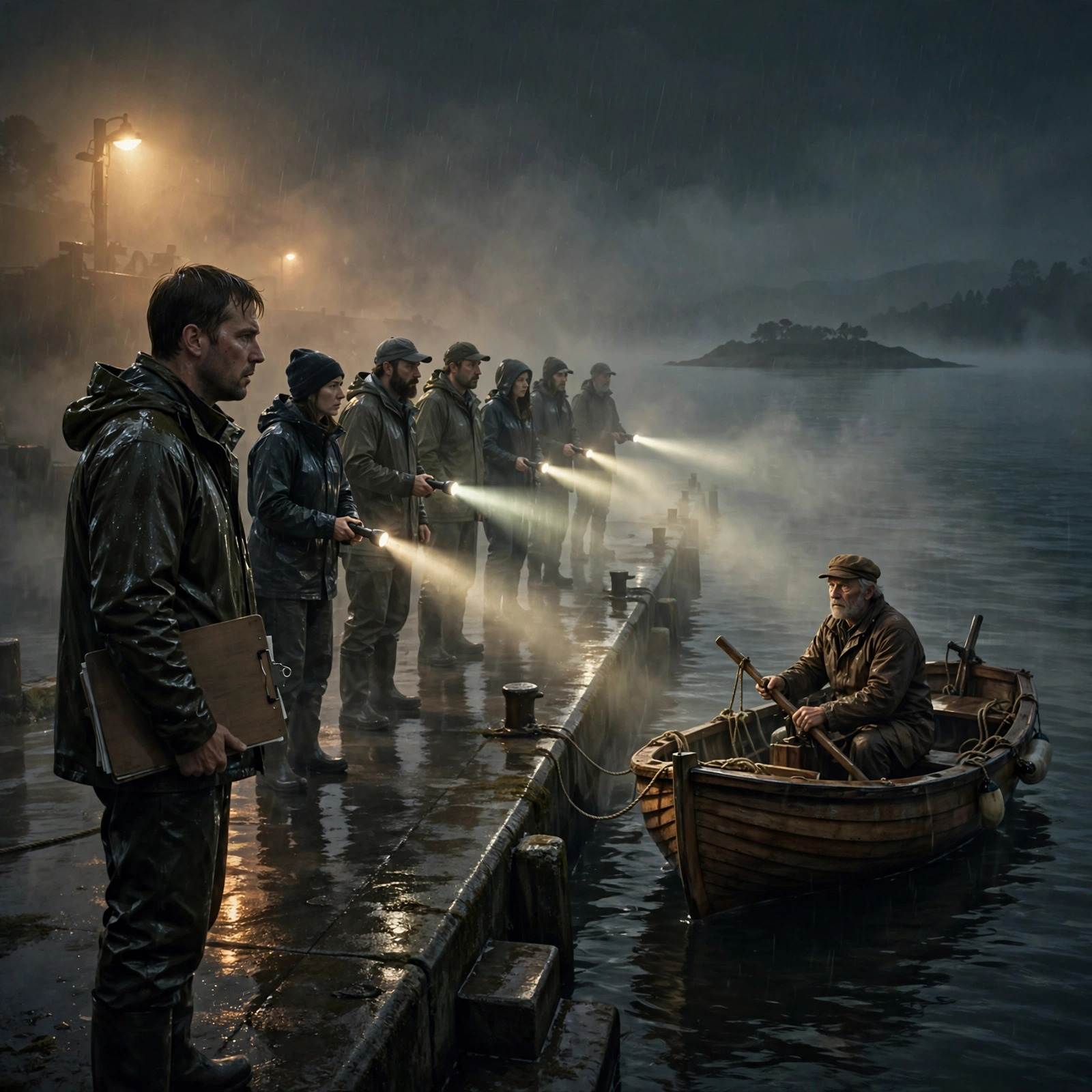
"Who saw him last." He spread the sheet on the counter and put a torch on it to keep the wind from taking it. Squares, harbour road, the shingle, the Ostmere front, all of it drawn out in biro and photocopied crooked. "Names and times. I'll take them in any order."
Bettina Froy had her coat on over her cardigan and her handbag hooked in the crook of her elbow, as though she had been about to go home and had thought better of it. "I sold him his fare."
Ottoline turned from the window.
"Foot passenger, last crossing." Bettina's chin came up. "He came in here with a face on him like the end of the world, and he put his money down, and he said Ostmere, and he went up the ramp with his hands in his pockets. Never looked back at me. I remember thinking, well, let him sulk."
"You sold him a fare."
"I've sold fares on this kiosk since before you sat at that desk, love."
The kiosk drawer came out on its runners with a sound like a spade going into gravel. Bettina hauled up the island book, the thick one with the soft cover and the elastic gone slack, and thumbed back through the counterfoils until she found the place, and tore. The perforation gave unevenly. She had to pull twice.
"There." She held it out. "That's his number. That's the crossing."
Ottoline took it. Printed card, the company's crest gone grey with carbon, OSTMERE across the top and a serial running down the side. The edge was cut where the punch had been, a small clean triangle out of the corner. Bettina's punch had always cut like that; she had watched it come down on Ada Quill's pass earlier in the evening and had thought nothing of it then either. The price box was on the other half, the half he would have carried in his pocket, and there was no reading it from this one.
Behind the book the drawer sat pushed to, not shut, the cord of brass punches hanging out over the edge and swinging a little in the draught, and a loose stub lying beside it on the felt.
"He went to Ostmere," Bettina said. "You can ring the harbour office there and ask who came off the ramp."
It went through Ottoline like warm water. A brother who had taken a fare and gone across to sulk in a town where nobody knew his surname was a brother she could be angry with in the morning. She held the card flat on her palm and did not look up.
"He didn't go on my boat."
Vernon Pate had come along from the office end with his cap in his hand, and he stood at the counter's edge with the docket still square where he had laid it hours before.
"I watched him go up the harbour road," he said. "Bag over his shoulder. Past the chandlery, past the shelter. He was set on the mainland bus and he wasn't stopping to talk to anybody, and I don't blame him with the count the way it is."
Bettina's handbag came off her elbow. "He was in my kiosk."
"He was on the road, Bettina."
"I tore the stub out of my book, Vernon. It's in her hand."
Ivo wrote, and the torch rolled, and he steadied it with his wrist. "That's a different road out of town," he said, in the voice of a man reading a delivery note. "I've got to put both down. Nobody's arguing anybody out of anything tonight."
"Put mine down first."
"Put them down as they came."
Halden Rooke arrived along the pontoon with his fuel can still in his hand, the red one with the spout taped, coming from the direction of the Longstrand Hotel with his jacket open and no hat. He set the can against the office wall and left it there, and stood with his palm still curved as if it were holding the handle.
"I saw his pickup," he said.
Ottoline came round the counter fast enough to knock the stool.
"Island end. Off the hard, in the silt where they always put themselves. Stripe on the tailgate, I know that stripe." He rubbed his mouth. "I was coming back over."
"When?" Ivo had the pen up.
"Evening. It was light going, dark coming."
"Before the water turned, or after?"
Halden looked at the can, and at the wall above it. "I couldn't swear to the hour."
"Was he in it?"
"No. It was empty. That's all I've got."
"You checked the causeway this evening?"
A pause with the wind in it. "I was over for fuel."
Ivo wrote Halden's name, and then wrote something short beside it, and turned the sheet so that the writing was towards himself. Ottoline saw the pen make the mark and saw him not read it back.
"Could anyone have hailed from the island side?" she asked. "The siren. If he was stuck out there, he'd have gone for the siren."
"Crank's on the nail inside my hut," Halden said. "Kept indoors so no passer-by can play with it." He picked the can up again, and put it down again, and left it. "Hut was shut."
She went into the office and rang her mother, and stood with the cord round her wrist because it would not reach further.
Constance answered on the fourth or fifth ring, wide awake, the way she had always answered a phone at night since the school days. "Is it him?"
"No. It's me. Has he been over?"
"He said he'd come when the water was out." A rustle, a chair. "He had news. He wouldn't say it down a phone, he said he'd tell me standing up in my kitchen. I said, tell me now, and he said no."
News. Ottoline turned the counterfoil over on the desk with her thumb. A row about the money, then, and a job in his eye, and a mother to break it to gently; he had never been able to say a hard thing in a hurry. She could have asked what sort of news. She heard herself say, "He's probably gone across to Ostmere to think," and heard her mother take it, and let it stand.
Through the doorway Ivo was folding his sheet. "The causeway's under," he said. "It'll be under till the morning ebb. Whatever's on that island stays on it, and whoever's on it stays there. I'm not putting people on a road I can't see."
"Then look at Ostmere," Vernon said. "Look at the bus shelter and the front. There's no sense waking the whole harbour." He glanced along the inner pontoon, where the pilot launch lay under her cover with the lashings pulled tight over Halden's own planking. "And nothing goes off that pontoon without my word. Not tonight, not for anybody."
Ottoline held out the counterfoil. Ivo took it, copied the serial into his book with the torch under his chin, and gave it back. "Keep it. I've got the number."
She put it in her coat pocket. Through the office window, on the spike under the crossing board, the carbon slip sat with the top corner curled, unread since she had filed it, and she looked past it to the ramp.
The volunteers went down in a clatter of boots. Two of them peeled off up the harbour road with a torch between them, and the rest went to the rib on the outer pontoon, and the engine caught and coughed and settled. Ottoline stood at the head of the slipway with her hand flat on the card through the pocket, feeling the cut edge of it, telling herself the shape of a man walking up a ramp with his hands full of nothing.
The rib swung out, the wake opening white and bending away towards Ostmere, and down the shore the water was already licking over the causeway posts, one after another, going along the line like a hand counting them.
The Watch Slip
The spike let go of the carbon with a dry tick, and Ottoline laid the slip flat under the lamp and put the heel of her hand on the curled corner until it stopped trying to roll. Down at the water the volunteers were making their noise, boots on the slipway, an engine being asked twice. Up here there was only the lamp and the crossing board and her own log open at the night page with the pen lying in the fold.
She had sat down to enter the rib going out. The entries above the gap were hers, in order, the bag docket and the kiosk count and the small ordinary things she wrote so that the company would know what its night had been. Then nothing. She turned her head up to the board out of habit, the way she had done ten thousand times without seeing it, and the last line of the summer timetable sat there in chalk with the departure beside it, the last crossing of the season, cast off and gone to Ostmere.
The box on the slip said the watch had been handed over twenty minutes after that.
She looked at the figures for a while. They were her brother's, square and pushed slightly uphill, the way he wrote when he was standing at the counter instead of sitting. Under them, the countersign, the long loop she knew from every timesheet she had ever put in front of him. Gilroy Sarr handing the watch to Vernon Pate, twenty minutes after the last boat had taken her foot passengers off the ramp and swung out.
Her own log said, in her own hand, at the end of the late shift: bag up to safe, G.S., master not returned. She had written it and thought nothing of it. Deckhands carried bags up when the master was doing something else. She had filed the slip on the spike unread because the reading of it belonged to the morning.
So he had not gone up the ramp with his hands full of nothing. He had been standing in this office with a pen, on this side of the water, when the boat that Bettina swore he was on had already gone.
Ottoline folded the carbon twice and put it in her coat pocket, where the counterfoil was, and felt the two edges of card and paper settle against each other through the cloth. Then she took her coat off the hook and went down.
Vernon was at the head of the inner pontoon with his collar up and his hands in his pockets, standing where the light from the office fell shortest. Ivo had his book open against the rail with a torch held in his teeth. Halden sat on the bollard with his forearms on his knees, sobering, his hair wet at the temples where he had been at the tap.
"Read that," Ottoline said, and held the slip out to Vernon.
"It's the small hours, Ottoline."
"Read the box, and then look up at my board through the window, and then tell me again about the harbour road."
Ivo took the torch out of his mouth. Vernon unfolded the carbon against his palm and read it, and she watched him get to the countersign, his own, and stop there the way men stop at a step that isn't where they left it.
"A signature isn't a clock," Ivo said. "Men sign at the end of a watch, not the minute they hand it over. I've done it myself on the grid sheets."
"The time's in my brother's hand, not his. And I wrote in my log that the master hadn't come back, because he hadn't, because I carried the office myself and Gil brought the bag up." She turned to Vernon. "You weren't on that boat and you weren't on this pontoon. I was here. Where were you?"
The engine down the shore settled into its long note. Vernon looked at the slip and then at Ivo's book, and she saw him weigh which of the two would still be there in the morning.
"The Longstrand," he said. "I was ashore at the Longstrand. Gil covered the end of the watch for me and I came back and signed it. That's all it is."
"Then you never saw him go up the harbour road."
"No." A pause, and he made himself finish it. "I didn't see him go up any road. I said it because it was the tidy thing to say and everybody wanted a road to walk down."
Ivo wrote. His pen went on longer than the words had, and Vernon watched it with his jaw set.
"That's my ticket you're writing on," Vernon said.
"It's my brother," Ottoline said.
Halden got up off the bollard. He wiped his mouth with the back of his wrist and stood a little apart, the way he had stood at the inquiry into the slipway years back, waiting to be told he was mistaken.
"I'll say it properly this time," he said. "The pickup was at the island end, off the hard, where the shingle gives out to silt. Nose towards the road. I painted that stripe on his tailgate myself, to cover a rust streak, and it was that truck and no other. He keeps a tide card wedged in the sun visor. I give him them. I could see the corner of it hanging out because his door was stood open."
"What time?" Ivo said.
"I can't swear the hour and I won't invent one. I came over at the evening ebb for fuel and I stayed in the Longstrand past closing, and I never went back along to do my check. That's the truth and it's a poor one." He looked at his hands. "The ground there takes a wheel if you stop on it. He'd have gone into it up over the hubs. Ninety minutes either side of low water is all that road gives you, and after that it's water and it's water till the morning."
"Then he'd have sounded the siren," Ivo said. "Wouldn't he. If he was stuck on the island side with the flood coming, he'd have gone up to your hut and wound it."
"He couldn't." Halden shook his head slowly. "The crank hangs on a nail inside the hut. It never leaves that nail, that's the whole point of it, so no lad off the boats can set it off for a laugh. The hut was shut and it was empty all night, because I was ashore. There was nothing on that island to make a noise with."
Nobody said anything for a moment. Out past the outer pontoon the water was black and flat and busy, and the causeway posts were gone under it.
Ottoline walked out to the inner berth where the pilot launch lay under her cover, Halden's own planking under Halden's own tarpaulin, and she pulled the lashing loose and lifted the cover off the bow. The larch came up pale in the torchlight, the copper rivets in a line along her strakes like something written.
"She'll take the flood fine," Halden said quietly. "I built her to take worse."
"Put it back," Vernon said.
"Give me the word, then. One word, and Ivo can have the keys out of the cupboard and Halden can be aboard her, and we can be at the island end while the search is still going the wrong way up the front at Ostmere."
"No." He came along the pontoon after her and stopped at the edge of the light. "No authority, no launch. That's not me being hard. If a boat goes off this pontoon tonight, there's a form in the morning, and the form has my night on it, and I've just told you where my night was."
"You've told us because you had to."
"Aye," he said, and there was something almost like relief in it, and then it closed. "And you think about your own morning. The flat above the office goes with the post. Your mother's help is paid out of the same envelope as your wages, and there's no other envelope. You take that boat and you can hand me the key yourself."
Ottoline went up the ramp with the cover still in her hand and the tarpaulin dragging, and she stopped at the kiosk because the light was on in it. Bettina had the drawer open and the cord of brass punches hanging out over the edge, and the island book squared up beside the till.
"Let me see the book," Ottoline said. "The fare you told us about. If it's in there in the ordinary way I'll write it in my log myself and Ivo can stop chasing a serial number."
Bettina's hand went flat on the book. "The count's short and my name's on the count, and that book isn't balanced, and I'll not have it opened at this hour by somebody who isn't me."
"Bettina."
"I'm near enough to my pension to know what happens to a clerk whose books get read out loud." She slid the drawer shut, turned the key, and hooked it back on her belt with the others, and the sound of it was small and final. "Go and look after your brother. Leave me my drawer."
Down on the pontoon Ivo was saying something about keeping the rib on the Ostmere front until she came back in, and Halden had sat down again on the bollard. Ottoline stood over the launch with the folded carbon in her fist, the crease of it pressing into her palm, and Vernon waited with his hands in his pockets and his chin down, not moving, not going to move.
She let the cover go. It fell back over the bow and settled along the planking, and she knelt and drew the lashing tight, and her hands did it properly, the way he would have wanted it done, while she looked out past the pontoon at the water where the road had been.
The Warden's Keys
Ottoline shouldered the office door open with the water still running off her cuffs, and Ivo Trang put a finger up for quiet, because the voice out of Ostmere was coming through thin and he was copying it down.
"Nothing on the front," the set said. "No foot passenger off the last boat. Nobody asking the way at the shelter. The bus driver waited on the rank and went off empty."
"The road above the harbour?"
"Walked end to end, ditches and all. There's a phone box at the top with the light gone and a timetable in it, and that's the whole of what's up there."
Ivo thanked the voice, let the set settle into its hiss, and drew a line under what he had written. He was grey about the mouth with tiredness. He had been on his feet since the middle of the night before, and he had a wife who kept ringing the terminal and getting the machine.
"They've been over that road twice," he said. "There's nothing on it. There was never anything on it."
"Then he didn't go up it."
"No." He turned to the grid pinned along the wall by the crossing board, the whole shore drawn out in pencilled squares, the harbour front at Ostmere hatched over in blue where his people had walked and shone torches into every gap between the sheds. Sedge Holm sat at the edge of the paper with its squares still clean. He looked at them for a while with the cap of the marker between his teeth.
Halden had come up from the water behind Ottoline and stood in the doorway with his hands hanging. He had not gone home. There was no going home.
"I could put you over in the morning," he said. "Before the water drops. I know where the silt lies."
"You could." Ivo took the cap out of his teeth. "Halden, listen to me, because I'm going to say this once and I'm going to say it straight. The only person putting your brother on the island side is you, and you were drinking in the Longstrand past closing, the evening check never got made, the tide table never got looked at, and you can't swear the hour you saw the truck."
"I can't swear the hour." Halden's voice went down into the floor. "I can swear the truck. Painted stripe across the tailgate, tide card shoved up in the visor, near side wheels down in the silt where the road runs out."
"I believe you saw a truck. I do." He said it gently, and it was worse gentle. "But the road's under water and it'll stay under till the ebb, and if the truck's where you say, it's under water too, and there's nothing there for my people to find in the dark. I've got a rib and a lot of tired volunteers. I can't spend them on a sighting I'd have to defend in front of the company with your night behind it."
"No," Halden said. "You can't."
Ivo drew the marker through the island squares, corner to corner, and then through them the other way, and wrote a word beside them that Ottoline could not read from where she stood. The nib squeaked. It was a small sound to put an island out of a search.
Halden came to her desk. He took the ring out of his trouser pocket, the gate key and the hut key and the little brass one for the tide-table box, and he laid them on the blotter. Then he got out of his jacket, the warden's jacket with the company's badge gone shiny at the breast, and he folded it and set it beside the keys, and he squared the fold with the edge of the desk like a man tidying up after himself.
"Don't," Ottoline said.
"It's not yours to take back."
"Halden. You built half of what floats here."
"And I never walked the causeway." He pushed the keys a little nearer her lamp. "There's a crank on a nail in my hut, and the hut was shut, and the nail doesn't care who's sorry. Write it down that I said so, and write it while I'm still saying it."
She pushed the ring back across the blotter. He put it back. They did that without heat, the way people do when the thing being moved is not really the thing being argued about, and then he stopped and left it where she had put it and went and stood at the window with his arms bare and folded, looking at the black where the road had been.
Ada Quill was in the waiting room with her shopping bag on the bench beside her and her coat over her knees. Somebody had given her a cup of tea from the urn and she had not drunk it. She was going nowhere until the ebb and she had made her peace with that in the way of a woman who had spent her working life waiting on other people's timetables.
"Any word of your brother?"
"Not yet."
"He carried my bag up the ramp last week when the strap went. Wouldn't let me do it myself." Ada turned the cup on its saucer. "You'll not blame Bettina Froy for all this. She's a good girl to us over there. She's never once taken my fare, not since I gave up the post office. She puts the notch in the card and waves me through, and she's done it every crossing since, and she'd not hear of it being written anywhere."
Ottoline sat down on the bench opposite because her legs had begun to notice themselves.
"Half the island goes over on those notches," Ada said. "There's no shame in it. It's only money, and there's none of it about."
It was a kindness. Ottoline heard it as one and set it down as one, the way you set down a thing you have no room to carry: Bettina with her hand on the drawer key, Bettina who had sat up with half the island through half its bad nights, notching people through because she could not bear to take their money. She was too tired to make anything else of it, and the count was somebody else's arithmetic, and her brother was somewhere in the dark.
The kiosk hatch was up. Bettina had come out of her office with the cord of brass punches in her apron pocket, and she took them out now and set them on the counter, and they lay there warm from her body, the two heads dull under the strip light.
"You'll not talk about my arrangements in a public waiting room."
"I was praising you," Ada said.
"Then praise me quieter." Bettina's hand hovered over the punches and did not pick them up. "I've kept that book since before your brother could swim, and I'll answer for it to the company in the daylight, and not to a room full of men with torches."
Ottoline got the counterfoil out of her coat pocket. It had gone soft at the fold with handling. She held it under the lamp for Ivo and he came and looked, and took his notebook out, and found the serial he had copied hours ago, and put his finger on the two of them together.
"It matches," he said. "That's a ticket. He bought a fare and he went across on the last boat, and Ostmere's a long front with a lot of dark in it, and that's where my people are."
"He was here after the boat." She had the carbon out too, folded twice, the two signatures showing through where the paper had gone thin. "Twenty minutes after she cast off he signed the watch over to Vernon. It's on the slip. It's in my log."
"I've read your log." Ivo straightened up and rubbed his eyes with the heel of his hand, and he was not unkind about it either, and that was the trouble with all of them tonight. "That's a company matter between you and Pate. It doesn't put your brother anywhere I can search."
Vernon had the report form on her desk when she came back to it, and his reading glasses on, and his night behind him that he had already told them about and could not tell twice.
"Season-end discrepancy," he said, and waited for her pen. "Three hundred and forty dollars. Cash bag conveyed from the kiosk to the office safe by deckhand G. Sarr, whose initials appear on the docket. The said sum is unaccounted for and the said deckhand is suspected of removing it and leaving the island."
"Take out leaving the island."
"It's what the docket says."
"The docket says he carried a bag. Write that he's not been found. Write that he's missing."
"Missing goes in the other form, and the other form goes to the harbour people, and Ivo has just told us where the harbour people are looking." He took his glasses off. He looked older without them and no softer. "I'll give you the extract to sign, because the extract is your log and your log is true. Sign the true part, Ottoline. Nobody's asking you to sign more than that."
She thought about the flat above the office, and the envelope her wages came in, and her mother's help paid out of the same envelope, and the woman who came in the mornings and would stop coming. She read the extract through. Every line of it was hers and every line of it was true, and it would go into the same wallet as the report with her brother's name in it, and it would be read as though it agreed.
She signed it. The pen went over the paper twice on the last letter because her hand was cold.
Vernon clipped the two sheets together and stood them against the lamp to dry. Halden's keys lay on the blotter beside them, and the folded jacket beside the keys, the badge catching the light. Ottoline put the pen down and left the ink shining under her name, and did not blot it, and watched it to see how long it would take.
The Pilot Launch
Ottoline smoothed the counterfoil flat on the kiosk counter with the side of her thumb. The fold had gone furry overnight where the card had been torn, and it kept trying to curl back along it. She lifted the notch punch off the cord, opened the jaws, and closed them on the cut edge. The brass mouth took the triangle exactly, corner to corner, no daylight along any side of it.
She tried the other tool. The round hole sat over the cut with nothing to bite, and when she turned the card end for end it was the same. She held it up against the glass, where the light was coming grey off the water. There was no hole in it anywhere. A paid fare went through the round punch and came out with a hole you could put a pencil through. This card had been cut free, and the money column had a fare written in it in Bettina's small upright hand.
She unfolded the watch slip and carried it out to the departure board and held it under the line for the last crossing. Cast off, and the slip signed over twenty minutes after it, both names on the carbon, Gilroy's above Vernon's. A man who signs a watch over at Quarrow is standing at Quarrow. He is not sitting on a boat halfway to Ostmere with a foot passenger's ticket in his pocket. She stood looking at the board until the letters stopped being letters, and then she read it again and it said the same thing.
Bettina came in with the urn and set it down and began wiping a counter that was already clean.
"When you notch Ada through," Ottoline said, "where does it go in the island book?"
"In the book." Bettina's cloth went round and round the same place. "Every pass I cut goes in the book, entered and initialled, same as it's been since I came to this window. You've kept my dockets long enough to know that."
"That's not what I asked you."
"It's what I answered." She wrung the cloth out over the bucket. Her hands were red to the wrist and shaking a little, and she put them out of sight under the apron. "You've had no sleep. Neither have I. Don't come to my window at this hour and make out I can't keep a column straight."
Ottoline laid the stub on the counter and set the two punches on top of it, one across the other, and left them there where anybody coming for a ticket would see them. Bettina looked at them and then looked at the urn and did not touch them.
Vernon was in the office doorway with his coat on. He had his reading glasses pushed up on his head, which meant he had been at the report again.
"Ivo's people are still walking Ostmere," he said. "The road's been swept twice. When the water drops you can walk the causeway dry and I'll go over myself with two of them."
"He's been out on the shingle all night."
"You don't know that."
"I know he never got on your boat, and I know his truck isn't in the lot, and I know Halden saw it at the island end." She went past him to the cupboard and hooked the launch keys off the nail. The tab knocked against the door and went on knocking. "And I know you were ashore when he signed your watch over, so there's nobody in this building can tell me where he went after."
"That boat doesn't move without my authority. I've told you once."
"Then tell me twice, so I've heard it properly."
He took the glasses off his head and folded them, and he was not angry, which was the hard part. "It's a company hull. If anything happens to it, or to you, there's a form with your name on it and mine under it. I've a ticket to think of. You've a flat to think of."
"I have." Her voice came out level and surprised her. "The flat over this office. The wage envelope. The woman who comes in the mornings for my mother, who is on that island, and who has been sitting up since yesterday waiting for him to bring her his news. That's what's in it for me. Write it in your form. Write that I was told and went anyway."
Vernon looked at the keys in her hand for a while. Then he stepped out of the doorway, and stood with his back to the board, and did not say anything else at all.
Halden was already at the inner berth with the cover off and the lashings coiled on the boards. He had no jacket on. He had left it folded on her desk before first light with his keys on top of it, and he had come down in his shirt like a man who had finished with the weather. He primed the engine and swung the handle and it took on the third pull, and he held her steady while Ottoline stepped down, and neither of them mentioned the warden's badge that wasn't on him.
"You built her," she said.
"I built her. Sit aft, out of the spray."
The water was flat and the colour of tin. Ottoline took the watch slip out of her pocket to look at it once more, and the wind got under it, and she put it down on the thwart and set the fuel cap on top of it. Salt marks were drying on the carbon in little rings. Halden kept the bow into the swell and talked about the drying ground at the island end without being asked, where the silt lay soft over the old clay, where a vehicle would go in up to its boards and stay, where a man on foot would find hard shingle if he kept left of the posts and would find nothing but mud if he didn't.
He put the bow on the shingle and held her there with the engine turning over. Ottoline went up over the stones with her coat dragging.
The pickup stood at the island end with the silt up over its running boards, the painted stripe on the tailgate dull with it, the driver's door open and the key still in the ignition. The tide card was wedged in the sun visor where he always kept it. She touched the door frame as she passed, the way you touch a thing to make it true, and the cold of the steel went straight through her hand.
Halden's hut door stood open, swinging a little. Inside there was the bench and the stove and the nail, and the siren crank hanging on the nail where it lived, where it had hung all night with nobody in the room to take it down.
The boat shed was further along, and its door was ajar, and the shingle in front of it was scraped into a long furrow with the stones turned over and the silt smeared across them, coming out, not going in. Ottoline got her fingers under the edge and pulled. The door came a hand's width and stopped against something soft, and she pushed it and went in on her knees.
He was out of the wind under a sail cover, propped against the trestle, one leg straight out and the ankle turned wrong under the trouser. His hands were black with silt to the knuckles. There was a track behind him through the dust that he had made with his elbows.
"Otty." It came out of him with hardly any voice on it. "Phone went in the water. I tried the shed. I couldn't get further than the shed."
"Don't talk."
"I came over to tell Mother. I've got a berth on a tug, after the weekend." His teeth were going. "I couldn't say it to you. You'd have made it all right, and I couldn't have gone then."
She got her coat off and round him, over the sail cover, and pulled the collar up under his ears. Halden was already at the rack behind them, taking down laths and a roll of webbing, laying them across the trestle and measuring with his eye, quiet about it, working. Ottoline put both hands on her brother's face and his cold fingers came up and closed on her wrist inside the boat shed.
The Morning Ebb
Halden brought the launch in on the last of the ebb and Ottoline went over the bow before the keel touched, into water that took her to the knee and rang in her bones. She hauled on the stem. The planking came up the stones grinding, and Halden killed the engine and stayed sitting with both hands on the tiller until he trusted himself to stand.
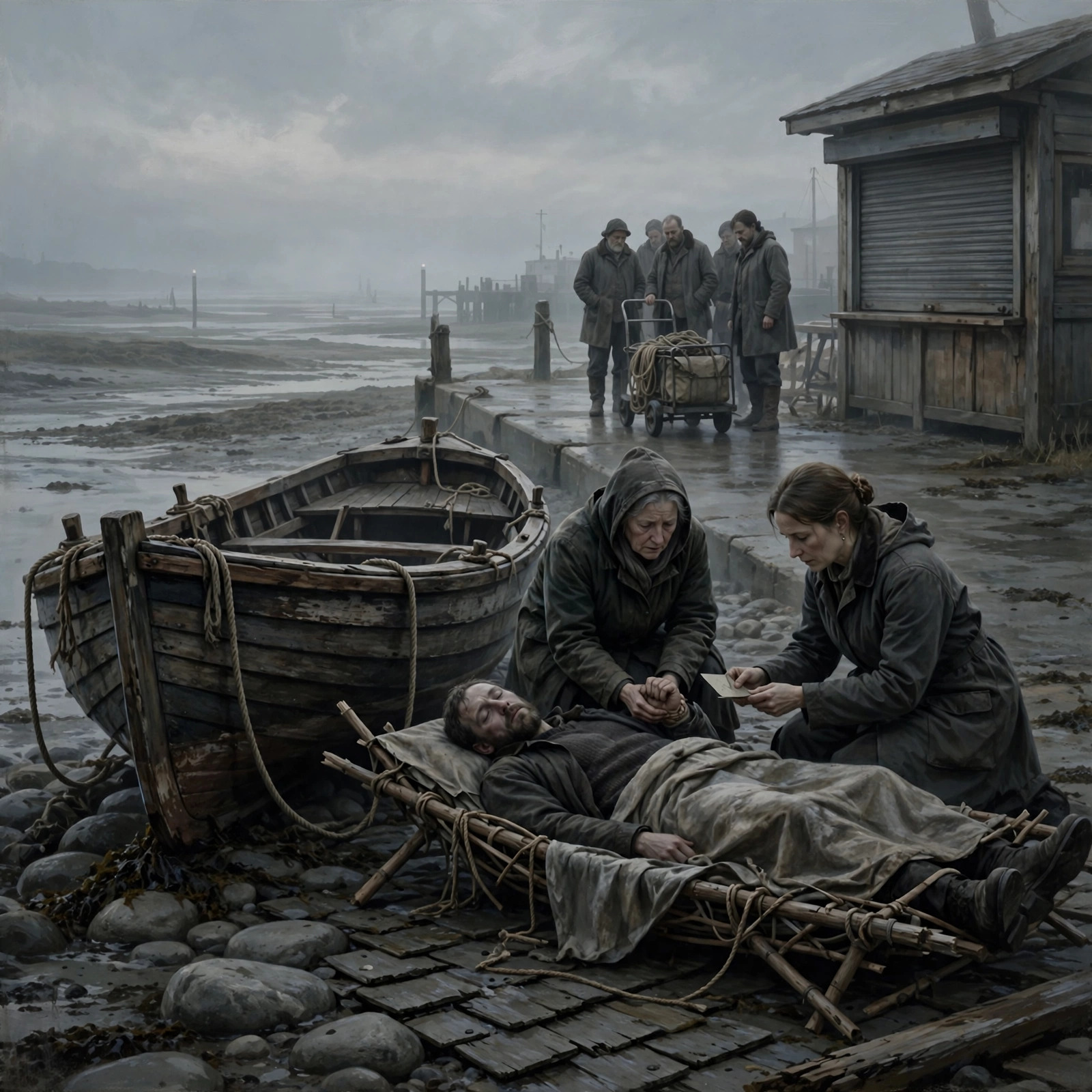
Gilroy lay along the floor where the cushions had been stripped out and piled under him, laths lashed either side of the ankle with webbing, the sail cover tucked to his chin. Constance sat beside him in Halden's spare oilskin with the cuffs turned back, holding his wrist as though she were counting something. She had not let go since the shingle.
"Not by the cover," Halden said. "Cradle first."
The morning deckhand and the fuel hand came down the wet concrete with the lath cradle between them and set it in the shallows alongside. Halden talked them through the lift, low and slow, and Ottoline took Gilroy's shoulders and turned her face away from him so he would not see it. He made no noise. That was worse than noise. They came up the slip with him level between them and the water running off the webbing in threads.
"Line's fast to his axle," Halden said to her, wiping his palms down his thighs. "Tractor winch. I made it off before we shoved. She'll come at the next ebb if somebody minds the slack."
"I'll mind it."
"You'll not be here to mind it." He said it flatly, and went to see to the stern line, and made her fast head and stern himself, the way he did everything, twice over and then a look at it.
Ivo Trang was at the head of the slip with his board under his arm and his sleeves wet to the elbow. He had been down to the water and back and down again. Ottoline went to the launch and lifted the fuel cap off the thwart and took out the watch slip, salt-spotted, the carbon gone grey where the spray had got at it, and she took the counterfoil out of her breast pocket where it had ridden dry all the way across, and she laid the both of them on his board together.
"Write it now," she said. "While she's standing there."
Bettina Froy had come down from the kiosk with the island book under her arm. She stopped at the top of the slip and did not come further, and the wind took her hair about and she let it.
"Say it to Ivo," Ottoline said. "Not to me."
Bettina looked at the counterfoil on the board, the triangular cut in its edge, the fare written on it in her own hand.
"Nobody took it," she said. "The money was never in the till. I notched them through. Ada, and the rest of the Holm with nothing coming in. I never entered a one of them."
Ivo's pen stopped. "For how long?"
"Years." She put the book down on the board beside the slip, and it was heavier than he expected, and he had to take it in both hands. "The count came, and my pension in sight, and I couldn't face it. So I let the boy's name carry it."
Nobody said anything for a bit. The fuel hand went past with his end of the cradle and his eyes down, and Halden swore quietly at the stern line, which did not need swearing at.
"It's three hundred and forty dollars," Bettina said. "It'll be more than that, if you go back through the book. I'll go back through it. I'll not have you doing it."
Vernon Pate came out of the office with the cash-bag docket in his hand and the pen already off his top pocket. He had heard enough of it from the doorway. He put the docket flat on the kiosk ledge, out of the wind, and wrote across it under Gilroy's initials: bag carried and lodged intact, shortfall not attributable to the deckhand, report of removal withdrawn. He signed it and dated it and turned it round.
"Read it," he told the deckhand. "You and him. Read it and say it up the road."
The deckhand read it with his lips going. Then he went up the slip with his end of the cradle and read it again to the fuel hand, who could not see it for carrying.
"The book's a company matter," Vernon said to Bettina. "You'll answer to the office for the book."
"I know what I'll answer for."
"Not for theft. I'll not have that word in it, and I'll not have it in the crew's mouths either." He looked at the island book in Ivo's hands, and at the water going out over the stones, and something in his face gave a little. "The free crossings go on the sheet from today. Hardship passes. Entered, initialled, signed off by me every week. It should have been that years back and I never asked."
"You never asked," Bettina said.
Ada Quill had come out of the waiting room with her bag in her fist and her coat buttoned wrong. She had slept in the chairs and she looked it. "You'll want a name to start it, then," she said. "Put mine. I've had enough of being a secret."
Bettina took the book back and opened it on the ledge and wrote Ada's name at the head of the clean page, and her hand went badly enough that she stopped and did it again underneath, and Vernon countersigned both.
Ottoline had Halden's jacket in her coat pocket, folded since before first light, and his keys with it. She brought them down to where he stood by the launch and shook the jacket out and held it up, and he put his arms in it like a man being dressed by somebody else. She put the lanyard over his head and pushed the keys into the breast pocket and buttoned the flap on it.
"His sighting stands," Ivo said, writing. "Pickup at the island end at the evening ebb. Siren crank indoors on the nail, hut shut, nobody on the Holm to sound it." He looked up. "You'll still answer for the Longstrand Hotel."
"I will," Halden said. "I've the tide table to answer for an' all. I'll do it sober."
Vernon held out his hand. "The office key," he said. "And the flat. It goes with the post, Ottoline. I can't carry you round the launch rule and keep the books straight."
She thought of her mother's care money, which came out of the flat and the post together, and had come out of them for most of a decade.
"You'll have it," she said. "I'll leave it on the counter where you can see me do it. I'll not argue you."
"On the counter, then." He put his hand down. "I'll write you a reference that says what you did this morning."
"Write what I did as well."
"I'll write it all," Vernon said, and went in to find the docket book.
They had set the cradle down on the wet concrete by the kiosk while the deckhand went for the trolley. Gilroy's eyes were open and following her.
"Ostmere," she said. "Say it properly."
"Tug. Berth's after the weekend. I've signed." His voice came out in pieces and he made himself finish it. "I couldn't tell you. You'd have made it all right, and then I'd not have gone."
"I'd have made it all right," she said. She let that sit and did not argue it. "Go, then."
"You knew," he said to Constance.
"I read the envelopes on my table," Constance said. "I've read them since the spring. I was waiting for you to be brave about it." She put her hand flat on his chest, over the sail cover, and left it there.
Ottoline went in behind the kiosk counter. She took the office key off her belt and laid it down square in front of the drawer, with nothing else on the ring, nothing kept back. Then she took up the brass punch, the notch one, and cut a pass in her brother's name, and folded it small and worked it into his fist and closed his fingers over it with both of hers. The trolley came rattling down. She put her shoulder under his good arm and took his weight on the cradle.
Get notified when new stories drop

Priya Castell
Priya writes inheritances, cold trails, and the people who keep looking, with every clue on the page before the answer.
Leave a comment
Comments