

The Hook Board

Beatrix worked her thumb into the heel of her mother's palm and waited for the fingers to come open. They came slowly, the way a hand opens when it has been shut a long while and is not certain yet. Under the floor the lake knocked at the piles. The front room smelled of varnish rising from the shop and of the eucalyptus spray the visiting nurse kept leaving on the sill.
"Give me the weight of it," Beatrix said. "All of it. I've got the elbow."
Lucille let the arm go heavy. Beatrix drew the wrist back until she felt the pull run up through the long muscles, and held it there while the tremor spent itself.
With her left hand her mother was sorting the brass tokens into the biscuit tin, nudging each disc into its row. HOLD. LEND. SHARE. GIVE. PAID. OWED. The metal was dull as pond ice, every disc slightly dished, the letters struck by hand so that the crossbar of each A was broken and the O leaned. Lucille had kept the desk this way since the stroke. Sort in the morning, hang in the evening, and nothing went out of the shop unmarked.
Beatrix took the tape from her bag and laid it round the forearm above the wrist. The edge met where it had met since the ice went out. She let the tape curl back into its case without writing anything, and her mother watched her not write it.
"Down," Lucille said.
"Down," Beatrix agreed. "I'm going to put a tag on every hull and every bench. Yolanda can't file a list I haven't made."
"Board."
"I'll leave the board alone."
Her mother's mouth moved, considering that, and she went back to her rows.
The workshop was cold in the way of a building that holds winter in its concrete. Beatrix worked along the racks with a marker and a fistful of shipping tags, writing what a thing was and whose it was, wiring the tags to cleats and bench legs and the cradle of the half-planked skiff. Sawhorses. The joiner's bench. The steam box, which had not been steamed since her father stopped.
Duncan Halloran was at his bench with a smoothing plane, taking a shaving off a spruce strake so thin the light came through it. He did not stop for her, and she did not ask him to.
By the shop door hung the oak board her father had planed and hung himself, brass hooks screwed along it, a word painted above each hook in capitals: HOLD, LEND, SHARE, GIVE, PAID, OWED. Six words, six hooks. The papers hung from them on string, each with its token at the corner, a skiff wintered under the east window, a sail lent out and never asked after, a mooring shared with a man across the water. The tokens knocked softly when the door moved.
Above the board, on a bare nail, hung a thin glass frame with nothing in it. Behind the glass the boards showed a pale rectangle, the colour the shop had been before the sun got at the rest of it.
"Card used to hang there," Duncan said, not looking up.
"What card?"
"Your mother had it printed after her stroke. The six words and what each one meant, plain, so nobody had to hold it in their head." He turned the strake, felt the edge with his thumb. "OWED was on it. Money out the door, paper stands till the money comes back."
"Where is it now?"
"She'll have took it up." The plane went along the wood and stopped. He let it go at that, and reached for the next strake, and Beatrix wrote bench, halloran, joint use on a tag and wired it on.
Silas had gone across the water to the haulage yard long before any of this. Before the stroke, before the tokens, before their father ever cut a disc out of a scrapped porthole ring. He had never worked the board; he thought it was a game their mother played with strangers' boats. Since the argument about who would have her and who would pay for her, he and Beatrix had spoken through Yolanda Pike in Kinnick Reach and not otherwise, and the attorney had the patience of a woman who had watched this family from a distance for years.
Beatrix went back up for her coat and found her mother at the window with the tin in her lap. On the sill lay the usual cargo: scallop shells, a jar of buttons, a brass token face down among them with its blank back to the light. She asked whether Silas was expected.
"Yolanda," her mother said.
"Yolanda's in Kinnick Reach till Thursday."
Lucille looked out at the water and did not say anything else.
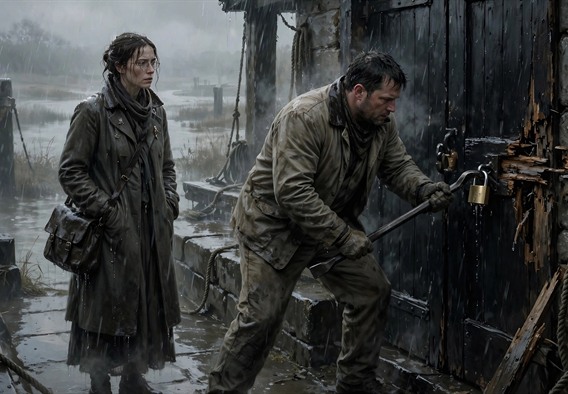
The yard truck came up the gravel while Beatrix was tagging the strongbox itself, which sat under the shop desk with its lid painted over so many times the hinge had to be persuaded. Silas got out and stood a moment looking at the boathouse the way a man looks at a job he has already priced. Curtis Fenn came behind him in a clean jacket, carrying a folder, and shook her hand as if they had met at a hearing.
"It's settled, is what it is," Silas said. "Dad signed it in 2013. Boathouse, shop, the rooms over. It's mine, and I've contracted it."
He put the deed in her hands. A printed shop form, the old letterhead, the typed line where the terms should have been: as marked. Nothing after it. Her father's signature underneath, the ink gone brown, the E made in three strokes the way he made it on everything. A brass paper fastener through the corner, and on the fastener a disc.
The disc said SOLD.
It was bright. Flat sheet brass, the letters cut clean and even, the hanging hole round and freshly drilled with a burr still on its rim. She turned it with her thumb and looked past it at the board, where every token was dull and dished and every hole was worn oval from years of swinging on a hook. HOLD, LEND, SHARE, GIVE, PAID, OWED. She read the painted words twice, and her thumb went on turning the bright one.
She could have said it there, with Fenn's pen already out. Instead she thought of her mother's fingers coming open that morning, and how long it had taken, and she kept her face still.
"The option runs to the end of the month," Fenn said pleasantly. "After that my people move to the parcel upshore. I'd rather close here. The frontage is what we're buying."
"I hold the back room for life," Duncan said from his bench. "It's wrote down and it's witnessed. Emmett put his mark on it himself."
"A paper in a drawer isn't a right," Silas said. He said it tiredly, not cruelly, a man repeating something he had said to himself in the truck. "You've had that room cheap since before I had a licence."
"Cheap because I built the stairs to it."
"Nobody is touching your room today, Mr. Halloran," Fenn said.
Beatrix squared the pages. "Where's the reverse?" she asked, and did not turn it, because her brother's hand came out and took the corner as if to help her, and she let him think he was helping.
"It's a deed, not a puzzle," Silas said. "You know what her care ran to. I carried it while you were in Kinnick Reach building your practice."
"I know what you carried."
"Then don't stand there counting the brass."
Fenn laughed a little, to smooth it, and looked at the lake.
"I'm the executor," Beatrix said. "Whatever this estate signs, I sign, and whatever comes into the shop as evidence stays with me until Yolanda has read it. That's not me being difficult. That's the job."
Silas held the deed a moment longer. Then he let go of it, and the letting go was almost a relief to him, she could see that, a man glad to put down a weight and call it a victory.
"Read it fast," he said. "Curtis isn't a patient man and neither is the bank."
They went out. The truck turned in the gravel and the tokens on the board knocked and settled.
Beatrix knelt at the strongbox, persuaded the hinge, laid the deed flat inside with the bright disc uppermost, and shut the lid. The key was cold and heavier than it looked. She put it in her coat pocket and kept her hand around it while she stood, and Duncan, who had not stopped planing through any of it, said nothing at all.
She climbed the stairs to the front room past the empty frame and its pale rectangle, the key against her knuckles through the cloth, and the word on the bright brass still facing up in her mind.
Berth Tags
Wanda Teal came through the shop door sideways, a shoe box riding her hip, and set it down among the pencils before she pulled her gloves off.
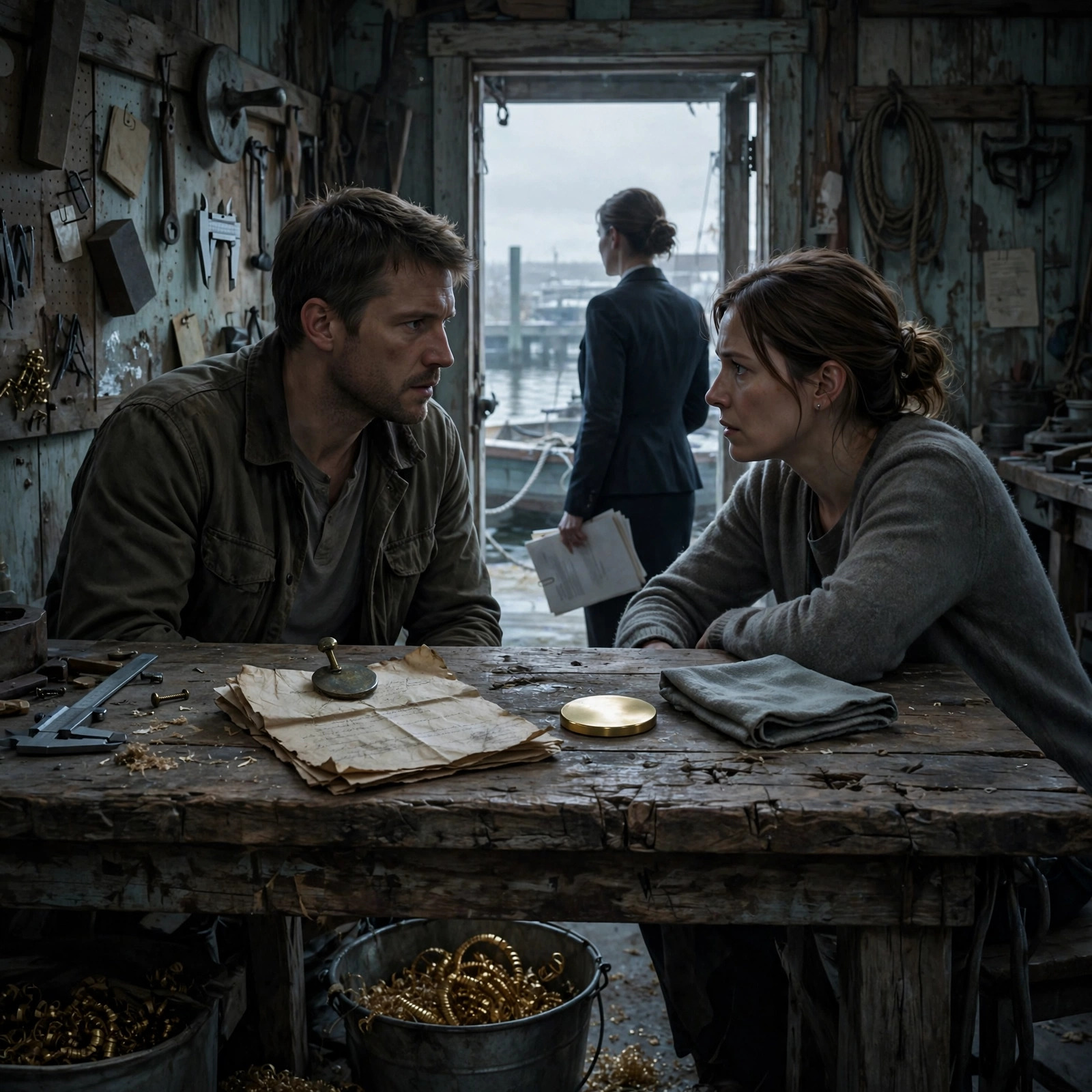
"Marina brass. New moorings up the north finger at Wanoka Marina, and half the old cleats down there have got your father's tags on them with the numbers worn to a smear." She flipped the lid. "So the marina's paying for a whole fresh set, and I'd rather cut them all at once than come back every week."
Beatrix lifted one out. Flat sheet brass, thin as a fingernail, the letters cut to an even depth, every R identical to every other R. The hanging hole was perfectly round and clean at the rim. She turned it over and found nothing on the back but a faint burr of light.
"Machine work," Wanda said. "Pantograph. I trace the pattern and it cuts what I trace, so it can't have a bad day even if I do."
"Keep one back for a pattern," Beatrix said, and dropped a disc into the desk drawer, where it slid under the pencil stubs.
The tokens on the board by the door knocked when Wanda shut it behind her. Beatrix went and looked at them properly for the first time since the truck had turned in the gravel yesterday. Oak, hand-planed, a brass hook screwed under each painted word, six hooks and six words, and above them the empty frame with its pale rectangle. HOLD. LEND. SHARE. GIVE. PAID. OWED. No hook said what the disc on her father's deed said.
"He'd strike a word when a job needed one," Duncan said from the bench. He had not stopped planing. "Board's not scripture. It's a board."
"Where's the card that hung in the frame?"
"Hung in the frame." The plane went the length of the strake and stopped. "Long as I've been in this shop it hung there."
Beatrix brought the biscuit tin down from the front room and set it by her mother's chair at the desk, because Lucille had been reaching for it on the bedside table all morning and getting the lid off and putting it back. Lucille settled her hands over it. She began sorting the loose tokens into their compartments, and her hands knew the work even where her speech did not; she looked up at the sound of the brass and went on.
"I'll want my skiff out while I'm here," Wanda said. "Tarp by the side door. Frost's coming and I've no shed."
The storage agreement was pinned to the thwart under the tarp, a shop form, the terms filled in with the words as marked and a hand-struck token fastened at the corner: HOLD, dished a little, cut from something that had been round before it was a disc. The letters were uneven, struck one at a time. The A had a broken crossbar, the left half of it standing and the right half gone.
The writing on the form was clear and careful, more printed than written, each letter finished before the next began. The O closed with a small overlap at the top, like a wire twisted shut.
"Your mother does that," Wanda said. "Emmett brought me a job once and I said I'd letter it, and he said no, Lucille writes the shop's hand. He wouldn't let me near his brass at all. Made his own out of a porthole ring off a tug they scrapped up the lake."
"She wrote this one."
"She writes all of them now." Wanda folded the tarp over her arm. "Better hand than my machine, and mine's very good."
Beatrix took the agreements off the hooks and spread them on the desk under the lamp, because if the deed's terms were as marked then the marking had to mean something, and it had to mean the same thing everywhere or it meant nothing. A lent skiff, LEND. A half hull built on shares, SHARE, the pencilled hours running down the margin. An invoice for a winter's storage, PAID, the token dull and the paper soft at the folds. An old advance on an outboard, OWED, and under the typed line a column of subtractions in pencil, each one struck through as it was settled, the last few still standing.
Every one of them carried brass. None of them said SOLD.
Lucille's hand came out and touched the corner of the deed where Beatrix had laid it, and her mouth began to work. She got a sound going, the front of a word, her tongue trying the roof of her mouth for it.
"Sold," Beatrix said. "I know. That's what it says, Mama." She turned to Wanda. "The skiff's yours, take the tarp too if you want it, it's cracked at the eyelets anyway."
Lucille put her hands back in her lap. The tin sat open with the tokens sorted in it and she did not touch them again.
Beatrix walked to the window with her phone and called Kinnick Reach.
"A signed deed is a deed," Yolanda Pike said. "Recorded or not, between your father and your brother it passes what it describes. I've read the copy you sent. There's a granting clause and a signature."
"There's a brass disc on it that doesn't match the shop's own board."
"A disc isn't a term of conveyance. A judge will look at the granting clause and the signature and stop there." Papers moved on the attorney's end. "I'll come out to the shop myself before the end of the week. Don't sign anything and don't let anybody change a lock."
Beatrix set the phone face down. Under the lamp the deed lay with its bright disc uppermost, and she looked at it the way she looked at a hand that had come back wrong after a repair: not at the scar first, at what sat beside the scar.
The paper around the disc was clean. A ring of unweathered cream where the rest of the sheet had gone the colour of weak tea, a circle left by something that had lain there a long while and had been taken off. She unrolled the metric tape from her therapy bag, the fiberglass one she used for swelling in a wrist, and laid it across the ring. Five centimeters. The token fastened over it was plainly smaller than the circle it sat in, and it did not sit in the circle's centre. The paper fastener had been pushed through a fresh hole, round and rough at the rim, close beside an older hole worn oval by years of hanging on a hook.
She stood with her palm flat on the desk for a while.
Then she turned the sheet.
A column of subtractions ran down the reverse in her father's pencil, boats and yard work and haulage set against something that had never been named at the top, most of the lines crossed through, the crossings getting shakier as they came down the page. At the bottom a figure stood uncrossed.
Behind her Duncan's plane started and stopped. Her brother's voice came back to her from the gravel, you know what her care ran to, and she looked at the uncrossed figure and did not read it out loud. She turned the deed face up again and slid it under the blotter's edge.
"Duncan. Your room paper. Where is it?"
"Drawer," he said. "Where it's always been."
She went through the drawer past the marina sample and the pencil stubs and a card of brass fasteners, and found it folded in a shop form: the back room above the workshop, held for the life of the tenant, the terms line reading as marked, a HOLD token fastened at the corner, dished, hand-struck, the A with its crossbar broken. Dated in the spring before her father died, when he had stopped coming down the stairs and the shop had smelled of the nebuliser and of sawdust anyway.
There was a mark at the foot, and beside the mark her father's name, and under that Duncan's scrawl as witness, the same D he put on a delivery book.
She carried the page to the window and held it up against the lake light, and the body of it came through the paper: clear, careful, each letter finished before the next was begun, the O closed with a small overlap at the top. Not her father's hand. Somebody else had written every word of it.
Under the Glass
Beatrix slid the tray across her mother's knees and set the water tumbler on the sill, then took her mother's right hand and laid it palm down on the wood. The fingers curled under, the way they had every morning since the stroke. She waited. She had learned to wait in clinics, with strangers, on a clock; at home she was always in a hurry about it.
"Flat," she said. "Just flat, Ma. No push."
Lucille's hand opened by degrees, like something thawing. Beatrix kept her own fingers under the wrist and watched the tendons stand up on the back of the hand, and while she watched, her eyes went over the bedside table because there was nothing else to look at. The tin lid. The saucer with its ring of dried tea. The glass top, and under the glass, printed matter she had taken for a photograph of a boat.
It was not a boat. She lifted the saucer and the lid off and set them on the quilt, and bent until her forehead was nearly against the cold surface.
The card was the card. She knew the type, the town printer's heavy capitals, the little rules between the lines. HOLD: kept for the name on it. LEND: ours, and comes back. SHARE: half ours, half theirs. GIVE: gone, with no money. PAID: money came, and it is gone. OWED: money went out, and the paper stands till it comes back.
Six words. Six hooks downstairs with six painted labels, and the frame above them empty, and here was the reason the frame was empty, lying under a water ring where her mother could reach it without standing up.
There was no seventh word. There was no SOLD anywhere on the card.
Beatrix sat back on her heels. In the folder downstairs there was a deed with a bright disc fastened to its corner, and the disc said SOLD, and the clean circle behind it was wider than the disc, and the fastener went through a fresh hole beside an old one worn oval by hanging. She had measured that circle with a tape she used for swollen wrists. She could feel the wrongness of it sitting in her chest like a swallowed pin.
Then she thought of Duncan at the bench last winter, saying her father struck a new word whenever the shop needed one, that the board was never meant to be finished. Emmett had made the tokens himself out of a scrapped porthole ring; he had made the card too, or her mother had, and he had framed it. A man who could punch a new word into bronze could punch SOLD. He had been ill and frightened and proud, and he had wanted things settled with his own hands. That was all it was. A late word, added late.
Under her palm her mother's fingers had gone still.
Lucille brought her left hand across the quilt and tapped the glass. Twice, on OWED, flat and deliberate, the pad of her finger making a small dull sound each time.
"Paper," Lucille said.
"I know." Beatrix reached for the tumbler to move it back and found a brass disc lying on the sill among the screw heads and the shell her father had brought home from somewhere. Face down, dished, dull on its back, no shine on it at all. A spare. Her father had punched dozens and kept them everywhere, in jars, in the till, in his coat pockets. She set it back where it had been, the same way up, and put the water beside it. "I know about the bills, Ma. Silas carried them for years and I was in Kinnick Reach learning to do this, and I know how that looks. I'm not arguing with you about the bills."
Her mother's mouth worked. "Not," she said. Then nothing came, and her eyes went past Beatrix to the sill and stayed there.
"Do the flat one again," Beatrix said. "Two more and I'll bring up the toast."
She put the tape back in the therapy bag and zipped it and went down. The stairs smelled of sawdust and cold lake. Duncan had the shop door open to the gravel and was working the edge of a plank, and the shavings came off in long curls that fell over his boots.
"Your room paper," Beatrix said. "Whose hand wrote it?"
The plane stopped. He set it on its side, careful, the way he set everything down.
"Emmett's."
"Every word of the body of it?"
"Every word." He picked up a rag and drew it along the plane's iron. "He wrote it at that desk. I witnessed it. You saw my D."
She had seen his D. She had also held the page against the window light and watched a careful hand come through the paper, each letter finished before the next was begun, the O closed with a small overlap at the top. Her father's O had never closed at all; it had a gap in it like a horseshoe, on delivery books, on cheques, on the labels he tied to oars.
"It's dated in the spring," she said. "When he couldn't get down these stairs."
"He got down them." Duncan put the rag over the bench rail. "You'd know if you'd been here."
There it was, and it was fair, and it went into her somewhere soft. She took the folded agreement out of her folder anyway and looked at the HOLD token at its corner, dished, hand-struck, the A with its crossbar broken, and then at the date again.
A man who lied about the hand had a reason to lie about the hand. Her father had been dying, and someone had written a lifetime claim on the back room in a clear, careful, patient script, and put a dead man's mark at the foot of it, and dated it to a spring when the shop smelled of the nebuliser. And upstairs her mother kept a card that said HOLD meant kept for the name on it, and her mother had also, perhaps, kept a great many things she could no longer say out loud.
"I have to do this properly," Beatrix said.
"You've been doing it properly since Tuesday." Duncan turned the plank end for end. "Silas has been doing it properly for eighteen years."
Yolanda Pike's car came up the gravel while Beatrix was still holding the page. The attorney got out with her file against her hip and stood a moment looking at the water, the way people from town did, as though checking it was still there.
"Show me," Yolanda said.
Beatrix laid the room agreement on the desk and the deed beside it, out from under the blotter's edge, and stood back with her arms folded so nobody could see her hands. Yolanda read for a while. She read the reverse of the deed too, and her face did not change, and she turned it back.
"You want to challenge the room paper," she said.
"I want to know if it's real."
"Those aren't the same errand." Yolanda squared the pages. "Listen to me before you sign anything. If the executor disputes the occupancy, there's no settled tenant on the property while probate runs. Fenn's people will ask for possession pending the estate, and on this paperwork a judge may well give it to them. Your brother has already contracted to sell. Do you understand what you'd be handing over?"
"I understand he's had a deed in a drawer since 2013 and never recorded it."
"That's a different fight, and I'll take it up. This one you can lose in a week."
Beatrix looked at the shop door, at the board with its painted hooks and the agreements she had taken down off them, at the empty frame. Somewhere above her a floorboard took her mother's weight.
She pulled a blank shop form from the drawer, past the marina sample and the card of brass fasteners, and wrote out the objection in her own hand: that the executor disputed the instrument dated in the spring before death, purporting to hold the back room for the life of the tenant, and asked that it be proved. She wrote it quickly. Signing felt like doing something, and she had been in this house three days doing nothing but measuring.
There was no token to fasten to it. It was not a shop paper. She signed it flat on the desk with Duncan's plane lying beside her elbow.
Yolanda read it, sighed through her nose, and folded it into her file. Duncan came to the bench for his rag and his pocket gave out the small clink of the side-door key, still there, still his. Upstairs the card lay under the glass with the saucer set back on it, and the six words waited where a hand could reach them.
Tools on the Dock
The notice went up on Duncan's door while Beatrix stood at the foot of the stairs with her therapy bag still on her shoulder. The man who taped it smoothed the corners flat with the side of his thumb, the way you would finish a good job of painting, and stepped back to check it hung square.
Duncan came up from the bench with a rag in his hand. He read it standing close, because the print was small, and then he took it down off the door and folded it into his shirt pocket, and the door was bare again, and nothing about the morning had changed except everything.
"Possession pending the estate," Curtis Fenn said. He had a clipboard and a quilted vest and the pleasant, unhurried voice of a man who had never once had to raise it. "Nobody's throwing anybody off a lake. It's a paper step."
"He's lived up there since before I could walk."
"Then he'll have somewhere to be while it's decided." Fenn clicked his pen. "Side door key, Mr. Halloran."
Duncan put the key into Fenn's palm. Fenn passed it along to the man with the drill, who fumbled it, and it went down onto the dock boards with a small flat sound, and nobody picked it up. The new cylinder went in bright and clean. The man worked the screwdriver one-handed, whistling under his breath, and when he was done he shut the door and locked it and handed Fenn a key on a paper tag.
They inventoried the shop out loud. Fenn read the drawer labels while the other man wrote, and then they shut the drawer with the agreements and the marina sample and the card of fasteners inside it, and ran a strip of tape across the front and signed the tape.
"I need in there," Beatrix said.
"Sealed until the estate's settled. You've got the strongbox key, you keep that." He smiled at her, generous about it. "I'm not the enemy of your father's paperwork."
They brought the tools out in trays and then, when the trays ran out, in armloads. Chisels, gouges, the mallet with the split head, the oilstones, the bending form, the bench vise with its jaws wrapped in a rag as though somebody had thought about the weather after all. The staging for the half-planked skiff came out last, the trestles knocked apart, and they laid it all along the dock and threw a tarp over it and tucked the edges under the vise.
Silas watched from the shop floor with his cap in his hands. He looked at the stripped hooks beside the door, at the bare oak where the agreements had hung, and something in his face eased that Beatrix had not seen ease in him since she came back to town.
"That's the shop clear," he said. "That's the whole thing clear."
"It's clear when the title's clear." Fenn was already at the door, checking his phone. "Mr. Nguyen. If you can't deliver, the option money goes back to my client. All of it. I'd not be spending it on yard arrears."
Silas put his cap on. "There's a deed."
"There's a deed with a word on it that a court might read differently than you do." Fenn lifted two fingers to the crew, and the crew went to the truck. "Get me a clean instrument before the option runs out."
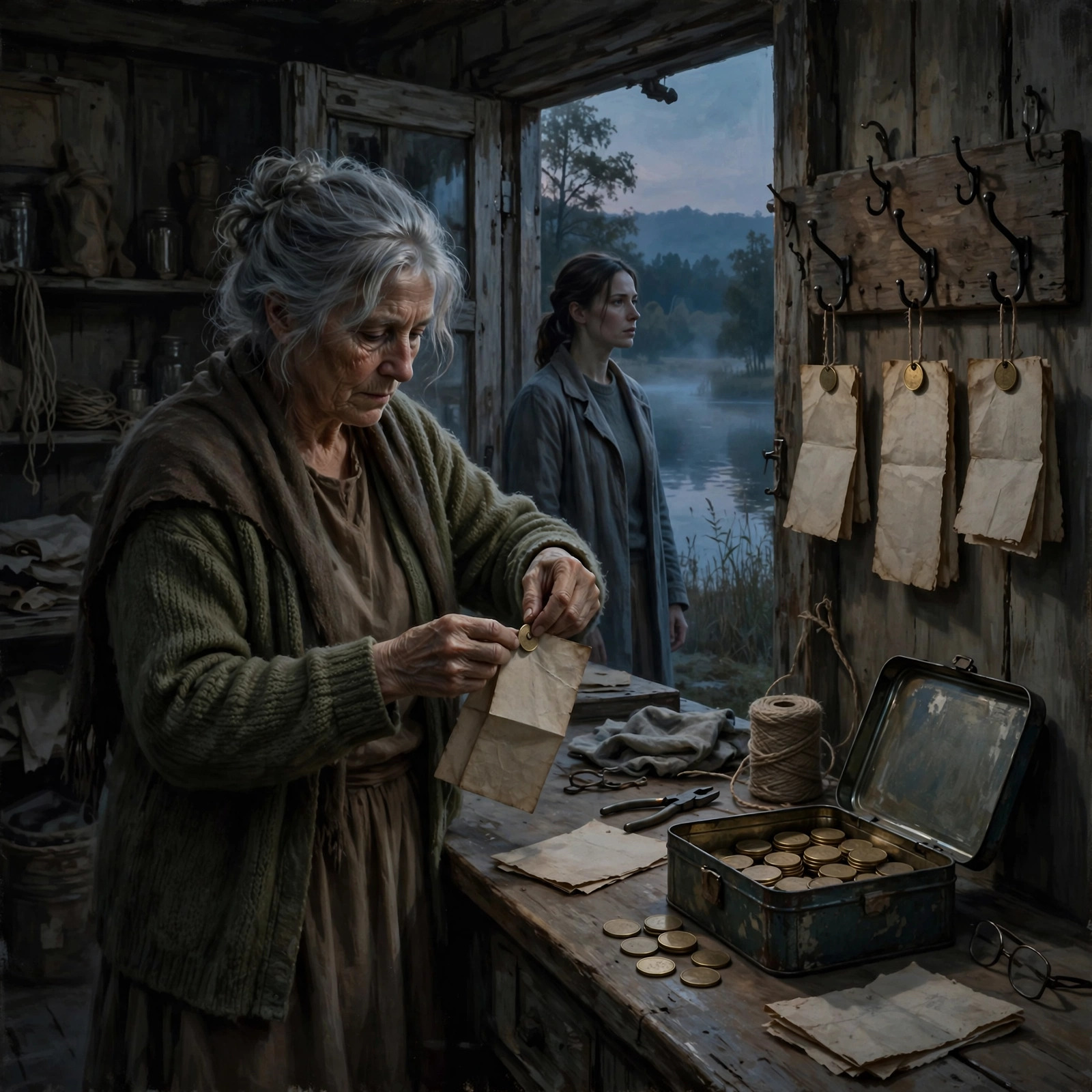
Beatrix carried the biscuit tin up the stairs at noon, sorted the way her mother had sorted it every morning of her working life, the little brass discs lying in their rows by word. She set it on the bedside table and took the lid off and turned the tin so the light fell into it.
Lucille lay on her side facing the window with the blanket up under her chin. Her right hand rested on the cover, thumb folded into the palm, the fingers curled over it, and Beatrix looked at that hand and knew exactly what she was looking at, because she had spent her working life pulling hands out of that exact shape.
"Ma. Just the HOLD ones. You don't have to say anything."
Her mother's eyes came around, and went to the tin, and went back to the window.
"Shop," Lucille said.
"Not today."
The word had come out whole. That was the thing Beatrix could not get past, standing there with her bag on the floor: the word came out whole and the hand stayed shut, and there was no version of this where she could tell herself the two were unrelated. Days like this took the work apart. Not the stroke. The days after it, the ones where nobody asked. She put the lid back on the tin and left it where her mother could see it, and went down, and did not put the tape measure in her hand, because there was nothing to measure that a number would help.
The weather came across Lake Wanoka in the night. She heard the tarp go from the front room, a crack like a sail filling, and then the slat and rattle of it working loose, and then rain on the roof with nothing under it but wood.
Duncan's truck was fogged solid in the morning, a blanket shape in the cab, and he was out of it before she reached the dock, saying nothing, standing looking at his tools laid out in the wet.
The tarp was gone somewhere down the shore. The vise had rusted along the jaws and the screw, a bloom of it, orange in the seams. She lifted the jointer plane and turned it over and the sole was scaled with rust, and the iron was pitted along its whole edge, and water stood in the mouth of it. She wiped it on her coat. It came off in smears and left the pits behind.
"I'll stone it," Duncan said.
"You can't stone that."
He took it from her, and looked, and gave it back, and that was all either of them said about it.
She could not open the desk drawer, so she used what was nailed outside it. The drawer fronts, the shelf ends over the bench, the bin labels, all in the same clear looping hand, capitals with the crossbar of the H set on a slant, the L with a tail that curled back under. Wanda Teal's skiff hung in the slings at the back of the shop with a paper tag wired to the thwart, marked for Wanoka Marina, and under the printed word HOLD there was a name and a date in that same slanted hand. Beatrix laid the room agreement on the bench beside the tag and set the two of them under the window light and looked from one to the other for a long time. The r that was almost an n. The way the flourish on the final d came back and stopped, every time, like a woman setting down a pen she meant to pick up again.
Her father's mark sat at the foot of it, the crooked boat-shaped scrawl he had used when his own hand got unreliable, initialed beside, and Duncan's name under that as witness.
"It's my mother's writing," Beatrix said.
Duncan stood with his hands hanging. "I told you Emmett wrote it because a paper made in a sick man's last weeks gets thrown out."
"Duncan."
"It was her hand and his mark, and I'd have lost my room." He looked at the wet staging. "That's the whole of it."
Yolanda Pike came out from Kinnick Reach with her file on the passenger seat and rain still coming off the eaves in strings. Beatrix wrote the withdrawal at the bench, standing up, on a shop form with no token fastened to it: that the executor withdrew her objection to the instrument holding the back room for the life of the tenant, and asked that it be admitted, and would answer for the challenge herself.
"You understand a beneficiary can put your conduct in front of the court," Yolanda said. "A challenge and a withdrawal, both in your hand."
"Put it in front of them."
Silas came in while she was signing. He read it upside down, the way he had read their father's plans as a boy, and his face went through several things and stopped on none of them.
"You've given him a room for life."
"It was already his."
"You've been here a week." He said it quietly, which was worse than shouting, and Beatrix made herself stand still and hear it. "I carried the bills. I carried her. You wrote a letter at Christmas." He put the paper down on the bench, careful, like a man setting something down before he broke it. "Sign whatever you like. I've got a buyer and a deed and a month."
He went out through the front. Yolanda folded the withdrawal into her file and said she would file it first thing, and did not offer to help with anything else, and her car went away down the track.
Beatrix carried the tools in herself, in the rain, through the shop door because the side door was not hers to open anymore. Chisels first, wrapped in her coat. Then the stones, then the mallet, then the trestles one at a time, and the vise last, dragging it up the boards on its side because she could not lift it, and the sound of it went on a long while under the rain. Duncan stood in the doorway of his own shop with the notice folded in his pocket and let her do it, because she had asked him to let her, and neither of them pretended that made anything even.
She set the jointer plane on the bench, sole up, pitted iron toward the window, where it could not be used and could at least be seen. Out on the dock, in a shallow skin of rainwater, Duncan's key lay on the boards where the man with the drill had dropped it.
The Biscuit Tin
Beatrix lifted the pane of glass off the bedside table, slid the printed card out from under it, and set the glass back down over the ferry timetable and the photograph beneath.
Her coat was on the chair by the window. She put it at the foot of the bed and turned the chair so her mother could see both her hands, and sat, and laid the card on the counterpane between them, printed side up.
In the clinic she taught families to keep their hands still. Let the word come. Let it come badly, let it come late, do not put your own word in the gap, because the gap belongs to the person working to fill it. She had trained strangers in it for years. She had never once done it in this room. She had come up the stairs with a list and read the list aloud, and her mother had listened, and that had been the whole of it.
Lucille looked at the card. Then at her daughter. Her mouth moved and stopped.
Beatrix kept her hands open on her knees. Down in the shop a loose halyard tapped the mast by the door, on and on, and out on the water a tow went by with its engine flat and steady. The light came off the lake and lay on the ceiling in strips. She let the quiet run until it stopped being a kindness and became a room with two people in it.
Her mother reached to the windowsill. She took the brass disc that had lain there face down since the autumn, set it on the card without turning it, and pushed it across the counterpane with two fingers.
Then she pulled the biscuit tin off the table, worked the lid loose with her thumbnail, and tipped the contents out on the coverlet. Tokens, a small brass heap of them, worn bright at the edges. HOLD. SHARE. PAID. LEND. GIVE. Every hole worn to an oval. Nothing in the heap said what the paper on the sill had said.
Beatrix turned the disc over.
OWED. The letters struck by hand, uneven in their depth, the A with its crossbar broken short. Bronze, slightly dished, cut from something round, a porthole ring by the look of the curve. The rim bent where a thumb had worried it. The hanging hole drilled and then worn long by years on a hook.
"You kept it," Beatrix said.
"Yes."
"All this time. Since Dad."
Her mother's hand went flat on the card, over the last line of it, and stayed there.
"You saw the other word on the deed. The bright one." Beatrix made herself say it slowly. "You knew it was wrong."
"Yes."
"Why didn't you tell me?"
"Nobody asked." Her mother's eyes came up and held. "Waited."
Beatrix put the token in her palm and closed her hand on it, and sat there with the tin lid in her mother's lap and the ferry going back across the far shore, and understood that she had been coming home for years and had never once come into this room and stopped talking.
"I'm going to take it down to the bench," she said. "I'll bring it back up."
Lucille shook her head. She pointed at the token, then at the stairs, and then, deliberately, at the card.
The strongbox key was still in her coat pocket. Beatrix unlocked the box on the shop bench, drew the deed out, and laid it under the window light with the corner uppermost. Brass paper fastener, legs spread flat. She opened them with the tip of a bench knife and lifted the bright disc off, and there it was underneath: the clean circle where the paper had never taken the sun or the damp, five centimeters across, and beside the fastener's fresh puncture the older hole, worn long.
The tape came out of her therapy bag, the one she used on swollen wrists and forearms, and she laid it across the ring, and then across the dished bronze. Five centimeters. She set the token down over the circle and the edges agreed all round, and the oval hole came over the old puncture like a key going home. She pushed the fastener through and bent the legs and the deed lay there marked the way it had been marked when her father was alive to mark it.
She carried the card past the hook board by the door on her way back. The painted capitals on the brass hooks answered the card, word for word, and every hook was bare.
Wanda Teal knocked at the front, because the side door was not a door anybody used now. She had her storage money in an envelope and her coat still buttoned.
"I'll settle to the end of the season," she said. "I'm not shifting my skiff on a maybe."
"Write it as marked, then. HOLD."
Beatrix wrote the receipt on a shop form and left the token line empty. Wanda's eye had gone to the bench, to the bright disc lying face up beside the deed.
"That's my cutter's work." She reached in her pocket and put her sample berth tag down beside it, Wanoka Marina, uniform lettering, the hole drilled clean and round. The S was the same S. The O was the same O. Nothing on either of them had been struck by a man with a punch and a hammer and a broken A.
"Who brought you the word to cut?"
"I cut what's written on the slip."
"Wanda. You must have--"
"I keep my slips." Wanda buttoned her coat higher. "I've a shop on that shore, and a marina full of people who talk. You want the slip, you ask for it proper." She put the envelope on the bench and went out to look at her skiff.
Yolanda Pike came up the track while Beatrix was still standing over the two discs. She had the file under her arm and her glasses in her hand, and she read the card before she read anything else, moving her lips at the last line.
"Money went out," she read. "Paper stands till it comes back."
"That's his word for it. Dad's word."
"It's a better word than most lawyers manage." Yolanda turned the deed over.
The reverse was a pencil column in her father's hand, headed for L., care. Skiff sold. Winter haulage. Docking, the summer of the roof. Yard income, twice. Each figure crossed through with a single ruled line, and at the bottom, uncrossed, the last of it.
"Twelve thousand dollars," Beatrix read aloud, and heard her own voice go strange on it. "That's what's left of her care money."
"Then your brother put money out and took the deed as security for it." Yolanda set the paper down. "A deed given as security is a mortgage in equity, whatever the typed line says. He isn't the owner of this boathouse. He's a creditor of it. He can be paid off."
"And the sale?"
"He can't sell what he holds as security. The estate can discharge him, but only by paying. Not by arguing." She looked at Beatrix over the glasses. "Have you got it?"
The account was in Kinnick Reach, and it had a name in her own handwriting on the folder at home: partnership. She had built it out of extra clinics and Saturday assessments and saying no to a flat with a second bedroom. The clinic had wanted an answer by summer.
"I've got it," Beatrix said.
She wrote the draft at the bench, standing, for 12,000 dollars, payable to her brother, and her hand was perfectly steady until the signature, and then it was not. Yolanda watched her finish.
"I'll paper it as an advance to the estate. You'll be a creditor of your father's estate yourself, and you'll wait behind the tax."
"Paper it."
"And the objection stays in the file. Withdrawn, but in your hand, both versions. If a beneficiary complains of you, that's the document they'll read."
"Then give me a form." Beatrix took one from the drawer. She wrote that the executor had challenged the room agreement, that the challenge had been wrong and was withdrawn, and that she would answer for it herself before any court that asked. She signed it and dated it, and Yolanda struck the objection through and clipped the draft to it, and put both in the file.
Then Beatrix picked up the card and the two tokens and went up the stairs.
Her mother had not moved. The tin lid was still in her lap.
"Yolanda's downstairs. She's going to ask what this paper is, and whose word it carries." Beatrix set the card on the counterpane and the tokens on the card. "I'm not answering her. I've answered for you since the stroke, in every room, on the phone, to the doctors, to Silas. I'm done doing it. You kept the desk for thirty years. Will you come down and answer her yourself, with these?"
Lucille looked at the tokens for a long while. Then she nodded, once, and put the lid on the tin, and got her feet under her.
On the bench below, the signed draft lay clipped to the struck objection. On the stairs her mother came down with the biscuit tin under her arm and her free hand on the rail, taking each tread whole.
The Share Token
Fenn came up the ramp with his folder open along his forearm and his pen already out of his pocket.
"Where do you want it signed?"
"Not the desk." Beatrix put her hand on the folder's cover and lowered it. "The bench. Give me a few minutes with my brother first."
"I've got a surveyor booked this afternoon." He glanced past her at the bare hooks beside the door. "I'm not in the business of turning people out. I'm in the business of closing files."
"Then you'll want to hear it after."
Yolanda had come out from Kinnick Reach with the release in her file and had not sat down since arriving. Beatrix asked them both for the dock. Fenn went, stiff at the shoulders. Yolanda gathered her papers and stood at the door with her back to the shop, which was its own kind of courtesy.
Silas came in from the yard side still wiping his hands on a rag, and Beatrix laid the things out on the bench where the light was best: the deed, the worn token fastened through its corner, the flat bright disc beside it, Wanda's sample berth tag, and the card in its thin glass frame.
"Read the card," she said. "Six words. HOLD, LEND, SHARE, GIVE, PAID, OWED. SOLD isn't one of them. That disc is smaller than the ring it sat in. Five centimeters of clean paper, and your token doesn't fill it. The hole's round and new. Dad's hole is worn oval from hanging on a hook."
"It's brass." Silas turned the sample tag over with one finger and turned it back. "It's a tag on a paper."
"Same letters as the sample. Same machine, out at Wanoka Marina. And the card was off its nail, Silas, because the card would have told anybody who bothered to look."
He set the rag down on the bench, folded it once, and left it there.
"I had it engraved. I fastened it on myself. I told myself it only said out loud what was always true." His jaw worked. "I carried the bills. Every one of them, for years, while you were in Kinnick Reach learning other people's hands."
"You did," Beatrix said, and let it stand, because it was true and because arguing it would have been a way of not paying it.
She took the draft out of her shirt pocket and put it on the deed.
"12,000 dollars. That's the remainder uncrossed on the back, and it's honestly yours, and it's the whole of what's yours." She kept her voice down to the bench. "The house isn't. Mother would have gone out of the front room she's slept in since before I was born. Duncan's vise sat on the dock in the rain. His plane is scrap. He slept in his truck with the heater running."
"The yard's finished." He said it flatly, to the paper. "The bank's stopped pretending."
"I know."
"You don't, but all right."
He bent over the corner of the deed and got his thumbnail under the legs of the fastener, and worked them straight, and lifted the disc off. He held it a moment in his palm. Then he dropped it in the scrap bucket under the bench, where it went in among the brass swarf with a sound like a coin in a tin cup.
"Yolanda," Beatrix called.
The release was short. Yolanda laid it on the bench and Silas signed it standing, with the shop pencil behind his ear untouched, using her pen. She wrote the discharge across the reverse of the deed, over the pencil column and its uncrossed remainder, and endorsed the security cancelled, and dated it, and asked him to initial the endorsement, and he did.
Fenn came in when she nodded to him. He read the release through twice, which Beatrix respected.
"That's the option gone, then." He capped his pen. "My fee's repayable to the buyer if title stalls. Your brother knows that. I'd rather have had the shed."
"I know you would."
He handed Silas the file copy, shook his hand because he was that sort of man, and went down the ramp, and his truck turned on the gravel and was gone up the shore road.
Silas stayed at the bench with the draft in his hand. "That's not going to save the yard."
"No," Beatrix said. "It's going to clear the title."
Lucille was at the shop desk with the biscuit tin under her arm, and she set the tin down and put the card flat in front of her before Yolanda had finished pulling out the chair.
"I'm going to ask you about the deed," Yolanda said. "Take your time. Tell me in whatever way suits."
Lucille put her finger on OWED. She held it there until Yolanda had written the word down. Then she took the pencil and wrote, in her clear upright hand, money out. paper stands. She underlined nothing. She turned the pencil around and tapped the deed, and wrote not sold, and pushed it across.
Beatrix felt the answer rise in her throat, the whole helpful sentence of it, the one she had been saying in corridors and on telephones since the stroke. She shut her mouth. She stood by the bench with her arms hanging and let the silence sit there and be her mother's.
"And the room upstairs, the front room," Yolanda said. "Whose is it?"
Lucille wrote mine, and then, after a while, while I live.
"I'll read this back, and you tell me if I've got it wrong."
Lucille listened with her chin up, and nodded once at the end, and signed her name beneath it, and Yolanda witnessed it and put it in the file with the withdrawn objection and the undertaking clipped behind.
Duncan came in from the dock when Silas went out to his truck, and he came in the way a man does when he isn't sure the door is his. Beatrix took the bolt cutters off the shop wall and went round the side with him and cut the new hasp lock off, and it fell in the wet gravel, and she left it lying there.
His key was still on the dock post where he'd put it. She picked it up and pressed it into his palm and closed his fingers over it, and he stood looking at his own hand.
She hung his room agreement back on the hook under HOLD.
Then she gave him the parcel, wrapped in oiled paper and tied with shop twine. He got the string off and folded the paper back.
"That's not my plane."
"It's a new one. Bought in Kinnick Reach on the way back, with what the account had left in it." She swallowed. "I let the notice go out. I did that."
Duncan ran his thumb along the blade's back, carefully, the way you touch a thing you're afraid of hoping for. "Your dad's had a chip in the tote," he said. "I used to catch it there."
"I know."
"This'll take a shaving." He wrapped it up again, slowly, and went upstairs with it under his arm.
Lucille was writing at the desk. Yolanda read the sheet over her shoulder and did not touch it. The front room to Lucille while she lived. The shop, the water, the ways and the landing in common, mother and both children, no one to sell out from under the others. The back room held to Duncan Halloran for his life. Silas came back in and read it and stood a while with his hands on the desk edge, and then signed under his sister, and Beatrix signed as executor last.
Beatrix coiled the metric tape into her therapy bag and zipped it for the drive back. She took the card and wiped the glass with a shop rag until the lake showed in it, and hung the frame on its nail beside the board, square.
Then she stepped away.
Her mother lifted PAID out of the tin and worked the fastener through the deed's corner and hung the cancelled paper on its hook. She dropped the worn OWED token back into the tin, its debt done with, and set the lid aside. The SHARE token took longer. The legs went through on the second try, and spread, and she turned the paper until the word sat right, and reached for the hook, and Beatrix did not move to help her, and the shop was very quiet, and the token settled with the word facing out, and her hands stayed at her sides.
Get notified when new stories drop

Priya Castell
Priya writes inheritances, cold trails, and the people who keep looking, with every clue on the page before the answer.
Leave a comment
Comments