

The Blank Door
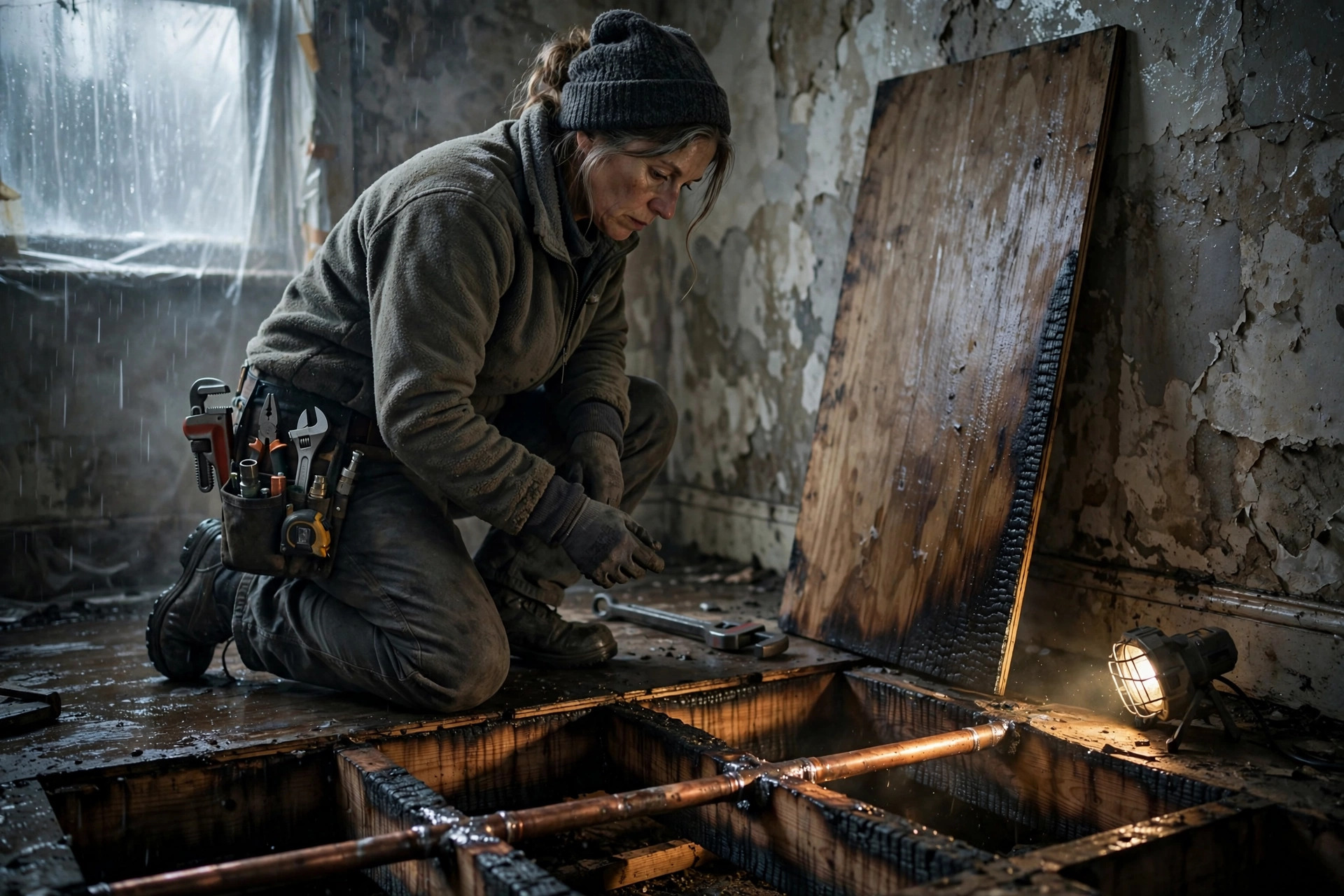
Ruth got the tailgate up and the pipe bag onto the mounting block, and the burned wing breathed out at her: wet char, cold soot, plaster gone sour under all the water they had put on it. Weeks now, and the smell had not moved on at all. Along the sound terrace the washing was out. A radio was going in somebody's kitchen, and a woman she did not know was beating a mat against the wall as though nothing had happened anywhere.
She had left the bench at Tilehouse Yard with a regulator stripped down in the vise and the parts laid out in order on a cloth, and she would be back at it by dark if the day let her. She carried the toolbox in from the van and set it inside the end door, where the floorboards were still black at the edges.
Lench came along the terrace with his folder under his arm and his keys already out.
"Don't breathe deep. They tell me it's only wet ash." He held the folder open against his chest so she could see the county heading. "Provisional cause. I'll read you the line and then we needn't speak of it again. Origin: the resident's portable gas heater. Accidental. The coroner's recorded it, the insurer's accepted it, and there's an end."
"The clearance crew were through that room before the marshal set foot in it."
"On my instruction." He said it without heat, the way he said everything, as if the two of them were agreeing about the weather. "I've a terrace full of people and a hole in the middle of it. What was I to leave standing?"
He walked her along the refit then, and he was good at it, she had to allow him that. New skirtings throughout. Meter position moved out to the passage where a man could read it without going into anybody's home. He tapped the floor with his heel.
"Sound as a nut. We lay over it. No lifting boards, Ruth, I can't fund joinery on top of everything else this year."
At the end door he stopped and looked at the brass rather than at her.
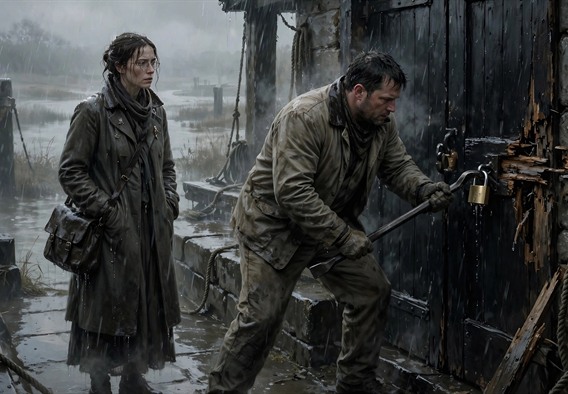
"Take Walter's plate off before the insurers come round. Blank the room. Fresh brass all along when we're finished, uniform, no names. Names on doors, this isn't a hotel."
"It's his door."
"It's the Trust's door, and it's a black hole with a name on it, and Loveday Blythe walks past it to bring me money." He put his hand flat on the doorframe, over the soot. "Bucket's there. Your yard renewal's coming to you, by the way. Same terms. A dollar a year and the maintenance attached, same as ever."
"Same as ever," Ruth said.
"How's your mother? I carried her boxes up myself when she came. She'd never have got that room through the county, you know. Not on her own."
She knew. He had put his name to her indenture and paid her fees the year her father died, and he had never once mentioned it afterward in a way that could be answered back. That was the trouble with him. He never handed you the bill; he simply left it where you would find it.
Grace had the kettle on the hotplate and the tray already set, because she heard footsteps the way other people heard a phone.
"Sit down, both of you. Ruth, that cupboard door wants a washer and you've walked past it twice."
"I've not walked past it once, I've only just come."
"Then walk past it and mend it." Grace poured. Her hands were steady, her wrists thickened from years of school dinners, and she put the cup in front of Lench with the handle turned to his right. "Look at the light in here. Afternoon and all. That man got me this room when I'd nowhere to go, and he wrote to the county himself, more than once, and he wouldn't let them put me in the hostel out on the ring road."
"It was no trouble, Grace."
"It was a deal of trouble and you know it." She sat, and looked at her daughter over the rim. "Whatever you're at in Walter's room, be quiet about it. Loveday comes by."
Loveday came by while the tea was still going. Ruth heard her at the end door and got there first, wiping her hands down her thighs, and the woman stood on the black boards in her good coat with an envelope held in both hands like a form she had filled in wrong.
"For the repairs." She gave it past Ruth to Lench. "There's a note in there of what it's for."
"I'll enter it in the book." He slid it into the folder without looking at the amount, which was its own kind of kindness.
"That's twelve hundred dollars I've handed you." Loveday's voice was flat and careful, a voice for reading out counts of seed sacks to men who wrote them down wrong. "There'll be more at the end of the month. I've asked them to stop me at source."
"Nobody's asking you for it, Loveday."
"He should never have kept that heater. I told him. I told him it wanted airing and he said it was his own affair, and I left it there, because it was easier to leave it there." She looked at the doorframe, and at the brass, and then away from both. "I'm not going to stand in the corridor and be the daughter of the man who burned the wing. Don't put his name anywhere I have to walk past it."
"Quite right," Lench said.
Ruth went back inside because there was nothing to say to that, and habit took her to the skirting behind the heater bay, where the supply came up through the boards. She had her torch out and her thumb on the socket before she had decided anything.
The cap was on. Her cap. Brass, hexagonal, seated hard down, and the wire still twisted through the tally tag she had crimped onto it, the tag tarnished now and filmed with soot but her own maker's mark legible under it when she rubbed her thumb across.
She had put that cap on nineteen days before the fire.
Lench had come into the yard and leaned against the end of her bench with his hat still on. Walter had the electric ring now, he said, the old boy wouldn't miss the gas, and would she do it for him as a favour, no charge, and not trouble Enid with the paperwork. She had cut the supply, capped it, wired the tally on, and gone home to her supper, and the favour had sat in her chest ever since like a swallowed pin.
"Gas safe in there?" Lench, from the passage.
"It's dead," Ruth said.
It was. That was the whole of the trouble.
She stayed crouched until she heard him go along to Grace's door, and then she got the screwdriver out and took the plate off. It came away heavier than it looked, brass thick as a coin, the corners rounded by his own file. He had engraved it early on, when he did the plates for every door in the Row, and he had cut his own name the way he signed everything, the whole of it in his long flowing hand, the letters running into one another, the black wax still clean in the cuts. WALTER BLYTHE. No shortcuts. He had never in his life put a mark where a name would go.
The scrap bucket sat by the passage step with offcuts and old washers in it, and the plate would have gone in with a clatter and been carted off with the rest.
She carried it to the toolbox instead and laid it on the cloth, face up, letters clear.
Then she shut the lid on it, and looked back across the black boards at the little brass tally wired to the capped pipe, and took her notebook out of her hip pocket. She wrote the room number on a fresh line and nothing else beside it, and put the notebook away, and did not show it to anybody.
Under the Floor
Ruth shouldered the site hut door open because the latch had swollen in the wet, and went in with her boots still black from the burned wing. Cecily Frayne had the trestle table cleared to bare ply, folders squared along one edge, a mug ringed in tea beside them. She moved a hi-vis off the second chair with two fingers and waited until Ruth sat.
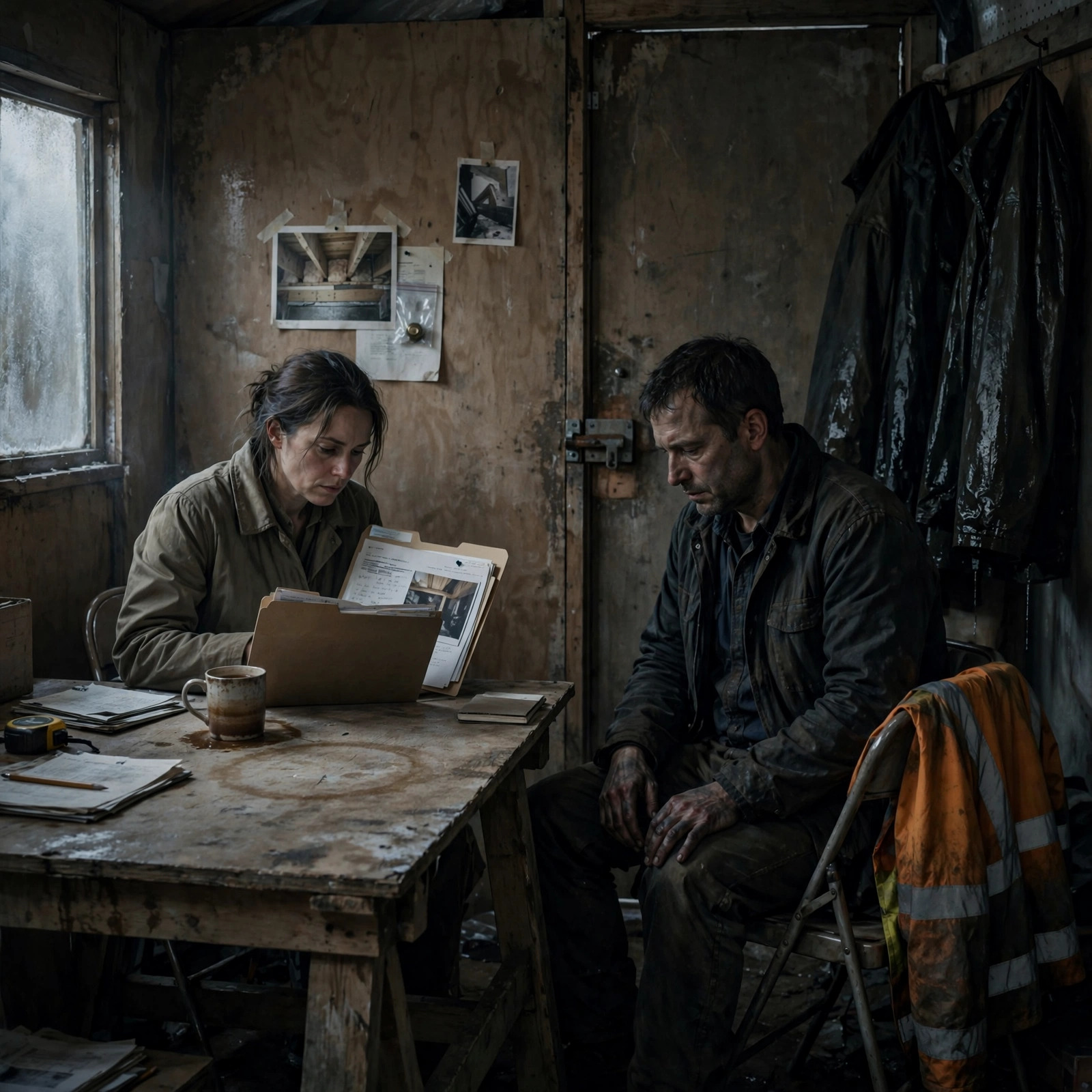
"You'll want the report," Cecily said. "I'd rather you read it than hear it from me at second hand."
She turned the top folder and slid it across. Provisional cause. County fire marshal. Ruth read the line twice, the way you read a measurement you already know is wrong. Origin at the resident's portable gas appliance, in the room of Walter Blythe, deceased. Coroner: accidental. Insurer: finding accepted, liability settled, discretionary fund released for the refit.
"The gas to that heater was capped," Ruth said.
"By you."
"By me. Brass cap, wired tally, my mark on it. It's still on the bayonet behind the bay. I put it on nineteen days before the fire."
Cecily did not write anything down. She let the sentence sit and then opened the second folder, and Ruth saw her own signature at the foot of a page, the annual safety record for the Row, the little boxes marching down it in Enid Trewin's tidy clerk hand. Against Walter's room, in the column for appliances, the word live.
"That is the Trust's account," Cecily said. "It's consistent with the marshal's origin, and it's signed by the fitter who capped the supply. I have to weigh a signed record against a spoken correction, and the record wins. I'm not being obtuse. I'm telling you where the weight sits."
"The clearance crew had that room stripped to the walls before the marshal set foot in it."
"Yes. I've noted it. It weakens the finding and it doesn't reverse it." Cecily closed the folder and set her palm flat on it, courteous as a woman holding a door. "I reopen on documents or on physical evidence. Something in the fabric, something a marshal can stand in front of and photograph. Suspicion I can't use. So tell me plainly, Mrs Kerr. What document do you think you have?"
Ruth had a cap. She had a tally tag with her own maker's mark stamped in it, and a brass nameplate lying face up in her toolbox, and nothing on paper at all.
"None," she said.
"Then bring me something that isn't a conversation." Cecily drew the folders back into line. "And understand what asking does. While there's doubt on the file the fund is paused, and the fund is what's paying for your refit and the daughter's contributions. I don't say that to lean on you. I say it so you know the shape of it before you start."
The boards in Walter's room had been talking to Ruth's boots all morning. She had laid them out as a fault in the subfloor, a softness where the clearance crew had trodden wet ash into the grain, and she had walked past it twice with a coil of pipe on her shoulder. Now she went back without the pipe and stood still in the middle of the floor, heel to toe, heel to toe, until she found the place that gave. Not rot. Rot is sullen. This had a spring in it, a hollow answer, a hand's width of nothing under a board that should have been sitting on pine.
She fetched the pry bar out of the van and worked it into the seam beside the heater bay. The nails came up with a sound like knuckles cracking. Old floorboard, thick as her thumb, tongue swollen with damp, and it lifted a hand's breadth and then all at once, and the smell came out of the void, cold char and something sweeter under it, the pine cooked long and slow rather than flashed.
Ruth put her torch down on the boards angled into the hole and lay on her stomach with her cheek near the grit.
The joist end was burned through from beneath. Not scorched along its top face where a burning room would have taken it, but eaten away underneath, the underside furred and cracked and hollowed, the sound wood above it still pale where the fire had never reached from the room side. She could see daylight grey along the top edge of the char. And at the edge, where the joist met the wall plate, a run of solder, bright as a wet tooth, spalled and dribbled and cooled in a rope, and beyond it a fan of scorching laid across the pine in the shape a blowlamp leaves when somebody holds it too long in one place.
She sat up and looked at the heater bay above. Scoured. Soot wiped and blistered paint, the plaster smoked, nothing burned through, nothing eaten from below. A fire in that bay would have gone up into the room and left the joist whole underneath. This had come up from the void, and it had come up with a lamp already burning down there before it started.
Ruth got the notebook out of her hip pocket and drew it. The bay, the cap, the board she had lifted, the joist in section with the char hatched underneath and the solder marked as a bright bead at the wall plate. She wrote scoured above, eaten below beside it, and then she sat looking at what she had, which was a sketch in a fitter's notebook, made by the fitter who had signed the record, of a hole she had opened herself in a room the Trust had already stripped.
Boots in the passage. Owen Tregaskis came in sideways through the doorway with a clipboard against his chest and his tape hanging out of his jacket pocket, and Bram behind him with the sleeves of his overalls pushed up and a bundle of pipe under one arm.
"You've got the floor up," Owen said. "I'm pricing a riser, not a resurrection. Lench wants the replacement in before the frost and I can't run a length through a room with the boards loose."
"Were you in this room before the fire?"
"Never." He said it comfortably, the way he said everything, with his chin up and his hands busy. "We had the kitchen end and the boiler house. This wing was shut to us. First time my boots crossed that threshold was after the marshal signed his sheet, and you know it, because you were the one letting us in."
"Show me your paperwork."
He flipped the clipboard over and gave her the invoice, carbon-smudged, his own biro pressing through. She read the title before she read anything else. Ferris Row, burned wing: riser renewal following fire. Tregaskis Heating. It sat there in his handwriting, plain as a label on a jar, and it agreed with him. Post-fire. Nothing on it about a leaking riser taken quiet to keep the Trust's bill down, nothing about a joint made in the floor of a room with an old man asleep in his chair above it. She read the title again and felt her argument go slack in her hands, and she handed the sheet back.
"Right," she said, and heard how much of it she had let go.
"Bram," she said. "Was there a lamp going in this room?"
"No." He looked at his uncle when he said it, a quick flick, and Owen was already writing on the clipboard.
Ruth crouched at the bay and got the rag out of her back pocket and wiped the tally tag clean, soot coming off in a grey smear on the cloth, her maker's mark standing up bright under the tarnish where her thumb had been at it yesterday. She left the cap wired and seated. Then she laid the board back down loosely, tongue not home, nails standing proud, so that anybody who came in after her would see it was not fixed.
"Nobody had a lamp going in here," Bram said again, from the doorway, closer than before. "Not once."
He pulled his overalls sleeve down over his wrist as he said it, tugging the cuff flat with his other hand, and Ruth found she was looking at the sleeve and not listening to the words at all.
The Consent Book
The office door had swollen with the rain, and Ruth put her hip against it and came through with her van keys still in her fist. Enid Trewin was up on the step stool, fingers walking along a shelf of buckram spines.
"You'll be the wing," Enid said. "Mr Lench telephoned down. He said give her the permissions, not the whole shelf."
"The wing. And Walter Blythe's room."
"It's all one book." Enid brought it down against her chest and set it on the counter with a flat sound, then blew the dust off the top edge. "Opened the year Mr Lench took the surveyorship. Before that it was loose sheets in a drawer and half of them gone. I put a stop to that."
Ruth turned the cover back. Buckram over board, corners gone soft as felt, the spine mended with linen tape that had browned with age. Inside, the forms were pasted in one under another, ridges of paste she could feel under her thumb, every entry in the same upright hand, the letters leaning neither way.
"White top copy stays in the book," Enid said, tapping the edge of a sheet. "Pink goes out to the resident. Buff to the works. Triplicate, so nobody can come back afterwards and tell me what was agreed."
Ruth worked along the room numbers in the margin until she reached the burned wing, and then back through the entries to the week of the fire. Walter had refused.
"I do not consent to the replacement of the riser through my room," she read, half aloud. "I am satisfied with the arrangements as they stand and I will not have my floor up. Walter Blythe."
It ran across the line in full flowing script, the letters joined, the long tail of the y curling back under the words like a signature on a cheque. She had his brass door plate in her toolbox out in the van, cut by hand and filled with black wax, and this was the hand that had cut it. The same hand that had done every plate in Ferris Row, and the numbers under them, and the little scroll on the end of the lane sign.
"He was proud of that writing," Enid said. "He did the office window in gold, free of charge, and never let me forget it."
"No," Ruth said. "He wouldn't."
Below the refusal, pasted flat and squared to the edge, was a consent and hot-work permit for the same room, dated the day of the fire.
She read it twice. Permission for the resident's floor to be lifted and the riser joint renewed. No signature. A cross, drawn in the box where the signature went, and beside it in Enid's upright hand, witnessed, E. Trewin, and under that the surveyor's countersign, A. Lench, the L looping up tall and the pen pressing hard enough to raise the paper on the reverse.
At the foot of the form, in a printed square, somebody had put a tick. Fire watch maintained throughout.
Ruth stood with her palm flat on the counter and felt the argument she had carried in from the site shift under her. Consent given. Permit issued. A watch posted. If all that was true then the job had been lawful and the fault lay with whoever held the lamp and walked away from it, and she could see the shape of a young fitter with his sleeve pulled down over his wrist.
"Who was on the watch?" she said.
"That would be the contractor's side. It isn't a Trust appointment." Enid was already turning to the door, because the door had opened again and the printer's man came in sideways with a carton hugged against his chest, rain on his shoulders.
"Counter's fine," he said. "Two pads to a box, same as the note. Where d'you want them?"
"There, and mind the book." Enid cleared a space with her forearm and took the delivery note off the top of the stack. He set the carton down, ran a knife along the tape, and lifted out the new pads in their paper bands, and the smell of fresh ink came up over the smell of wet coats.
Ruth looked at the top sheet of the nearest pad while he was still cutting the second band.
Room. Nature of works. Resident's signature or mark. Witness. Surveyor's countersign. And at the foot, in a printed square, fire watch maintained throughout. Empty. The same square, the same rule, the same wording, sitting under the same little instruction line about hot work in occupied rooms.
"That's your box, that is," Enid said, and she said it with pleasure, signing the note against the carton lid. "You came in here after the fire and you stood where you're standing now and you said there ought to be a box for the watch, so a person had to put their name to it. I wrote to the printer that week. It took him long enough."
"It's a good box," Ruth said.
"It's a proper improvement. First of the stock with it on." Enid slid the bands off and squared the pads with both hands, the way she squared everything. "The old forms had nothing. You could do a job in a man's room and never write down who was watching the lamp."
Ruth got her notebook out of her overall pocket and opened it past the sketch of the floor void, the joist end, the run of solder she had drawn with the pencil pressed hard. On a clean page she copied the refusal, the whole of it, and then the permit: the room number, the date, the cross, the witness, the countersign. She drew the square at the foot and put the tick inside it. Then she wrote the delivery, new pads, this morning, and did not say why she was writing it.
"I'll need Walter's pink," she said. "The duplicate of that consent. He kept everything. He'd have had it in the tin with the rest."
"We don't issue copies to the residents."
Ruth looked up. "You said pink goes out."
"That's the form." Enid laid the pen down along the edge of the pad, straight. "The residents don't get them. They lose them, or they put them in a drawer with the gas bills, and then there's a paper floating about the Row with a mark on it and no context to it, and somebody makes something of it."
"Enid. There's a cross where his name should be."
"He was cold and he was proud and he changed his mind, and he couldn't hold a pen that week to save himself." Enid's chin came up. "You know what happens if the claim fails. The Trust hasn't the reserve to carry that wing. The Row closes and the residents go into county care, and there's a room in that book with your mother's name on it. So no. I'm not hunting out a pink for you to take away and read out at a meeting."
The printer's man went out with his empty carton flattened under his arm, and the door swung and stuck and Ruth pushed it shut with her foot.
Saul came in then with his hours book inside his jacket to keep it dry, and stopped when he saw who was at the counter.
"Am I in the way?"
"Wipe your boots," Enid said, and her voice went soft in a way Ruth had not heard in it before. "There, on the mat. Bring it here, love, and I'll do the week."
He brought it. Enid signed and dated and blotted with the pad of her finger, and told him his grandmother had put by something for him in the drawer, and he went red and thanked her.
"Ruth," he said, turning. "The riser. When you gas it in, can I do the tightness test under you? I've the application half filled. I only need the last stretch signed off."
"We'll see what's left of the wing," Ruth said.
"He's near the end of it," Enid said to the book, not to her.
Lench came in with his coat over his arm and stood shaking the rain off it before he would come near the counter.
"Ruth. You've been in the floor."
"I've been in the book."
"Better." He set his coat on the chair and looked at the new pads with satisfaction. "Now. This refit. I want it done at proper rates, not the charity prices you've been charging me since you had a bench. Materials, labour, your hours, a margin. I'll not have you subsidising my almshouses."
"The contract's at cost."
"The contract is what I say it is, and your yard is a dollar a year, and I'd like to keep both those arrangements where they are." He put two fingers on the open page, well clear of the ink. "You've come a long way from the girl I articled. I signed your papers when there was nobody left to sign them. I'd hate to see you spend all that on a floorboard."
"Walter refused the work in writing."
"And then he asked for the heat back." Lench said it patiently, a man explaining a rate to a committee. "I countersigned it myself. Was I to leave him cold because of a form he'd signed in a temper?"
"Who kept the watch?"
"Ask Tregaskis. It's their permit line." He took his coat up again. "Bring me the refit priced properly, Ruth. That's the work in front of you."
Enid was signing the delivery book. Ruth slid a blank form off the top of the new pad, the paper crisp, the empty square sitting at the foot of it, and put it in her pocket while nobody was looking at her hands.
Then she took it out again and folded it once, and once more, and pressed it flat into her notebook beside the square she had drawn with the tick inside it. Enid shut the book without looking at the page.
The Unsigned Renewal
Ruth got the pry bar under the board at the wall plate and leaned on it until the nails let go, a dry crackling run, and the smell of wet char came up out of the floor. She lifted the plywood clear, propped it against the skirting, and set her lamp down so the beam ran along the joist end instead of across it.
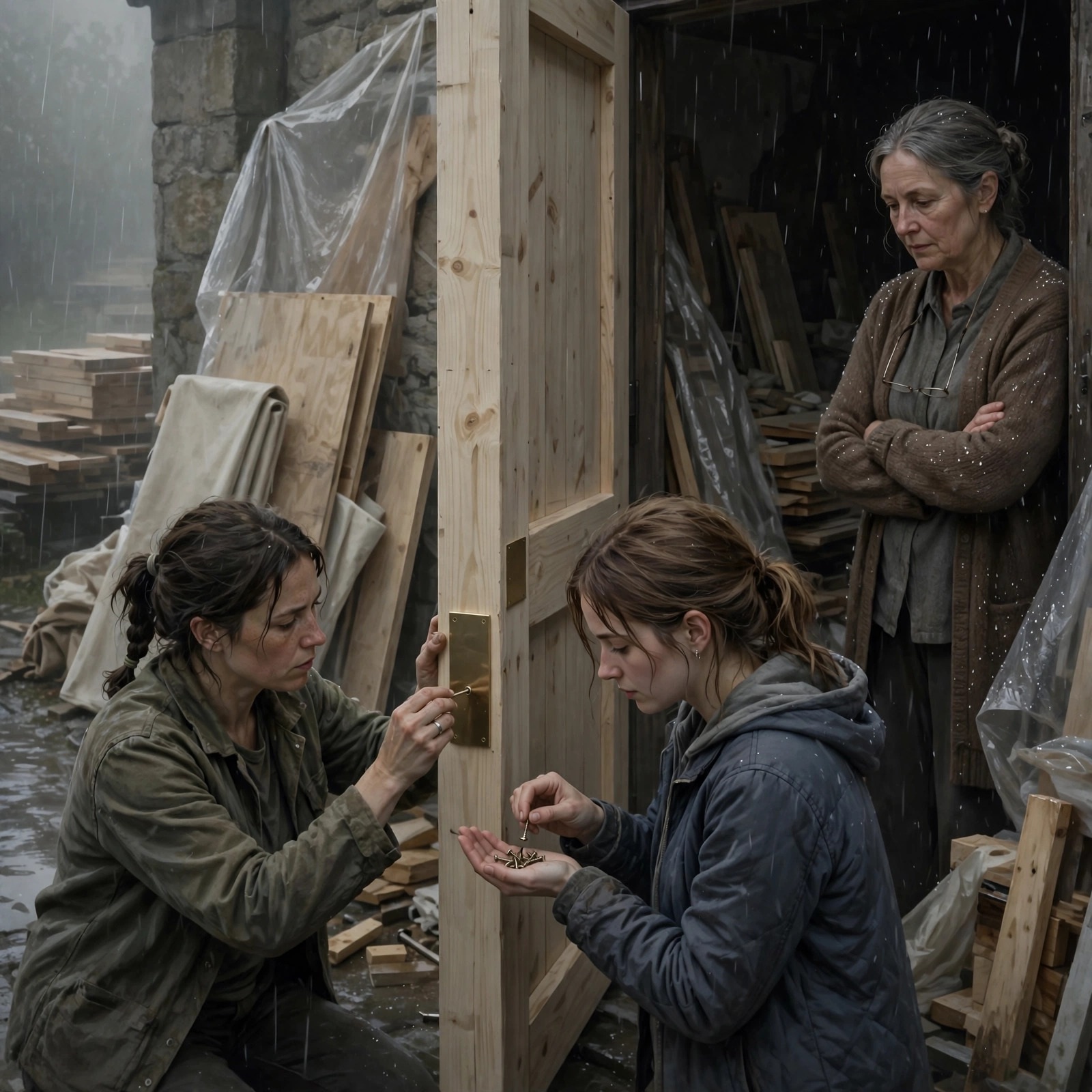
"There," she said. "Burned from underneath. The heater bay above it's scoured and nothing more. Look at the solder."
Owen Tregaskis came down on his heels with a grunt and put his glasses on. The bright run of it lay along the wall plate where the pine had gone black and hollow, and the fan of scorch above it was still sharp under all the water that had gone through the room.
"That's a lamp," Owen said.
"That's a lamp held under an occupied room with nobody standing watch on it."
Bram was by the window with his cap in his hands, turning it. Saul had the lamp lead coiled over his forearm and stood where he could see the floor and not the men. Lench came in off the landing, shook the rain off his coat in the doorway, and looked at the open void the way he looked at a rate somebody had queried.
"Well," Lench said. "You've made your point, Ruth."
"I've made it before. I'm making it where the crew can hear."
She had it whole now, and it fitted, and the fitting of it was such a relief she did not stop to test it. A fitter with no ticket. A lamp under a floor with a man asleep above it. A permit line filled in by the firm to cover the job after the fact. And upstairs, a surveyor countersigning what he was handed, because he was sixty and busy and had never in his life climbed into a void.
"Bram brazed it," she said. "He's the only one who was under this floor. The permit line belongs to Tregaskis Heating. Mr Lench signed what he was given and he was given a lie."
Bram's cap stopped turning.
"Now hold on." Owen got up off his heels by degrees. "You'll not put my firm's name to a permit. I've never filled a permit line in my life. Ask who wrote it, and ask them with a witness."
"Then tell me whose lamp."
"I'll tell you what I did do, since we're all being frank." Owen took his glasses off. "I priced the riser off the books. Mr Lench asked me for a number that didn't need a shutdown and a resident's consent, and I gave him one, and the Trust saved itself a bill it couldn't pay. That's mine. I'll carry that."
"There was no money for a shutdown," Lench said. "There's less now."
"And I told that boy no lamps in occupied rooms." Owen turned and it was awful how quietly he did it. "Bram. Give me your keys. You're done with me."
"Uncle, I was told--"
"Keys."
Bram put them in his uncle's palm and stood there with his hands empty, and Ruth watched it happen and let it happen, because she had said the name and the name was the right one, or the nearest one, and the nearest one had a firm behind it that could pay.
Lench had already taken out his phone. "Take your men off the wing," he said to Owen. "All of them. The insurer will want it untouched."
The sheeting went up before the crew went out. Ruth held the roll while a labourer stapled the polythene across the doorway, and the boards came down over the void, and Saul brought the last of the fixings and set them in her hand without being asked. The room went white and dim behind the plastic. The solder was under there with her cap and its brass tag still wired to the capped bayonet, and she thought, with something close to comfort, that at least nothing else would be disturbed.
Bram caught her on the landing. He was shaking so badly the paper rattled.
"I kept it in my overalls." A work order, folded small and gone soft at the creases, carbon flaking off the inside of the fold. "It come from the office. Uncle said get the heat back on and get out. I never wrote nothing on it."
Ruth opened it against the window ledge. The riser renewal, the room number in the margin, and beside the number two initials in a hand she had been reading on her own indenture papers half her life. At the foot, the signature. Aubrey Lench, surveyor to the Marlbeck Almshouse Trust, the downstroke of the L hooked the way he hooked it on everything.
Surveyors' clerks initialled for them all day. Enid wrote every entry in that book, and she could write a man's initials as easily as his name.
She folded the order and put it in her coat pocket and did not take it out again on the landing.
Her phone went in the van. A woman from the licensing board, polite, reading from a screen. Records pulled for review. The annual safety record for Ferris Row, signed by Ruth Kerr, listing the portable heater in that room as live.
"That's my signature," Ruth said.
"We'll need the amendment filed against it."
There was no amendment. She had capped the supply nineteen days before the fire, wired her tally tag to it, done it as a favour and never charged a penny, and never sent the paperwork in, because Lench had asked her quietly and she had been glad to be asked. Nineteen days, and the record still said live, and the finding had stood up on that record like a leg on a floor.
"There's an apprentice application linked to your ticket," the woman said. "It's held with yours."
Saul was waiting at the tailgate with a letter. He put it in her hand and stood back while she read the board's line about his assessment being withdrawn pending review, and she got to the bottom of it and looked up, and he did not ask her to fix it. He did not ask her anything about it at all.
"Shall I put the coils back in the van?" he said.
"Put them back."
He did it, and shut the doors, and went to see whether the sheeting needed another staple, and Ruth stood with the letter and understood that she would rather he had shouted at her in front of the whole yard.
Loveday Blythe came up the path at the end of her shift with her warehouse pass still on her lanyard. Lench met her at the hut door with an envelope and explained it to her gently, twice, because she did not seem to take it in the first time. The insurer had frozen the discretionary fund pending cause. The balance of the repairs would be billed to her, as the resident's next of kin, against the twelve hundred dollars already received.
She took the letter with both hands, as though it were something hot that had been passed to her across a counter.
"I'm sorry," she said. "I know it's an inconvenience to everybody. He was fond of that heater. He wouldn't have anything else in the room, and I've told them so, and I'll say it again to whoever needs it." She smoothed the envelope flat against her coat. "He kept everything, my father. Every note they ever gave him. There's tins of it in the house at Cadger Lane. If any of it would help you people, you're welcome to it."
Ruth said she would come and look at the tins, and Loveday thanked her for her patience, and went back down the path with the letter held against her chest.
Inside the hut Lench had cleared the bench. The renewal of her lease of Tilehouse Yard lay on it, typed on Trust letterhead, signed by him alone, a dollar a year, with the maintenance contract clipped behind it and the rates left blank for her to fill. A closure statement sat on top. He laid a pen across the papers and turned it so the nib was towards her.
"Sign the closure and I can put the rebuild out to tender," he said. "Properly priced. Your hours, your materials, a margin, none of this charity. Your mother's room is warm and it will stay warm. I signed your papers when there was nobody left alive to sign them, Ruth. I'm not asking you to forget that. I'm asking you to be practical."
"Walter refused the work in writing."
"And then he asked for the heat back." He rubbed his eyes with the heel of his hand, and for a moment he looked like what he was, an old man in a wet coat in a site hut. "You've a name now. Don't spend it on a floorboard."
Ruth went out to the van. The plate was in the toolbox under a rag, brass gone dull at the edges, the letters cut by hand and filled with black wax, the flowing W and the long tail on the Y that he had put on every door in Ferris Row including his own. She carried it back and set it on the bench beside the unsigned renewal, close enough that he had to read it.
Lench looked at it for a while. "He did all the doors," he said.
"He did all the doors."
She wrapped the plate in the rag, carried it out, laid it back in the toolbox and closed the lid, and left the pen lying where he had put it.
Her Father's Tin
Ruth sat in the van at the top of Cadger Lane with Walter's door plate on her knee, working her thumb along the tail of the Y until the brass came up bright around the black wax. Then she wrapped it in its rag, laid it back in the toolbox, and went down to the door with the wet cold coming up through her boots.
Loveday had the kitchen warm and the radio off. She took the tin down from the dresser with both hands, a toffee thing gone rust at the hinge, and set it on the table between the salt and the sugar. The lid would not shift. She worked a butter knife under the rim and it came with a crack like a knuckle.
"I've never been through them," Loveday said. "I couldn't see what I'd be reading them for."
Inside were pink carbons, thin as onion skin, the writing pressed through from the top copies in Enid Trewin's careful clerk's hand. Ruth laid them along the table in the order Loveday gave them: a new window catch, the boiler service, the gutter clearance, the repointing of the path. Every one signed at the foot in full flowing script, Walter Blythe, the same hand that had cut the letters into every brass plate in Ferris Row.
The refusal sat among them where it belonged. I will not have men under my floor while I sleep above it. And underneath, the whole name, unhurried, the long tail on the Y.
"He was vain about his hand," Loveday said, and half laughed, and stopped. "He did the plates for the whole Row, every door, and he'd not let anybody polish them but himself. He'd have walked out of that office before he'd put a cross on a paper and let a stranger write his name beside it."
"Is there one for the day of the fire?"
Loveday squared the copies by their dates and went through them twice, licking her thumb, laying each one down like a card she was certain of. The last was the gutter clearance. After that, nothing.
"He kept every pink they ever handed him. Every one, going back to when he first came. If they'd given him a paper that morning he'd have brought it home and put it in here." She pressed the lid flat with her palm. "There's no copy because there was nothing to copy."
Ruth took her notebook out and the blank form she had pulled from the new pad in the Trust Office, and laid the blank against the entry she had copied out in the office with Enid watching her do it. The consent for Walter's room. The hot-work permit. The date, the day of the fire. The cross mark, witnessed. And in the corner, the little box for the fire watch, ticked.
The box sat in the same place on the blank sheet in her hand. It had not been on any form in that book before the fire. She had asked for it herself, sitting in the site hut with her hands shaking, and the printer had brought the first pads while she stood at the counter reading Walter's refusal.
The consent had been written afterwards. On paper that had not existed on the day it claimed to be written.
She had spent the whole week building a version of this in which Aubrey Lench was one more person who had been lied to. There was no room left in it for him.
"They've sent me the balance," Loveday said. "For the repairs. I've paid them twelve hundred dollars and I'll pay the rest by the end of the month, I've said so."
"Don't send them anything else."
"It's my father's room, Ruth."
"The permission they've got for his room was made after he was dead." Ruth turned the blank form so the box faced her. "Look where the tick is. That box came off a printer's van after the fire. He never asked for his heat back. He never asked for anything."
Loveday put both hands on the table and left them there. "Then say that to somebody. Say it to whoever writes these things down."
"I'm going to."
Grace had the kettle on before Ruth had her coat off. The room at the end of the Row was hot enough to make Ruth's face prickle, the radiator ticking under the window, the geraniums turned towards the glass.
"Sit down," Grace said. "No. Don't sit, you'll only get up again."
"Mam."
"Enid tells me you've been in the consent book. Enid tells me you took a blank form out of the new pad and walked out with it." Grace filled a mug and set it in front of Ruth. "Let it stand."
"I can't."
"You can, and you'll be doing what everybody else in this town does, which is minding their own trade." Grace's voice went up and cracked on the last word and she brought it down again. "You've a bench because he gave you a yard. A dollar a year, Ruth, and the work at cost, and your father in the ground and nobody left to sign your papers but him. I've a door that locks. I've the sun in the afternoon. I've carried trays through the county place and I know what's at the end of that corridor, and it isn't a geranium."
"I know what he did for me."
"Then don't hand it back for a floorboard."
"For Walter's name," Ruth said. "He cut the plates for every door in this Row. They've got him down as a man who put a cross on a paper because he couldn't write."
Grace took the mug she had filled, poured it out in the sink, and set it upside down on the drainer. She stood with her back to the room and her hands on the edge of the counter.
"I'm not promising you that," Ruth said. "I'd be lying and you'd know it by Friday."
"Then don't come for tea."
The sheeting over the doorway of Walter's room came away in Ruth's hands with a sound like a sail. Inside, the stripped walls, the scoured mounting block, the bayonet supply with her cap on it and her brass tally wired to the cap, her own maker's mark stamped into the metal where she had crimped it. She took the side cutters from her bag and cut the wire and the tag came free into her palm, still warm from the room, which was nonsense, which was only her hand.
She wrote the statement in the driver's seat with the pad on the wheel. The room. The date. That she had capped and tagged the supply nineteen days before the fire, at the surveyor's asking, uncharged, as a favour. That she had filed no amendment with the board. That the annual safety record she had signed still listed the heater as live, and that the finding of accidental death had leaned on her signature, and her signature had been wrong. She read it through once and signed it under her own words.
In the site hut the renewal was still on the bench where Lench had left it, the pen beside it. Ruth folded the papers and put them in her coat pocket without looking at the rates.
Cecily Frayne came out from behind the counter with the marshal's report in her hand. Ruth laid the tag down, and the statement, and Bram's work order with the surveyor's initials against the room number, and then took her ticket out of the window in her wallet and put that down too.
Cecily read the statement standing up. She read it again.
"You know what this is. It's an admission in your own hand and I have to disclose it. The board will suspend you pending a hearing. They may take the ticket for good. I can't hold your registration, it isn't mine to hold."
"Log it as an exhibit. It's the number on the record you're reopening. Let it go to them from your file and not from his desk."
Cecily looked at the card a while, then slid it in behind the statement. "The bill on the Blythe woman stands until the marshal moves. I can't stop that today."
"Look at the joist before anybody sheets that wing over again."
"I'll photograph it myself." She lifted her camera off the shelf and put the strap over her head. "And I'll ask the printer for his delivery note. Paper can be dated anything a man likes. A delivery note is a fact."
She slid the brass tag into a clear bag, clipped Ruth's statement behind it, and wrote on the bag in small square letters. Ruth went out past the sheeting and the stacked boards to the van, and shut her wallet on nothing, and drove with the renewal folded in her coat, unsigned.
Brass Screws
Ruth had the old hinge plate off the repaired door when Cecily Frayne came up the path with a folder held flat against her coat.
"The marshal has amended it." Cecily laid the report on the doorstep and weighted the corner with the tin of screws. "Origin in the floor void. A contractor's lamp on the riser joint, no fire watch, room occupied. The resident's appliance is excluded."
Ruth wiped her palms down her thighs before she touched the paper. The photograph was the one she had asked for and had not let herself imagine: the joist end opened up, the run of solder, the scorch fanning out from the joint into the pine.
"Your cap is in it," Cecily said. "Bagged and listed, maker's mark legible. He writes that the bayonet was capped and tagged nineteen days before the fire and could not have fed anything. Your tag does that. Your statement sits underneath it, and the board has both."
"And the loss?"
"Tregaskis Heating's liability cover. Their insurer has the notification and hasn't argued it. Owen reported the unregistered work himself, in writing, and took Bram back on as a labourer until the registration comes through. He carries the reporting instead of the firm going under." Cecily shut the folder. "The Trust's claim stands on the true cause. The Row stays open. Nobody moves out."
Loveday came up the path with an envelope soft from being carried about. "They've billed me again. The balance." She held it out and then didn't let go of it. "I've been to the bank twice this week."
"That bill is withdrawn as of this morning," Cecily said. "The Trust refunds what you've paid. Enid has the authority at the counter and you'll sign for it. Bring anything of your father's they need filed."
Loveday looked at the door, at the raw new timber and the empty screw holes above the handle. "I've got his pink copy. The refusal. It's been on my kitchen table since she came up the lane."
"Then bring that," Ruth said.
The Trust Office smelled of radiator dust and gum. Enid Trewin was alone at the counter with the consent book open in front of her and both hands flat on the buckram, as though she had been sitting that way since the fire.
Ruth took the blank form out of her notebook, the one she had pulled from the new pad while the printer's man stood in the doorway with his trolley, and laid it beside the bound consent for Walter's room. The little box sat in the same place on both sheets. Fire watch in attendance. Ticked on one, empty on the other.
"That box didn't exist when this was dated," Ruth said. "I asked for it. After."
Enid's mouth moved without sound. The inner door opened and Lench came through with his coat over his arm and the rent ledger under it, and he stopped where he was, at the end of the counter, because he was a man who read a room the way he read a schedule.
"Whose hand dated it?" Ruth asked him.
He set the ledger down. He looked at the two forms side by side for a while, and then at the cross mark, small and neat and made by a woman who had never in her life forged anything before.
"Mine," Lench said. "Enid wrote the body at my dictation. I put the date on afterwards, and I told her to make the mark and witness it. Walter refused the work in his own hand and I had no consent, and a permitted job needed a shutdown I couldn't pay for."
"You wrote it after he was dead."
"I wrote it after, so the insurer would keep paying." He straightened the ledger against the counter edge. "Do you know what the cottages would have cost the county? A failed claim closes the Row. The land goes, the roof goes, and every one of them goes into a home on the ring road with a locker for their things. Your mother included. I weighed that against a date on a form and I chose."
"You could have asked me to sign the amendment," Ruth said. "Nineteen days before. I'd have filed it and taken the fine."
"Yes." He said nothing else, and that was the worst of it, that he didn't dress it.
Ruth took the renewal out of her coat and unfolded it and pushed it back along the counter, unsigned, and laid the yard keys beside it. The brass fob had worn smooth on one side from her thumb.
"A dollar a year was never rent," she said. "Take it back."
"The trustees will let the yard at the market rate. You won't be able to hold it."
"Then I won't hold it."
Lench pulled a sheet of Trust letterhead from the drawer under the counter, and Enid handed him the pen without being asked, and he wrote a short paragraph in the same hand that had signed the work order and the false date. He signed it. He put his office keys on the wood beside the pen, and his coat went over his arm again, and he stopped in front of Ruth as if there were something left, and there wasn't.
"I articled you," he said.
"You did. That's why I could read the form."
The inner door shut behind him. Enid sat down slowly and drew the consent book towards her and ruled a single line through the false entry, corner to corner, and initialled it in the margin. Her hand shook on the initial and she let it.
"The trustees have written to me," she said. "I keep the counter on probation. One more untrue entry and I'm out of the post and the flat with it." She looked up. "I've a grandson who needs his hours signed by somebody honest. I'd rather it was me, if you can stand the sight of me."
"Bind these in behind it." Ruth laid her copy of the statement on the counter, and Loveday laid the pink refusal beside it, carbon-smudged at the edge, Walter's full flowing signature running clean across the bottom the way he had signed every plate he ever engraved.
Enid threaded the needle through the sewing and pulled the sheets in tight and trimmed the tape. Then she counted twelve hundred dollars across the counter in used notes, and wrote the receipt, and stamped the balance bill withdrawn, and Loveday signed with the pen still shaking in her own hand now.
Saul came in with his hours book under his jumper, out of the rain that had started while nobody was looking. Ruth filled the book at the counter: the days he had actually worked, the stretch he had stood idle when the board pulled her records, written plainly as idle, no invention in it. She signed the transfer of the rest of his indenture to Tregaskis Heating and Enid witnessed it and stamped it with the office seal.
"Owen's put me on wages," Ruth said. "Shop work, under his ticket. You'll finish under him and he'll sign you off proper."
"Will you be there?"
"On the bench beside you, most days." She handed him the book. "Don't let anybody write your hours for you."
Grace was standing at the door of the wing when they came back, in her cardigan, with the rain on her shoulders and her chin up in the way Ruth had been walking through all week.
"You've lost the yard," Grace said.
"I have."
"And your ticket."
"Pending a hearing. I might get it back."
Grace looked past her at the sheeting and the stacked boards. "I told you to leave it alone. I'd have let him keep on. That's mine to sit with, not yours." She put her hand on her daughter's arm and left it there, heavy and warm through the wet sleeve. "The kettle's on. Don't stand out here being noble."
Ruth got the rag out of the toolbox and unwrapped the plate. The brass had come up bright under the polish, the black wax still sitting deep in every letter, the serifs Walter had cut by hand with a graver and a steady wrist, WALTER BLYTHE, the whole name flowing like a signature because he had never in his life done anything shorter.
She set it against the new timber and sighted it along the moulding, and moved it, and sighted it again. Loveday stood at her shoulder with the brass screws in her cupped palm and handed them up one at a time, and Ruth started each one with her fingertips so the old threads in the new wood took hold without tearing.
The rain came finer. Grace watched from the doorway with her arms folded. Loveday tipped the last screw into Ruth's fingers, and Ruth drove it home until the plate sat straight under her father's name.
Get notified when new stories drop

Imogen Reyes
Imogen writes searches against the clock and records that lie, led by ordinary people who notice what others miss.
Leave a comment
Comments