

The Scale House
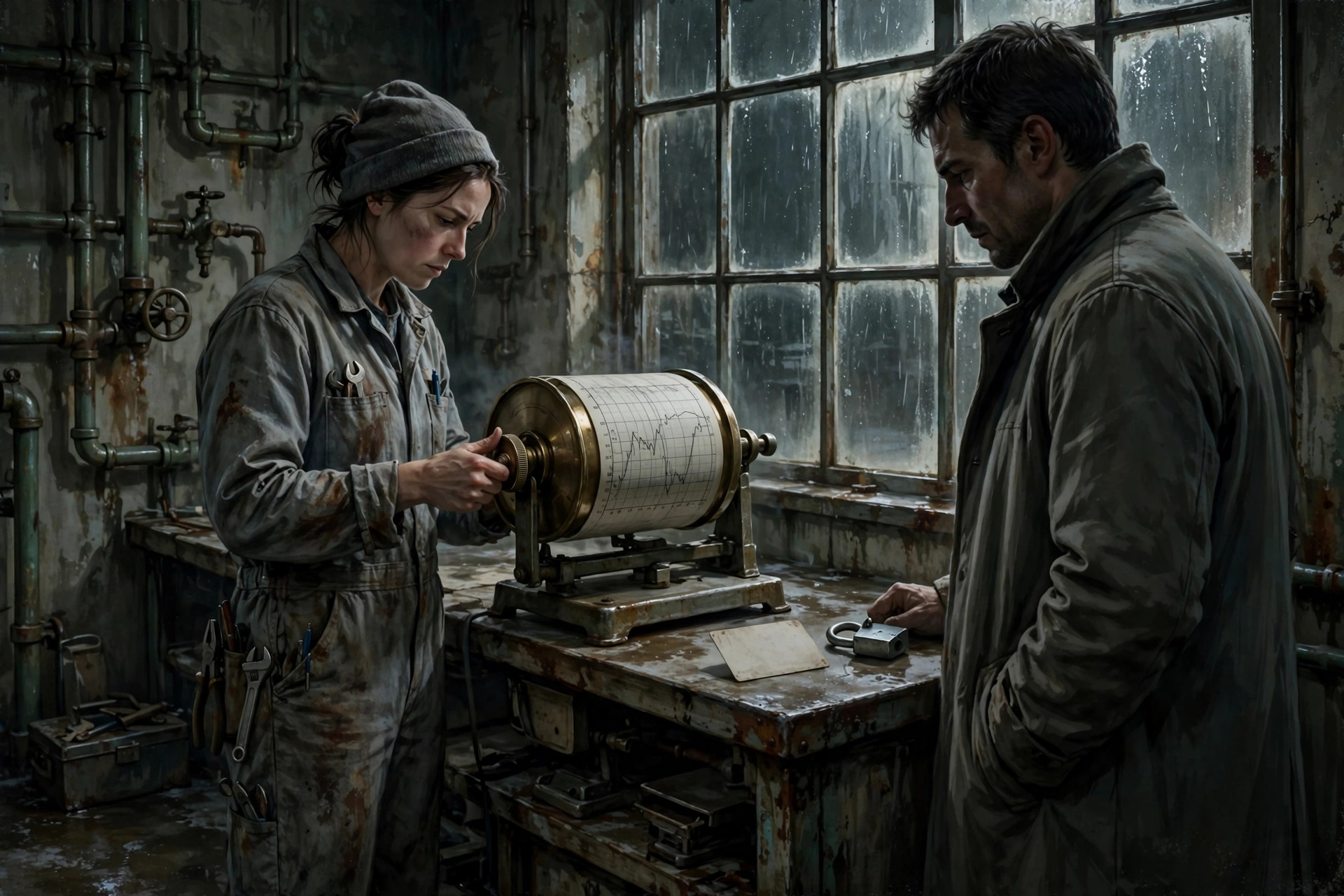
The drum turned under Greta's thumb and she read the night off the paper, right to left, the way the pens had written it.
Brine temperature had ridden its band since the late shift, a hairline shivering with the compressor's cycling. Suction sat where she had left it. The load pen for the chiller had never come down off its ridge; it drew one long even country across the whole night, no dip, no notch, nothing to mark a machine coming off. She had read a thousand charts like it. She initialed the corner in pencil, sprang the clip, rolled the sheet and slid it into the tube rack over the bench, then seated a fresh chart and brought the pens down onto it.
Her pocket book took the rest. Pump gland weeping, worth repacking. Salt creeping up the chiller shell like frost that had given up on melting.
She went along the machine with her lamp and laid her palm on the shell, and the cold came up through the callus. At the isolation valve she stopped, because the jumper was there where it always was, a two-core cable bridged across the terminals on the valve head so the switch could never drop the machine out. Salt had crusted the binding wire. The brass tag wired to it swung against the housing and caught her lamp, and the letters stamped into it were a ticket mark, the kind a journeyman carries. She thumbed the crust off the face of it. It was not in the log. It had never been in the log, through the lean season it was put on and the season after.
She wrote the pressures down and shut the book.
Cleve came in sideways through the engine-room door, cap in his hands, which he never was
Two Inks
Osgood had the card out of the rack before Greta got her gloves off. He squared it to the edge of the Scale House counter with the side of his thumb and set a steel lock beside it, out of his case, the way another man would set a paperweight. The lock had a short shackle and a key on a wire loop. He did not look at her while he did it.
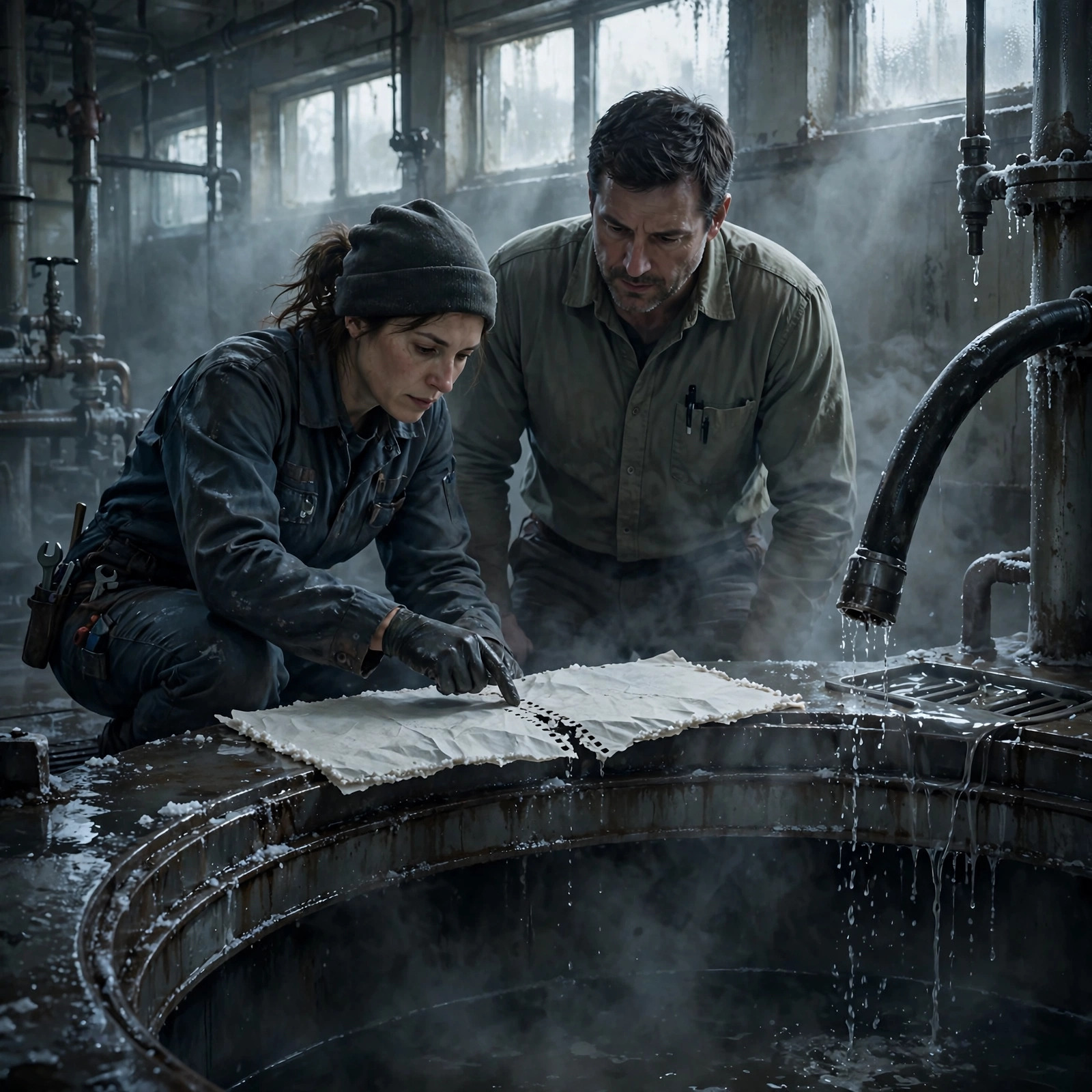
Gaunt was at the far end of the counter with the freight ledger open and his mug going cold at his elbow. He turned a page and let it lie. The green felt-tip rode in his shirt pocket where it always rode, clip stretched, cap chewed flat on one side.
Greta came and looked. The card was the ordinary stock, stiff, carbon-backed, the tank named across the top in Gaunt's block capitals: BRINE No. 2, INTERIOR, WASH AND INSPECT. The approval box was filled in green, his signature sprawling out of it and over the printed rule. In the witness box sat a pencil initial, small and pressed hard, C.T. At the foot, in ballpoint, was Bruno's name, the H made in two strokes with the second one trailing off because his hands were never still long enough to finish a letter.
"The signature at the bottom," Osgood said. "You've seen it on other paper."
"Dues cards. Grievance forms. His benefit election, every year." She kept her finger off the card. "That's his. He does the H like a man walking away from it."
What sat above the signature stopped her. The line granting entry had been struck through with a single stroke, and under the stroke, in the margin, someone had written entry not sanctioned. Both in green. She bent until the counter's edge pressed her hip and looked at the way the ink had feathered into the grain of the stock, the little blooms where the felt had rested at the start of a letter, the width of the stroke where it crossed the printed rule. It was the same green. Not a green close to it. The pen that had approved the entry and the pen that had cancelled it had come out of the same box from the company stationer, and there was only ever one of them out of the box at a time, and it lived in Gaunt's shirt.
"Who wrote underneath?" she asked.
Gaunt came down the counter without hurrying and looked where she was looking, as if it were a freight rate he had already checked. "It's my hand. Everything in green on that rack is my hand or it's nobody's. That's the whole point of the colour."
He took the pen out and used the barrel to point, not touching the card, tracing the air above the witness box. "Cleve puts his initials there. Pencil. He sees a man go, he writes that he saw it. He can't approve. He's never been able to approve."
"Then who approved this one?"
"I did." He put the pen back and clipped it with his thumb. "The card was written here, at this counter, and signed here. He came up with his boots on and his lamp in his hand and I told him the line was cold and he signed it. Then I was here the rest of the night. Load-out sheets, the freight bills, that ledger you're leaning on. Ask the weighbridge if you like your answers stamped."
Greta turned to the rack. It was Gaunt's own build, oak offcuts and brass screws, slots cut for the cards to stand on edge. The slot where Bruno's card had lived was a gap, and the cards that should have stood behind the gap were standing in front of it, filed ahead of the empty place, night work written after his, the wash-down cards and the pump inspection. She lifted them with a fingernail and let them fall back.
"They go in as they come back to me," Gaunt said. "Not as they're written. Cards come back when a man's out and cleaned up and remembers he's carrying one. Sometimes that's the shift after. I'm not going to shuffle a rack to make it look tidy for a visitor."
"And a man goes in on a nod from Cleve," Greta said. "Half the time. You know that."
"I know it happens." He drank the cold coffee and did not wince at it. "The card's approved and the man's standing at the tank and Cleve's on the floor and I'm up here, and nobody wants to walk the yard for a piece of paper that already exists. It's lazy. It isn't the same as sending a man in without a permit, and I won't have it written down as if it were."
Osgood wrote something in a small notebook, standing, without resting it on anything. Greta took out her phone.
"Before it goes in the bag," she said. "The local's entitled to know what the company's holding."
"Flat on the counter. No flash. Nothing moved." He stepped back exactly far enough to be out of the frame and no farther.
She took it from above, then low along the surface so the light raked the ink and showed the felt's ridges. On the screen the strike-through and the note underneath glowed the same shade of green as the approval, and the perforation at the card's foot showed its ragged edge where the flimsy had been torn away. She put the phone in her pocket with the picture in it.
"Now the machine," Osgood said. "Was the chiller isolated before he climbed in?"
The brass tag was in her mind then, swinging against the valve housing, the salt crust on the binding wire, the letters stamped in it that were hers. She heard herself answer in the voice she used for rounds.
"Line was isolated. It's isolated for every interior. That's the procedure and that's what happened."
He looked past her, through the engine-room door, at the recorder with its fresh chart turning and the pens down. "The night sheet."
"Filed in the tube rack. You'll want the pressures more than the paper." She had her pocket book open before he could ask again, and she gave him the gland weeping on the brine pump, worth repacking, and the salt creeping up the chiller shell, and the band the temperature had ridden since the late shift, and how the pens rode high and lazy when a shell was fouled, which was a maintenance note and not a mystery. She talked about fouling until he stopped looking at the door.
He let her finish. Then he wrote in the notebook again, unhurried, and she understood that he had marked the place where she had gone around a thing instead of through it, and would come back to it, and that he was keeping something in that case besides a lock. She was keeping the tag on the valve. He was keeping whatever a man from the parent firm keeps.
Osgood slid the card into a heavy envelope, licked the flap, and pressed it down along the whole length with two fingers. He initialled across the seal, then clicked the steel lock shut on his case and put the key on its wire loop inside his coat.
Greta's hand had gone to her keyring, to the little brass padlock the hall kept there, and she stood turning it over. The rack card was sealed. The flimsy had been torn off at the perforation before Bruno ever put his boot on the ladder, and a man folds a flimsy into his coveralls or his boot because that is where a man puts things, and his coveralls and his boots were in his locker in the change room, and the company had put its tape across the locker door.
Bruno's Boot
The tape came away from the locker door in a long strip, and Zora wound it around her fist until the knuckles stood up white. "They told me not to open it."
"They told me a lot of things yesterday." Greta peeled the last of it off the paint and stuck it to the bench edge, where it curled and let go.
Zora put the key in her palm. Small brass, worn smooth, threaded on a bootlace gone grey at the knot. "He never carried it on a ring. He said a ring catches on a ladder." She shut her hand over Greta's fingers and then took her own away fast, as if the giving were the hard part and she meant to be done with it.
The lock turned stiffly. Inside hung his coveralls, laundered and folded over the hook the way he had always done it, and beneath them his boots stood side by side with the toes out, salt blooming along the seams. A bar of soap in a tin. A tin of the salve he rubbed into his knuckles in the cold months. Nothing else, because he had never kept anything at the plant that he could keep at home.
"I had my hand in the left boot up past my wrist." Zora's voice went flat and quick, the packing-line voice. "I felt paper. I stood right here and I couldn't pull it out. I couldn't make myself look at his handwriting." She lifted both boots off the locker floor and held them out at arm's length. "You do it. You're his mechanic. You've had your hands in worse than his boot."
Greta took them. They were heavier than she expected, stiff as bark, and the left one still held the shape of the man's ankle. She worked her fingers down between the leather and the lining, past the felt, and the paper crackled against her thumb.
It came out folded in quarters, thin as an onion skin, the carbon side smudged where his sock had ridden against it all night and into the morning. She opened it on the bench under the window light.
The tank was named at the head in a hand she knew better than her own, the deep brine tank on the north wall, and above it the approval ran across the flimsy in green, Gaunt's slanted capitals bearing hard enough that the felt had come through the thin stock. Whole. Unbroken. Under that, the work written out in carbon purple, the interior inspection of the brine coil, and the entry hour set down ahead of the shift bell, before the nights ever took the floor. At the foot, Bruno's signature, the H like a ladder, the l trailing off where his hand always slid on cheap paper.
Along the top edge ran the little teeth of the perforation.
Greta turned the flimsy over, as if the back might have something to add, and it did not. She took out her phone and thumbed to the photograph she had taken at the Scale House counter, the rack card with its green approval and its signature and the line struck through the work beneath, and the note written under the strike. She held the phone above the bench. The teeth on the flimsy and the teeth in the photograph matched, tooth for tooth, the whole ragged width of them, the way a torn thing matches only its own other half.
There was no strike on the flimsy. There was no note beneath.
Carbon was a poor witness, she told herself. Faint, smeared, half of it lost in a boot. She had seen flimsies come out of coveralls with nothing legible on them at all.
"Is it something?" Zora had come around the bench. "Is it something they need?"
"It's his half of the permit." Greta kept her thumb flat on the fold. "The part he was supposed to carry inside with him. That's all it is."
"Then it's nothing." Zora sat down on the bench, and her shoulders came down with her, and that was worse to watch than the crying had been at the infirmary door. "They keep using that word in the office. Unauthorized. The girl on the phone said it twice, like she was reading it off a card."
"People read a lot off cards."
"You'll tell me if it turns into something."
Greta put the boots into a feed sack from under the bench and knotted the neck of it. "I'll take these up to him. He'll want his own boots at the foot of the bed when they let him sit up." She did not say the rest of what was in her head, and Zora, who had grown up around machinery and men who withheld things, took the sack and did not ask again.
Cleve was at the time clock in the passage with his cap in his hands, which he only did when he was thinking about the office.
"You had the locker open." He looked past her at Zora and then away. "That's fine. That's family."
"Cleve. The hour he went in."
"What about the hour."
"Who gave the go-ahead?"
He turned the cap around. "Roderick gives the go-ahead. Roderick always gives the go-ahead, you know that, you've been in that tank yourself. I initial in pencil. Pencil, Greta. I witness. I've never approved anything in my life, not a purchase order, not a sandwich."
"Were you at the hatch when he climbed?"
"I was on the floor." He said it too quickly, and then he said it again, slower, to smooth it. "Where else would I be."
"I'm not asking to hang you."
"You're the steward, that's exactly what you're for." He put the cap on and took it off again. "Look. You know what a suspension does to a man's coverage. It doesn't stop at the pay. I've got a dependent on my card and a pill I take every morning that costs more than my truck payment. They find a reason to write me up, and it isn't the write-up that kills me." He leaned in, and his breath was coffee and nerves. "So the hour is the hour, and I was on the floor. Don't put my name in a sentence with the word hour in it."
He went off toward the packing hall, and Greta stood with the flimsy folded in her fist and thought that a man with a pill and a dependent had a reason to lie that had nothing at all to do with a tank.
Gaunt was at the hatch on the north wall with the cleanup crew waiting on the platform, and he had the rack card clipped to a board and the green pen out of his shirt pocket, the cap chewed flat on the end.
"Nobody goes in on a verbal," he said, to her and to the crew and to the two men from the office standing well back. "Not now. Not ever again, if I have to write the cards myself in the road."
He wrote the tank, the work, the hour, and the approval across the head, and he signed it, and the felt squeaked. Then he tore the flimsy off at the perforation with a sound like a zipper and handed it up to the cleanup man.
"In your boot," Gaunt said. "Not your pocket. Your boot, where you can feel it. If you come out and you haven't got it on you, I'll take the whole crew off the floor and we'll start the day over."
The man folded it and sat down on the grating to pull his boot off, and Greta watched him do it, and something turned over slowly in her chest.
"The buyers won't see a plant that can't paper a tank," Gaunt said, quieter, cap back on the pen. "The lining gets looked at under the new owners or it doesn't get looked at. That's the truth and I'd rather you heard it from me."
"I heard it."
She went along the catwalk to the engine room to log the pressures, because rounds were rounds and a woman who stopped doing rounds was a woman with something on her mind. Osgood came through the door behind her with his case in his hand and his coat over his arm, walking the length of the chiller shell with his eyes on the salt creeping up the lagging. He stopped at the isolation valve. He looked at the terminals, at the little bridged wire, at the brass tag swinging on its binding wire against the housing.
Greta reached past him for the valve wheel to feel the seat, the way she had done a thousand times, and her thumb came down over the tag and stayed there, over the letters stamped in the brass, while she talked about the gland on the brine pump and how it wept when it was cold. He listened. He wrote something in the notebook. He went out.
Her thumb had gone white at the nail. She took it off the tag and looked at the mark underneath, her own ticket stamp, the letters she had struck into brass in a lean winter with the line running and the season on the edge, and then she put her hand in her pocket.
At the bench she took the flimsy out and folded it along its old creases, small as a stamp, and slid it into the clear sleeve on her badge where the steward's card sat. It went in behind the card, where nothing showed but a grey shadow at the corner. She pressed the sleeve flat with her palm.
The company would not have it. Neither would the hall, not yet, not while Wilma still had the badge and the fund and the plant's whole living to weigh against one man's back. Greta clipped the badge to her coveralls over her heart, where a flimsy was supposed to be carried, and went to find a sack for the boots.
The Hall Floor
Greta got the Benevolent Hall door open with her shoulder and carried the coffee urn in ahead of her, and by the time she had it on the folding table the retort men had quit talking to listen. The hall key went back onto her ring beside the local's padlock, brass knocking brass.
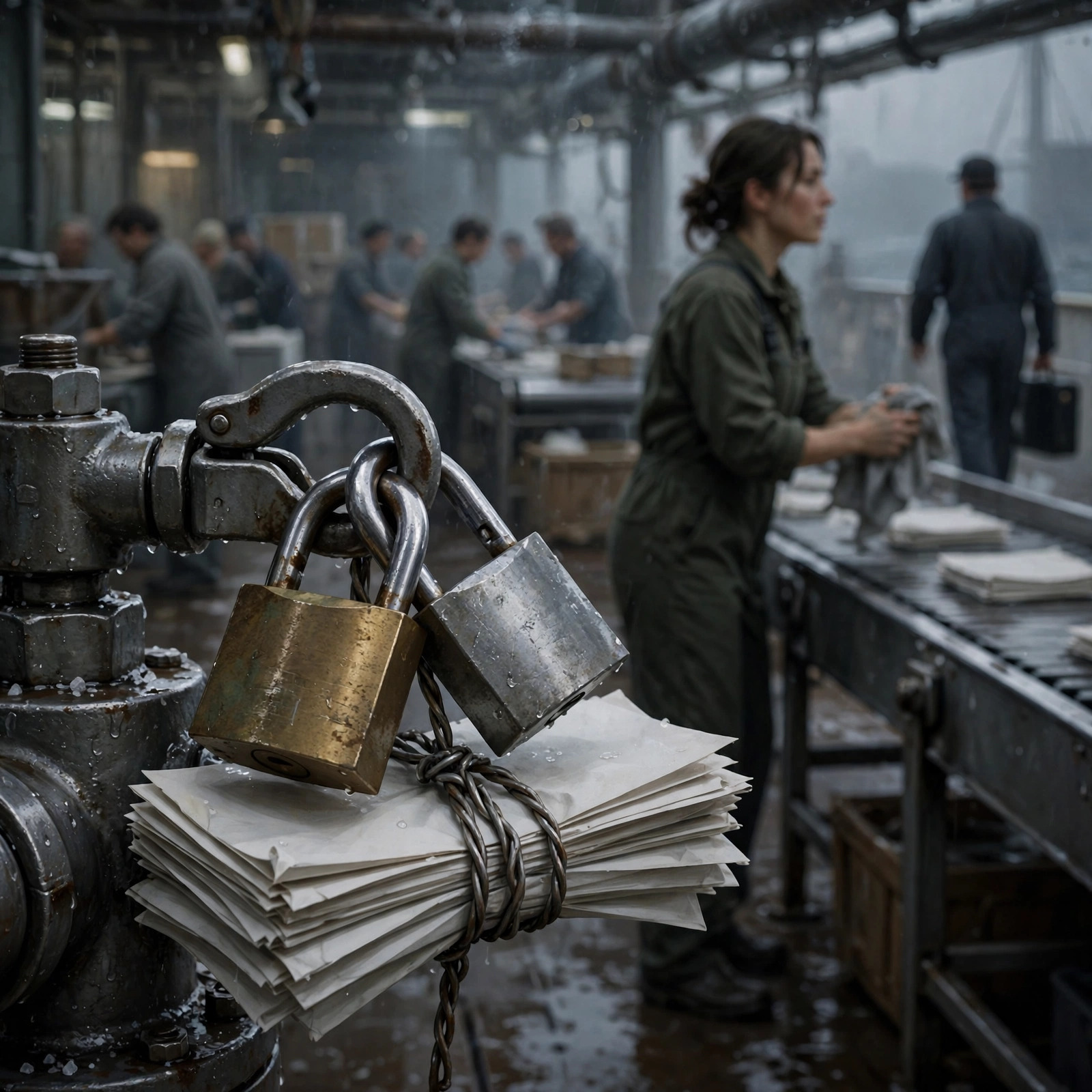
"Bruno Havel climbed into the deep brine tank on a spoken go-ahead," she said. "There's a pencil initial on that card and no approval behind it. Cleve Tarr had the night. He let a man go up the ladder and then he went on with his rounds."
Cleve was at the back by the coat hooks with his cap in his hands. He came forward a step. "I initialed it, Greta. Initialing's all I've ever done. You know I can't approve a tank."
"Then you shouldn't have let him climb."
"I never--"
"You had the floor." She kept her voice level, the way she did when a compressor was surging and the whole engine room was watching her hands. "That's what a supervisor is for."
He stopped. His mouth worked and shut, and he looked at the boards, and Greta took the quiet for agreement because it was easier to take it that way.
Wilma came up beside the urn with the grievance pad already out of her bag. "Write it as supervision," she said. "Not as procedure. A supervisor's negligence is company money and the local can carry that. We do not hand them a paper with our own violation written on it."
"Bruno's back is broken in two places, Wilma."
"And the fund has a bottom to it." Wilma squared the pad against the table edge. "You want the plant certified and you want his reserve kept open. This is the road that does both. Don't wander off it."
Greta wrote. The pen went through the top sheet and the flimsy under it, and she thought, absurdly, of another flimsy, folded small behind the steward's card over her heart. She signed. Wilma signed under her and pressed the hall's stamp into the corner and blew on the ink.
"Take it to the counter," Wilma said. "Today. Before the office hears it sideways."
Cleve was gone when Greta looked up. His coat was still on the hook, and one of the packing women took it down and folded it over her arm without a word, the way you do for a man who has been called out of a room.
The suspension letter was waiting on the Scale House counter with the green felt-tip lying across it, cap chewed flat. The scale clerk pushed the steward's copy over without being asked.
"Manager signed it before breakfast," the clerk said. "Night hours are cut back till the review's done. It's all in there."
Greta read it standing. Suspension without pay pending investigation. Entry cited as unauthorized, per the permit card held in the auditor's sealed file. She turned the sheet over. Nothing on the back. The pen lay where it had been set down, and she did not touch it.
Zora was on the step outside with a thin envelope in her hand.
"They stopped me at the gate," she said. "Packing nights are off. There's a shift on days when the buyer's gone and maybe not even then." She held the envelope up so Greta could see the window and the few lines through it. "That's my last check. It's not enough for the rent and it's not enough for the bus to the infirmary both."
"Zora--"
"You said his name in there." Zora's voice did not rise. That was the worst of it. "My father's in a bed with his back strapped and you stood on a hall floor and said the name of the only man on nights who ever let me leave early to see him." She pushed the envelope against Greta's chest until Greta took it. "You hold it. You're the steward."
She went down the steps and along the fence line toward the road, and Greta stood with the paper in her fingers and the coffee taste still in her mouth.
Rounds were rounds. She went through the engine room because the pressures needed logging, and at the bench she pulled the filed night chart out of the tube and laid it flat under the lamp, and there it was again, the load pen riding its ridge straight through the hours before the bell, never dropping, never so much as a notch. A chiller that comes off load leaves a mark. This one had not come off anything. She looked at the line for a while and then she rolled it and put it back in the tube and slid the tube into the rack, and her hands were not quite right on the cap.
Out on the catwalk she passed the isolation valve without turning her head.
Bruno was propped up at the infirmary with the window blind half down. She set the boots on the chair where he could see them and he put his hand on the left one and left it there.
"Cold," he said.
"What was cold, Bruno?"
"He said the line was cold." His breath went shallow and he waited it out. "Gaunt. At the tank. He handed me the card at the hatch, not the counter. Said it was cold and to be quick."
"Did you sign anything else? After?"
"I signed the card. I signed it standing on the grating." His eyes moved to the boots. "The valve, I can't tell you. I never went to the valve. Somebody said it was off."
"Who said?"
He was quiet so long she thought he had gone under. "It was cold," he said again, apologetic, as though he were failing her by having nothing better.
Osgood was in the corridor with his coat over his arm and his case shut at his feet, the steel seal still bright on the hasp. He walked out with her to the steps and opened his notebook, not the case.
"You'll want to know where the file stands," he said. "Entry unauthorized. Supervisory failure. The condition of the vessel is deferred to the purchaser, which puts it outside my terms for this visit." He turned the page so she could see the headings, tidy, spaced, nothing crossed out. "The valve is not on my list. Nobody has asked me to put it there."
"You had a list before I ever spoke to you."
"I have several lists." He closed the notebook and slid the elastic over it. "You've made the remainder of my visit very quiet, Ms. Sowell. I don't say that to be ungrateful. Quiet is what I was sent for." He looked out at the yard, at the tank shell standing in its cradle of scaffolding. "A man will lose his coverage over this. You know that. I'd think about whether the shape you gave me is the shape you can live in."
Cleve was in the lot beside his truck with a cardboard box on the hood: thermos, gloves, the pencil stub he kept behind his ear. He had the gate badge in his other hand, turned over and over.
"They took it at the gate," he said. "Didn't even walk me. Just took it."
"Cleve." Greta stopped an arm's length off. "Where were you when Bruno went in?"
He set the badge on the hood, very carefully, as if it might go off.
"Tallow Creek," he said. "Card game in the back of the fire hall. I was off the property and I'd been off it most of that hour." He rubbed his face with the flat of his hand. "I let entries go on a spoken word all season. Half the nights the green never got written till morning and I'd initial what he put down after. I've got a wife on the pump medication, Greta. I couldn't be the man who says no to Roderick Gaunt."
"You let me say your name in that hall."
"I couldn't say where I was without saying the rest of it." He put the pencil stub in the box. "You never asked me. Not once, not before you stood up."
The lot light came on over them, and a gull went over toward the water, and Greta heard the retorts starting up on the far side of the wall.
She unclipped her badge. She slid the flimsy out from behind the steward's card and unfolded it along its old creases and laid the thin paper flat against the inside of her wrist, where the pulse was, the green approval whole and unstruck, the perforation edge soft as cloth. In her other hand she held Cleve's suspension letter, and the wind took the corner of it and worried at it, and she let it.
The Jumper Tag
The binding wire gave with a dry click, and Greta caught the brass tag before it could drop through the grating.
She set the cutters on the pipe bracket and worked the jumper free of the isolation valve, hand over hand, the way you draw out a splinter you put in yourself. The copper came away warm. Loose twists of wire still hung on the stem where she had cinched them, and the wheel stood where it had stood all season, a thing to look at and nothing to turn.
Osgood waited at the foot of the ladder with his case against his shin. He had a pencil out and nothing to rest it on.
"Come down where I can see your face."
She came down. She held the tag up so the light off the water found the stamp in it, her own ticket mark, the chipped corner of the die she had never paid to have recut.
"The winter before last we were running lean," she said. "Nobody upstairs would carry the chiller down long enough for me to pack the gland properly. So I bridged the isolation valve to keep the line moving. Never logged it. Stamped the tag myself, because I don't hide from my own work. Only from the rest."
"The rest being the valve."
"The rest being that the wheel could be spun all night and the brine would keep on coming. That tank could not be isolated. Not by Cleve. Not by anybody." She put the tag into his palm and folded his fingers over it, which was a liberty, and then let go. "I told you the line was cold. I told you that at the Scale House counter with my badge on my coat."
Osgood looked at the brass for a while. Somewhere behind the wall a retort let go of its steam and the whole engine room breathed out.
"You know what this is, in my file."
"It's the end of my ticket. It's a union violation with my name stamped in the metal, and it's yours to keep." She wiped her hands down her thighs. "Bruno went into a tank that could not be shut off, and he went in because a card said it was shut off. Write that down before I lose the nerve for it."
They walked out through the lot. The tank shell stood in its cradle of scaffolding with the hatch open like a mouth that had been made to say something. Greta did not look at it. In her left pocket sat the envelope Zora had pushed into her hands at the Scale House step, still unopened, still light.
Gaunt was inside at the scale desk with the walkthrough folder squared in front of him and his reading glasses pushed up into his hair. He had the green felt-tip laid across the folder the way other men lay a pipe.
"Buyer's people are through the gate in the morning," he said. "I'd like the engine room to smell like paint and not like a hearing."
"Then you'll want to hear this while it's still mine to say," Greta told him, and went past him to the bench under the permit rack.
Osgood set his case on the bench. He peeled the paper seal off the steel lock and dropped the torn paper into his breast pocket, and made a note of the breaking of it, and turned the notebook so she could initial beside the note. She initialed. He lifted out the sealed envelope with Bruno's card in it and laid it unopened at the far end, where the light was better, and then he lifted out something else.
It was a bound report, the cover stock gone grey at the corners from handling. His firm's name at the top. Under it, the tank named, the deep brine tank, and the lining condemned in language that had no hurry in it at all. The date at the head of the page sat months back of the night Bruno climbed.
Greta read it standing up. Then she read the single sheet clipped behind it, a copy of a memo out of this plant, and Gaunt's hand at the foot of it declining the relining as unaffordable in the current season, and asking that the finding be held pending sale.
"You had this in your case," she said. "You had it when you came up the yard."
"I had it when I was sent." Osgood's voice did not change, which was somehow the worst of it. "I was sent to close a file cheaply. A man goes in without a permit, the reserve dissolves with the sale, everybody's hands stay clean. That was the shape of the errand."
"And now?"
"Now the shape has a mechanic in it who cuts her own tag off and hands it over." He set the report down between them, flat, where Gaunt could see it.
Gaunt had come along the bench with his glasses still up in his hair. He looked at the memo for a long moment and did not reach for it.
"They gave me a lining quote and a season that wouldn't carry it," he said. "You've read the packhouse figures, Greta. You've stood in this room and told me yourself what a shutdown costs. I asked them to hold it. Holding isn't the same as refusing."
"It is on paper," Osgood said. "May I borrow your pen?"
Gaunt looked at him. Then he picked the felt-tip off the folder and held it out, cap chewed, and stood with his arms folded while Osgood uncapped it.
Greta pulled the older cards. The rack had been out of order since the night of it and she did not put it right; she took the cards down in armfuls and laid them along the bench in the order she found them, and Osgood drew a stroke on the back of a spoiled blank and laid the pen beside it.
They found it on a card from the spring, the tank name struck through in green and a line of annotation beneath in the same hand. Then they found it again, further back, on a card whose approval had gone brown at the edges from the damp of the room. The strike-through on that one still looked bright. Greta noticed it and set the noticing aside, the way you set aside a noise in a machine you have not got time to strip.
Osgood held his fresh stroke against the old green and moved the card into the window light and back.
"Same felt. Same box of pens," he said. "Only one man in this plant puts green on a card."
Gaunt said nothing at all. He took his pen back, capped it, and put it in his shirt pocket, and went out to meet the paint crew, and the door swung twice behind him.
Wilma came in through that same door with her coat still buttoned to the throat. She had the local's ledger under her arm, the one with the benefit fund in it, and she looked at the bench, at the report, at the tag in Osgood's hand, and understood the whole of it faster than Greta had wanted her to.
"You've given them our violation."
"I've given them the truth about the valve."
"They're the same envelope, girl." Wilma set the ledger down. "I'll stand up in that hall and I'll move that we take your badge, and I'll hate every word of it. If we hand the parent company a paper admitting we broke our own agreement, they'll void the fund and shut the gate and call it our doing. Cleve's already home. Zora's pay's stopped. I've got retired women on that fund who cannot eat a principle."
"I know what's on that fund."
"Then know what I'll do." Wilma's mouth worked. "And know I'd have done it for you, once, if you'd asked me first."
Greta took her keyring out. She worked the local's brass padlock off the ring, the hall mark on it worn shallow from her pocket, and unclipped the steward's badge and laid the two of them together in Wilma's hand, and Wilma's fingers closed on them because a hand closes.
"Don't lose the key," Greta said.
She reached under the rack for the blank stock, the carbon-backed card stock Gaunt bought by the box, and slid a fresh card out with its flimsy still attached at the perforation. She laid it square. She put down the winter, the lean season, the jumper, the stamp, the valve that could not isolate, and Bruno's name, and what she had told Osgood in the lot and why she had told him that instead. Her hand shook on the last line and she let the shake go into the paper rather than stop for it.
She signed. Osgood signed under her as witness, and dated it, and did not offer her anything for it, which she was glad of.
Then Greta held the stiff card down with her palm and tore the flimsy away at the perforation, a small ripping sound like a match coming out of a book, and pushed the thin carbon across the bench to him. She kept the card.
Two Locks
Greta had the salt sled clear of the packing floor when the buyers' cars came up the lot, dark and slow over the ruts. She leaned the sled against the wall, wiped her palms down her thighs, and went to the Scale House door, where Osgood stood with the envelope already open.
He put the rack card in her hand and laid the flimsy on top of it, the thin carbon curling at its fold, stiff with old salt.
"At the tank," he said. "Him alone. I'll keep the buyers in the cook room as long as the cook room interests them."
"He'll call it a forgery."
"Then he'll call it that to the perforation." Osgood closed her fingers over the paper and let go. "I file what a man can't argue with in front of his own money. Bring me that."
Gaunt was at the deep brine tank with the wash hose running, laying water over the hatch rim in long sweeps so the crust went grey and slid off into the scupper. He shut the nozzle when he saw what she carried. The hose drooped and kept dripping.
"You're on the belt now."
"Wilma put me there. I've got a minute before they come down the deck."
She laid the flimsy on the wet rim and the rack card beside it, and squared them with two fingers so the torn edges lay together.
Both papers carried the same approval in his green felt-tip: the deep tank named, the entry set before the shift bell, his signature looping underneath. On the flimsy the green stood whole. On the rack card a stroke of the same green ran through the approval, and below it, in the same hand, the note about the entry being unauthorized and no isolation confirmed.
"Look at the tear." She set her fingernail where the strike crossed the perforation and ran off into air. "The stroke goes past the paper. There's nothing left under it to take the carbon. If you'd struck it before you tore the twin, it would be on his flimsy, and his flimsy is clean. You added it after he climbed in."
Gaunt looked at the two edges lying tooth to tooth along their whole run. He put his thumb on the hatch rim and left a print in the water.
"The chiller wasn't going to lift," he said. "It hadn't lifted all season. I told him the line was cold because that tank had to be clean before this morning."
"You told him cold."
"I told him cold." He said it flatly, without dressing it. "The relining was money the buyer would spend anyway. I wasn't going to spend it twice out of a plant I was selling."
"And the strike-through."
"An unauthorized entry is his own hard luck. An approved one comes out of the reserve, and the reserve is part of what they're buying." He turned his hand over, an appeal to arithmetic. "Nobody was going to be poorer for it except a man who climbed without paper."
"He had paper. He kept it in his boot, the way you told the cleanup crew to keep theirs." Greta pushed the flimsy an inch toward him. "You wrote the approval. You tore it. He carried your word inside him and it burned his lungs, and you struck it out afterward so the fund could stay whole for the sale."
The hose dripped. Down the deck a door went, and men's voices came and went again.
"Your pen," Greta said.
He took the green felt-tip out of his shirt pocket and stood with it a while, and she did not help him by speaking. Then he uncapped it, bent over the rack card, and inked his correction in the clear space beneath the strike: approval given at the hatch before entry, line not isolated, strike-through and note added after the twin was torn. He signed under it. His signature had a shake in the last letter that his approvals never had.
"That's the whole of what I did," he said. "The rest of it was the season."
"The rest of it goes in the file too."
He capped the pen, set it on the hatch rim, and went up the deck to meet the buyers, and Greta let him go. She lifted the card and the flimsy off the wet steel and held them apart so the ink could dry.
Osgood came back along the brine deck with his case under his arm and Cleve Tarr behind him in a clean shirt, carrying his own pencil because he had nothing else left to carry. Zora came up from the packing floor with her hair still under the line cap. Wilma arrived last, coat buttoned, the local's ledger under her arm.
Osgood handed Cleve a slip. "Suspension lifted. The finding names the alteration of an approved permit, not the supervisor's absence. Back pay to be drawn before the sale closes."
Cleve read it twice, then looked at the card in Greta's hand. "I can initial it. That's all I was ever able to do."
"Then initial it as witness."
He laid the card on the valve bonnet and put his pencil initials beside Gaunt's correction, small and careful, the way he had put them on permits all season while men went down on a spoken go-ahead.
"Night hours are restored," Osgood told Zora. "Your stopped pay is made up in the same draft. The entry is recorded as approved and the reserve is payable to your father, not dissolved at the sale. A clerk takes the paper to Sennet Point Infirmary for his mark this afternoon." He turned the case around and drew out the engineer report with Gaunt's refusal clipped behind it. "The relining is charged to the parent's side as a condition of the sale. The tank stays out of service until it's done. That was the price of my signature going on the same page as hers."
"Your firm will be asked about that report," Greta said.
"My firm will be asked why it sat in a drawer, and I'll be asked along with it." He shut the case. "I'm staying for the relining."
Greta went to her locker and came back with the boots, laces knotted, the left one split at the lining where she had opened it. She held them out. Zora looked at the split and not at her face.
"It's empty."
"It's in the file. It's doing what he meant it to do."
Zora took the boots by the knotted laces. Greta brought the envelope out of her left pocket, her own money folded in it, unopened since the pay stopped, and put it in Zora's coat pocket, and Zora let it stay there this time.
Wilma set the ledger on the bonnet and opened her hand. The steward's badge lay across her palm with the hall mark worn shallow. She closed her fingers on the badge and held out the brass padlock and its key instead.
"Badge stays with me. The hall voted the fund whole and nobody thanked me for it." She pushed the lock into Greta's hand. "Floor crew. Belt, brine deck, whatever the shift needs. You'll sign for nobody. I'm not forgiving you, girl. I can still use you."
"I know the difference."
"Don't lose the key."
Greta took her wallet out and worked the journeyman ticket from behind the bus pass, soft as cloth at the folds, Bruno's money in every crease of it, his hand in her pocket when nobody else in Sennet Point would put a hand there. She gave it to Osgood. He laid it in the file beside the brass tag with her stamp on it, and her statement beneath both, and clipped them without comment.
Then she went to the isolation valve. The jumper's cut ends were taped back out of the way, and the wheel took its whole travel for the first time since the lean winter, turning down and down until the gate seated and the wheel stopped hard.
Osgood came and stood at the hasp with his steel seal lock. Greta put the local's brass through the same hasp and closed it, and he closed his alongside, steel against brass. She took the binding wire and her pliers and wired the corrected card and the salt-stiff twin to the hasp beside the locks, twisting the wire until the papers hung flat and could not blow off the valve.
The shift bell went. The two locks knocked together on the hasp, brass and steel, and kept knocking as the deck filled. Osgood picked up his case. Greta wiped her hands and turned toward the belt. Neither offered more than a nod.
Get notified when new stories drop

Tobias Lund
Tobias writes wary partnerships and pressure-cooker puzzles where trust is the hardest clue to find.
Leave a comment
Comments